The tiger is the king of beasts in Chinese folk belief and the third sign of the zodiac. Feared by everything else, it was trusted above all other animals to guard the people you love most.
This page offers a traditional folk tiger pattern as a free printable template. Download the PDF below, print it at 100% scale, and cut your own tiger.
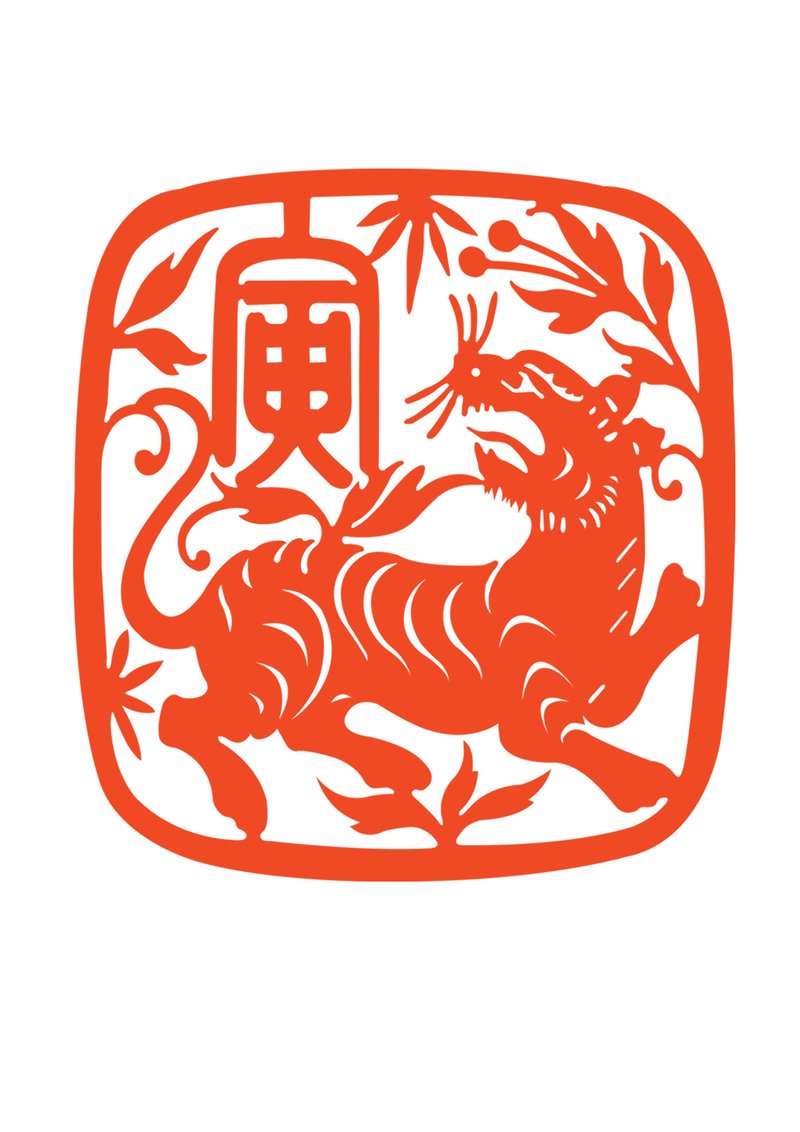
A traditional folk pattern, restored for printing. Free for personal and classroom use. Print at 100% scale.
What the tiger means in paper cutting
The tiger's power in folk art works in a particular direction: because the tiger is feared, it is trusted to frighten away everything else people fear. Tiger imagery is protective imagery. A tiger pasted on a door is not mere decoration but a guard, set there to keep evil spirits and illness outside the household. In the zodiac, people born in tiger years are traditionally thought brave, confident, and unwilling to back down.
Nowhere is the protective tiger clearer than in the customs around children. Folk tradition dressed babies in tiger-head hats and tiger-head shoes, so the child would borrow the tiger's fierceness and be watched over by it. In Shaanxi and other northern regions, tiger paper cuts were pasted near a child's bed or doorway for the same reason. These tigers are rarely realistic: they have round or square heads, wide staring eyes, and bodies filled with flowers and spirals — closer to a friendly monster than to a real cat. A fierce-looking tiger is a good tiger, because its whole job is to look more frightening than whatever might come.
In the zodiac the tiger is paired with the earthly branch Yin (寅), and the character often stands beside the animal in cut designs, as it does in this template. In a tiger year the designs multiply across windows and doors at Spring Festival; in any year, a tiger cut is given as a wish for courage and protection — a paper guardian for a new home, a new baby, or a new beginning.
About this template
This template is a single-piece traditional folk pattern in red. The tiger is shown leaping among foliage inside a rounded-square frame, and the design includes the character Yin (寅), the tiger's earthly branch, at the upper left.
The pattern is moderate-to-advanced in difficulty. It is a dynamic, multi-element composition: the outer frame and the tiger's leaping outline are manageable with scissors, but the interior — the curving body stripes, the whiskers and mane, and the leaves around the animal — is best worked with a craft knife. The template is a traditional folk pattern restored for printing, and it is free for personal and classroom use.
How to print and cut
Print the template at 100% scale and resist any fit-to-page setting — the proportions matter. The download comes in two paper sizes, A4 and US Letter; use whichever your printer takes. Red paper gives the traditional look straight off the printer, or you can print on white paper and back the finished cut with red.
Cut the outer contour first with small, sharp scissors, then switch to a craft knife and a cutting mat for everything inside. The logic of the pattern is simple: the red shapes are the design and stay in place, while the white areas are cut away. Do the fine interior work slowly, beginning near the center and moving outward, so the paper around each cut still has support.
More zodiac templates
The tiger belongs to our full set of twelve Chinese zodiac paper-cutting templates, each offered as a free printable PDF with its own story and cutting tips:
- Chinese zodiac paper-cutting templates — the complete set of all twelve signs
- Ox paper-cutting template — the second sign, steady and hardworking
- Rabbit paper-cutting template — the fourth sign, gentle and moon-blessed
FAQ
Can I use this template in things I sell? The template is free for personal and classroom use only. Commercial projects need a license, so please contact us to arrange terms before using it in products for sale.
What is the best paper for this pattern? Thin red paper is the traditional material and cuts the cleanest. Standard printer paper, origami paper, or light craft paper also work — in general, the thinner the sheet, the neater the result.
Do I need both scissors and a craft knife? For this design, a knife helps a great deal. Scissors handle the frame and the tiger's outline well, but the stripes, whiskers, and leaf details are tight interior cuts that come out far cleaner with a craft knife.
Why do Chinese children wear tiger-head hats? Folk belief holds that the tiger's fierceness rubs off on what it guards. Dressing a child in a tiger-head hat or tiger-head shoes lent the child the animal's power and frightened away illness and evil — a wearable paper guardian in cloth form.
Author
This article was prepared by the team at ChineseFolkCrafts.com. We are not intangible-cultural-heritage inheritors or museum researchers. Our job is to find authoritative Chinese sources, understand them, and explain them clearly for international readers.
If you spot an error — a date, a translation, a misattributed custom — please let us know and we will correct it. Last updated 2026-08-02.