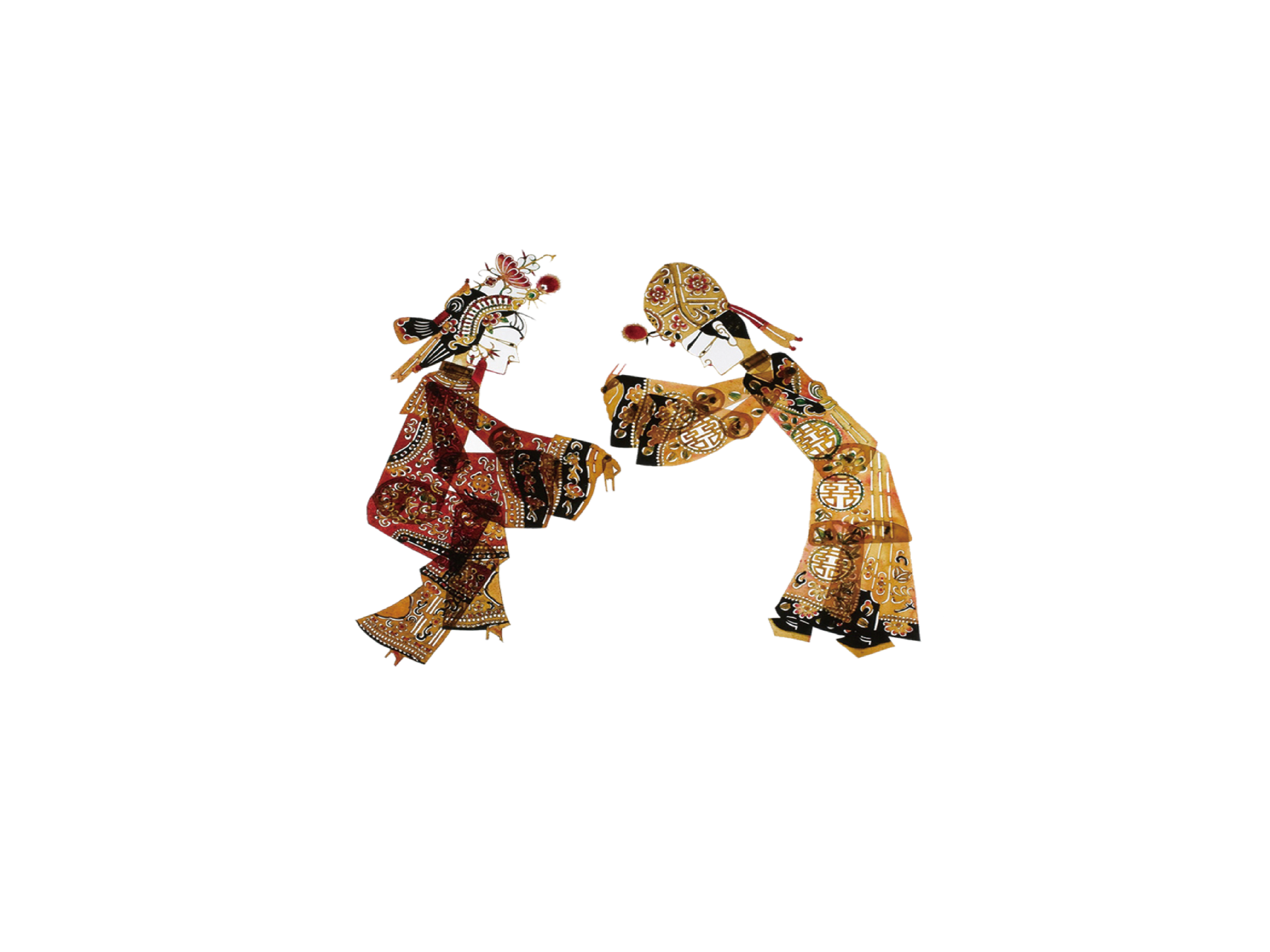
How to Make a Chinese Shadow Puppet: From Hide to Hero
Behind a white cloth screen, with one lamp and a few bamboo rods, a little leather figure can ride into battle, fly to the heavens, or dive into the sea. The audience sees the magic in the lamplight. What they don't see is the craft backstage: turning a piece of animal hide into a character on that stage takes eight steps — selecting the skin, curing it, drafting, transferring, carving, coloring, sweat-ironing, and assembling — some three thousand hand cuts, and weeks of a craftsman's time [source:3].
This article lifts a corner of that white screen. First, we follow the traditional process cut by cut. Then we show you how to make a simple cardboard shadow puppet with kids — and stage your very own shadow play at home.
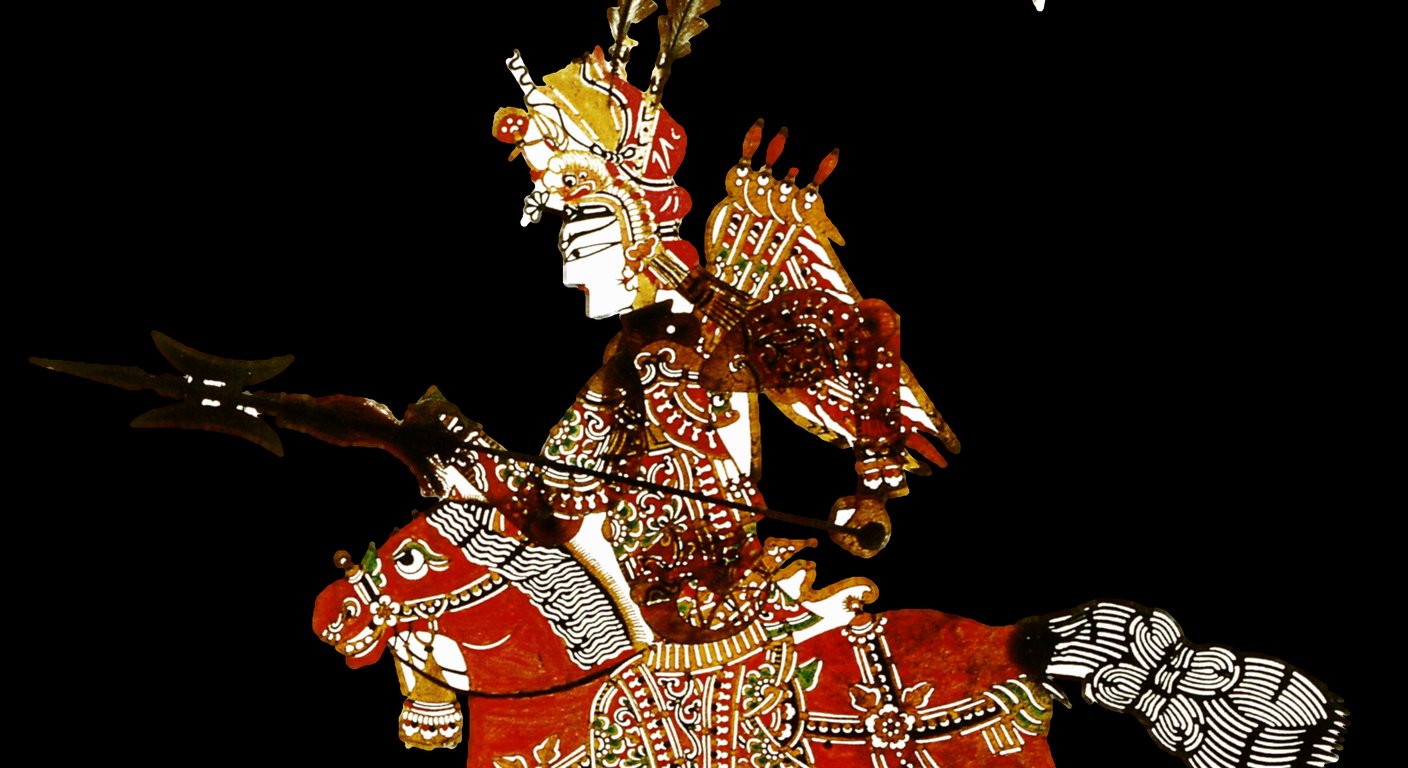
A warrior on horseback: carved from leather, painted in five colors, and pierced with镂空 patterns that turn into lace in the lamplight.
Why leather?
The first secret of shadow puppetry is the material. Paper can be cut into a silhouette, but it cannot survive night after night of lamp heat and scene after scene of tumbling combat. Animal hide, scraped thin, is translucent, supple, and holds its shape: light shines through its colors, and carved镂空 patterns glow. That is something paper cannot do [source:3].
Across China, makers use whatever hide the land provides — cow, sheep, donkey, pig. Cowhide is the most common material today; Tangshan puppets are carved from donkey hide, which is why old Beijingers nicknamed the art "donkey-leather shadows"; Longdong makers in Gansu insist on the hide of a young black bull — medium thickness, tough yet flexible, with a bluish transparency [source:2][source:3].
Selection is only the beginning. The hide must be cleaned of hair and blood, then cured and scraped thin. Shaanxi tradition knows two methods. The "clean" method soaks the hide in cold water for two or three days, then scrapes it four times, soaking between each scraping, until the hide is thin, bright, and stretched to dry on a wooden frame to a clean transparency. The "gray" method soaks the hide repeatedly in a solution of lime and alkali; the resulting skin is almost like glass and even better for carving [source:3]. By this point, a heavy raw hide has become a page of "leather paper" ready to be drawn on.
The eight steps: from leather paper to puppet
Drafting and transferring. A puppet's face is never improvised. Makers work from special pattern books called yangpu, handed down through generations [source:3]. The craftsman cuts the prepared hide into pieces, softens them with a damp cloth, then rubs them again and again with a special pushing board and a little oil, until the leather lies flat, smooth, and free of shrinkage — only then can the pattern go on. Using the hide wisely is a craft of its own: thin, translucent pieces go to the face, chest, and belly — the places that matter; thicker, darker pieces become legs and ordinary props. This saves material and keeps the puppet light on top and steady below, balanced both in performance and at rest. Next comes "transferring": with a steel needle, the outlines and patterns of every part are traced onto the leather, which is then laid on a jujube or pear-wood board for carving [source:3].
Carving. This is the hardest gate. A carver keeps eleven or twelve knives — the meticulous ones, thirty or more: slant knives, flat knives, round knives, triangular knives, and flower-mouth knives in different widths, each with its own job. The handed-down rules say: stab line patterns with the flat knife, push straight lines with the flat knife, chisel the round sleeve-border patterns with the gouge, and carve winding motifs with the slant knife. A rhyme keeps it all straight: "Cherry blossoms — stab with the flat knife; the wan pattern — push with the flat knife; sleeve and robe borders — up with the chisel; flowers — carve with the pointed knife" [source:3]. Carving comes in two modes: relief (yang) carving keeps the outline and clears the rest — used for the white faces of noble roles; intaglio (yin) carving hollows out the lines themselves, common for architecture. The镂空 piercing is not merely decoration: it keeps the shadow free of dead-black masses, so that robe patterns, armor, and ornaments show in the light with every thread intact [source:4]. One puppet means about three thousand hand cuts [source:3].
Coloring. Then comes the paint. Shadow puppets use five pure colors — red, yellow, cyan, green, and black — which old masters traditionally prepared themselves from minerals and plants like copper minerals, cinnabar, and indigo. In Shaanxi practice, the pure color is dissolved in a wine cup with a few pieces of transparent hide glue boiled from fine leather, set on a lamp stand over an alcohol flame, and applied hot once glue and pigment melt into a porridge [source:3]. The palette may be small, but old hands are masters of matching and shading. The patterns follow rules, too: women's hair and robes favor flowers, grasses, clouds, and phoenixes; men take dragons, tigers, water, and clouds [source:3].
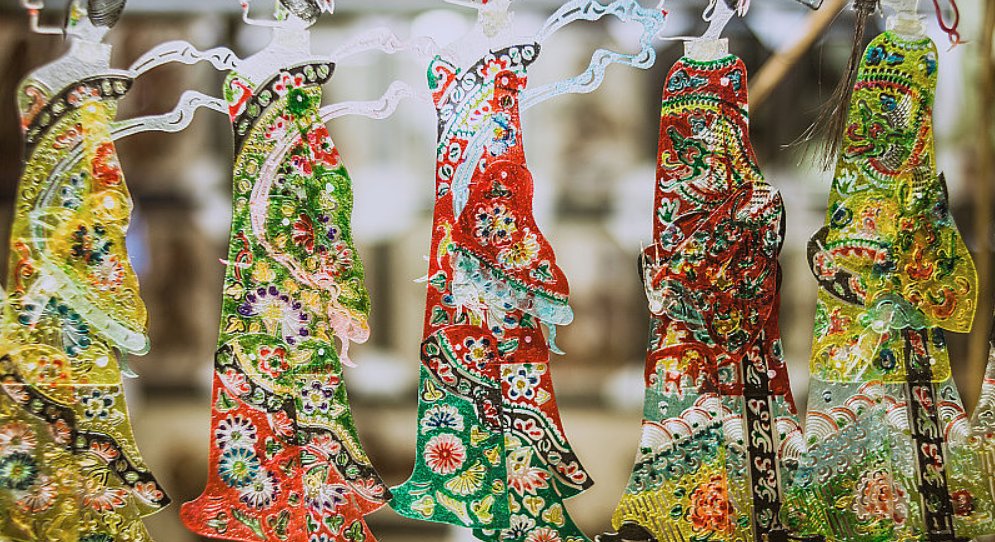
Scraped thin, the leather lets the lamplight through — five colors, countless shades, every figure cut and painted by hand.
Sweat-ironing. After coloring, the puppet must be "dehydrated and sweated" — the step that decides success or failure. Proper heat drives the color into the leather and forces out the moisture trapped inside. Methods vary: some clamp the parts between thin boards under the mat of a heated kang; some wrap them in plain cloth and press with a soldering iron or electric iron; some build an A-frame of adobe bricks, warm it with burning wheat straw, and press the puppets flat. Temperature control is everything. The old way of testing the iron is called "flicking water with the fingertips": flick a drop of water onto the iron and judge the heat by the size of the bubbles and the speed of evaporation — the target is about 70°C. Done right, the color bites deep into the hide, the puppet keeps its bright tones for years without fading, and the melted glue seals the pores so the figure never warps. Too hot, and the leather shrivels into a ball — the whole job is lost [source:3].
Assembly. The last step puts the figure together. A complete puppet has eleven parts — head, chest, belly, two legs, two upper arms, two forearms, two hands — each carved separately and joined with thread so every joint moves freely [source:3].
Eleven parts, three rods
Every detail of a puppet's body serves the performance. The head — face, hat, and beard together — ends in a small wedge that plugs into a socket at the top of the chest during a show and is removed for storage. That is why in the trade, "heads" and "bodies" live apart: one trunk of bodies can serve many sets of "head-pieces." The chest carries the socket; each arm divides into upper and lower sections, with a hand at the end; the belly joins chest above and legs below; leg and foot are one piece [source:3].
What brings the puppet alive are the qianzi — three bamboo rods. For civil roles, the main rod goes at the upper front of the chest, with one rod on each hand, for turning, bowing, and holding props. For martial roles, the main rod mounts at the upper back, so the figure can run, stand, sit, lie, roll, crawl, and fight through a hundred poses [source:3]. A master can manipulate seven or eight puppets at once: hands flying, mouth delivering narration, dialogue, percussion cues, and song, feet working the drums and gongs [source:3].
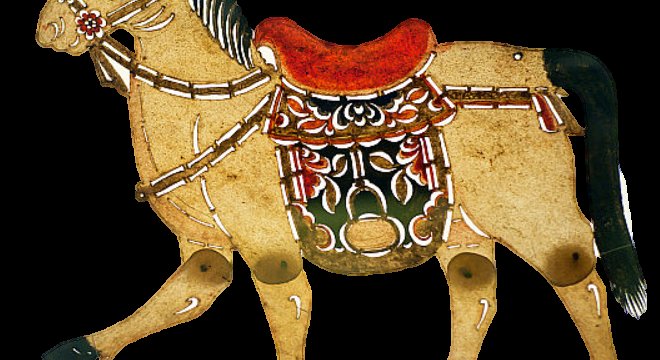
Look closely at the legs: the riveted joints that let a puppet bend, kick, and gallop — the leather original of our paper fasteners.
Make your own: a cardboard shadow puppet for kids
After three thousand cuts of the old craft, are your hands itching? The principle of shadow puppetry is no mystery at all: an opaque silhouette + joints + rods + light behind a screen. At home, cardstock can reproduce a simple version. You will need: white or colored cardstock, a pencil, scissors (or a small craft knife), coloring pens, brass paper fasteners, tape, and bamboo skewers or drinking straws.
Step 1: Draw the figure. Draw a person in profile on the cardstock — shadow puppets always face sideways, because a shadow lives in its outline. Draw the big joints separately: head, torso, upper arm, forearm, hand. Don't connect them yet. In the spirit of the old puppets, give the clothes big, bold flower patterns.
Step 2: Cut. Cut out each part along its outline. For a taste of the real thing, an adult can pierce a few simple镂空 patterns in the clothing with a craft knife — fingers carefully away.
Step 3: Color. Traditional puppets use five colors; so can you — red, yellow, cyan, green, black, laid on bold and full.
Step 4: Join the limbs. Connect forearm to upper arm, and arms to body, with brass paper fasteners. The fastener is the paper puppet's "thread joint": it lets the limb turn, exactly like the joints in a leather puppet.
Step 5: Add the rods. Tape a bamboo skewer or straw to the torso and one to each hand — three rods, the standard rig of a real puppet.
Step 6: Raise the curtain. Stretch a white sheet or big sheet of paper between two chair backs, put a desk lamp behind it, and turn off the room lights. Let the kids press their puppets against the back of the sheet — in the lamplight, their little figures come alive.
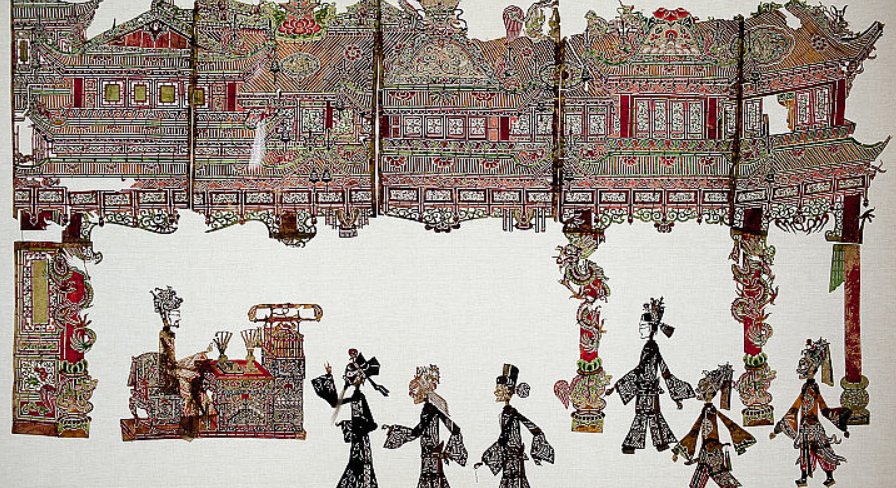
A whole theater in one trunk: palace backdrops, tables and chairs, civil and martial figures, horses — everything a traveling troupe needs.
From a trunk of puppets to a full show
A traditional shadow troupe travels with a single trunk: the figures, the head-pieces, the scenery tablets — towers, tables, chairs, carriages, boats, sedan chairs — plus a white gauze screen called the liangzi and a lamp. The gauze is polished with fish oil until it is crisp and translucent; in performance the puppets press tight against the screen, and the figures and their five colors appear vivid and true [source:2][source:3].
Never underestimate that white cloth. Carriages and boats, demons and monsters all take the stage; flying to heaven, diving underground, vanishing, shape-shifting, breathing smoke and fire, splitting mountains and seas — for sheer fantasy in myth drama, no other of the hundred traditional arts rivals shadow puppetry [source:3]. Your cardboard stage at home works the same way: one puppet not enough? Make another. The stories kids invent often outshine the old librettos.
In 2011, Chinese shadow puppetry was inscribed on UNESCO's Representative List of the Intangible Cultural Heritage of Humanity [source:1]. Born in the Western Han, flourishing in the Tang, peaking in the Qing, and carried as far as West Asia and Europe by the Yuan, the art also helped lead the way to the invention of cinema and animated film [source:1][source:4]. Two thousand years later, it can still light up a child's evening — all it takes is a white sheet, a lamp, and a little figure made by hand.
Frequently asked questions
What kind of leather are shadow puppets made of? Whatever the region provides: cow, sheep, donkey, and pig hides are all used. Cowhide is the most common today; Tangshan puppets use donkey hide (hence the Beijing nickname "donkey-leather shadows"); Longdong makers favor the hide of a young black bull [source:2][source:3].
How long does a traditional shadow puppet take to make? Eight steps and about three thousand hand cuts — the process can occupy a craftsman for weeks, and a single serious mistake cannot be undone [source:3].
Why are shadow puppets translucent? The figure performs behind a lit white screen: thin, bright leather lets the colors shine through, and镂空 carving lets light pass, so the shadow's edges stay crisp and its details rich. That is also why puppets are leather rather than paper [source:3].
When did shadow puppetry become world heritage? In 2011, Chinese shadow puppetry was inscribed on UNESCO's Representative List of the Intangible Cultural Heritage of Humanity. Earlier, from 2006 on, schools such as Tangshan and Haining shadow puppetry entered China's national intangible cultural heritage list [source:1][source:2].
What matters most when making a paper puppet at home? Three things: draw the figure in profile (the outline carries the show); join the limbs with paper fasteners (movement makes the play); put the lamp directly behind the screen and keep the puppet pressed close (that keeps the shadow sharp).镂空 patterns are optional — for a first puppet, moving at all is success.