Long before film and television, Chinese villagers gathered at night to watch shadows dance on a white screen. A single lamp, a few carved figures, and a storyteller's voice turned a piece of cloth into a palace, a battlefield, or a kingdom under the sea. This is piyingxi (皮影戏), shadow puppetry, one of the oldest dramatic arts in China.
The art is still alive today, though it has moved from village squares to museums, schools, and heritage festivals. Understanding shadow puppetry means understanding how Chinese folk artists turned simple materials — leather, light, and pigment — into a complete world.
What is shadow puppetry
Chinese shadow puppetry is a form of theater in which flat, articulated figures made of leather or paper are held behind a translucent screen and illuminated from behind. The audience sees only the silhouettes and colored shadows of the figures, while puppeteers and musicians work from behind.
A traditional troupe is small but complete. One or two puppeteers manipulate the figures with rods attached to the neck, hands, and joints. A singer narrates the story and speaks the dialogue, often in local dialect. Musicians add drums, gongs, flutes, and stringed instruments. The result is not just a visual show; it is a miniature opera.
The puppets themselves are called pi ying (皮影), literally "leather shadows." They are usually cut from donkey, cow, or sheep hide, then carved, dyed, and lacquered until they are thin enough to let light pass through the colored sections.
A love story from the Han court
The origin story of shadow puppetry is recorded in the Book of Han. When Emperor Wu's favorite concubine, Lady Li, died, the emperor was so heartbroken that he neglected his duties. A minister named Li Shaoweng noticed children playing with dolls whose shadows moved on the ground. He had an idea.
Li Shaoweng made a figure of Lady Li from silk, painted her face and dress, and attached rods to her joints. At night he set up a curtain, lit candles behind it, and made the figure move and bow. The emperor saw the shadow of his beloved again and was comforted. Whether or not the story is historically accurate, it shows how old the idea is: shadow puppetry has been part of Chinese culture for more than two thousand years.
From the Han court, the art spread to the countryside. By the Tang and Song dynasties, shadow plays were common entertainment in cities and villages. During the Ming and Qing dynasties, the art reached its peak, with professional troupes traveling from town to town and noble families keeping private puppet companies.
How the show works
A shadow puppet stage is deceptively simple. A white cloth screen, about two meters square, is stretched inside a wooden frame. A bright lamp sits behind the screen, casting the puppeteer's shadows forward. The audience sits on the other side, watching the action in silhouette.
The puppeteer stands close to the screen, holding the figure flat against the cloth with one hand while moving its arms and head with the other. Skilled performers can make a puppet walk, fight, bow, dance, and even ride a horse. Several puppets may appear at once, requiring the performer to hold multiple rods in one hand.
Distance from the screen changes the size and sharpness of the shadow. A puppet pressed against the cloth appears crisp and small; pulled back, it grows soft and large. Puppeteers use this to create effects such as a giant demon looming over a hero or a figure fading into mist.
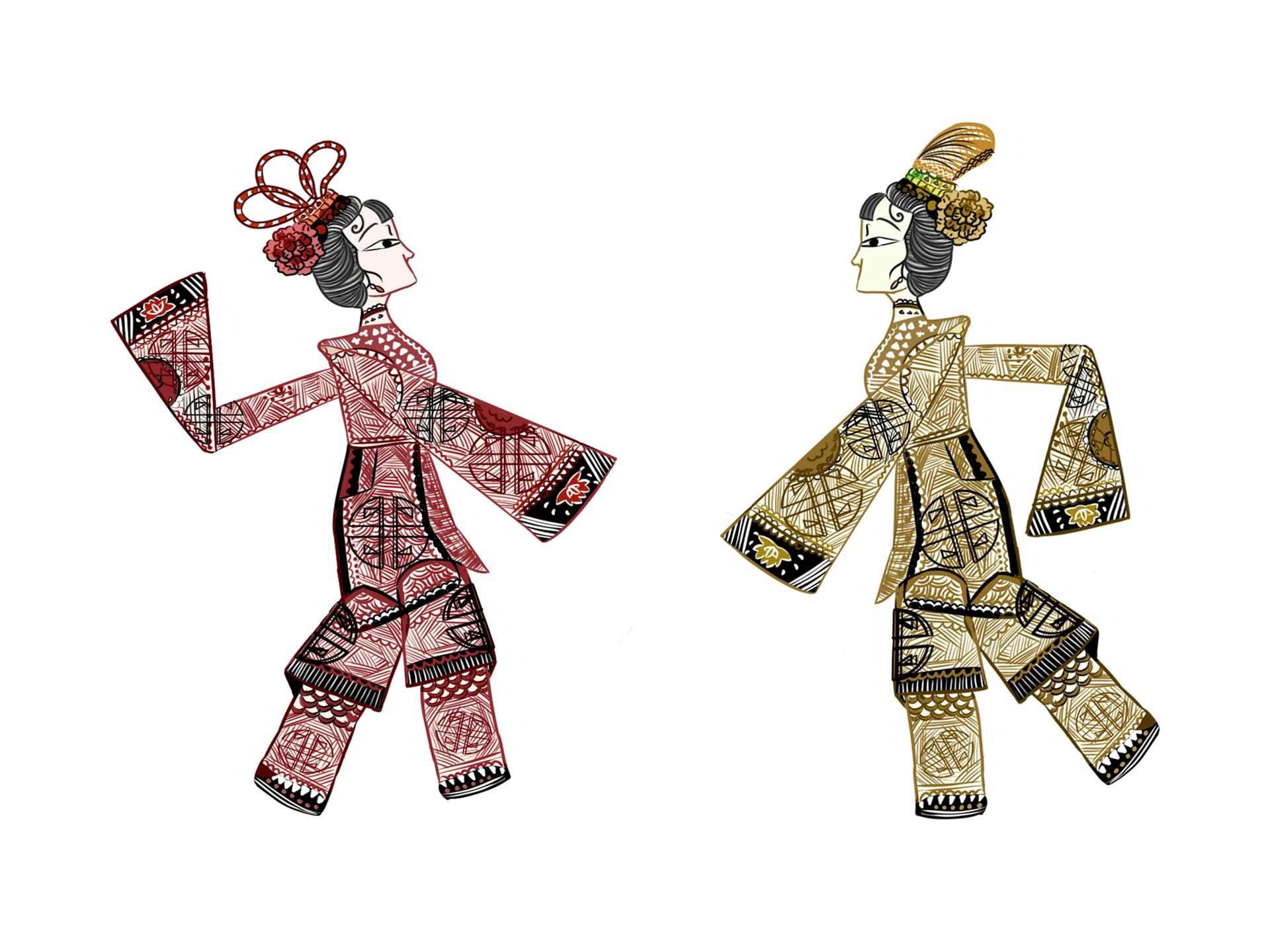
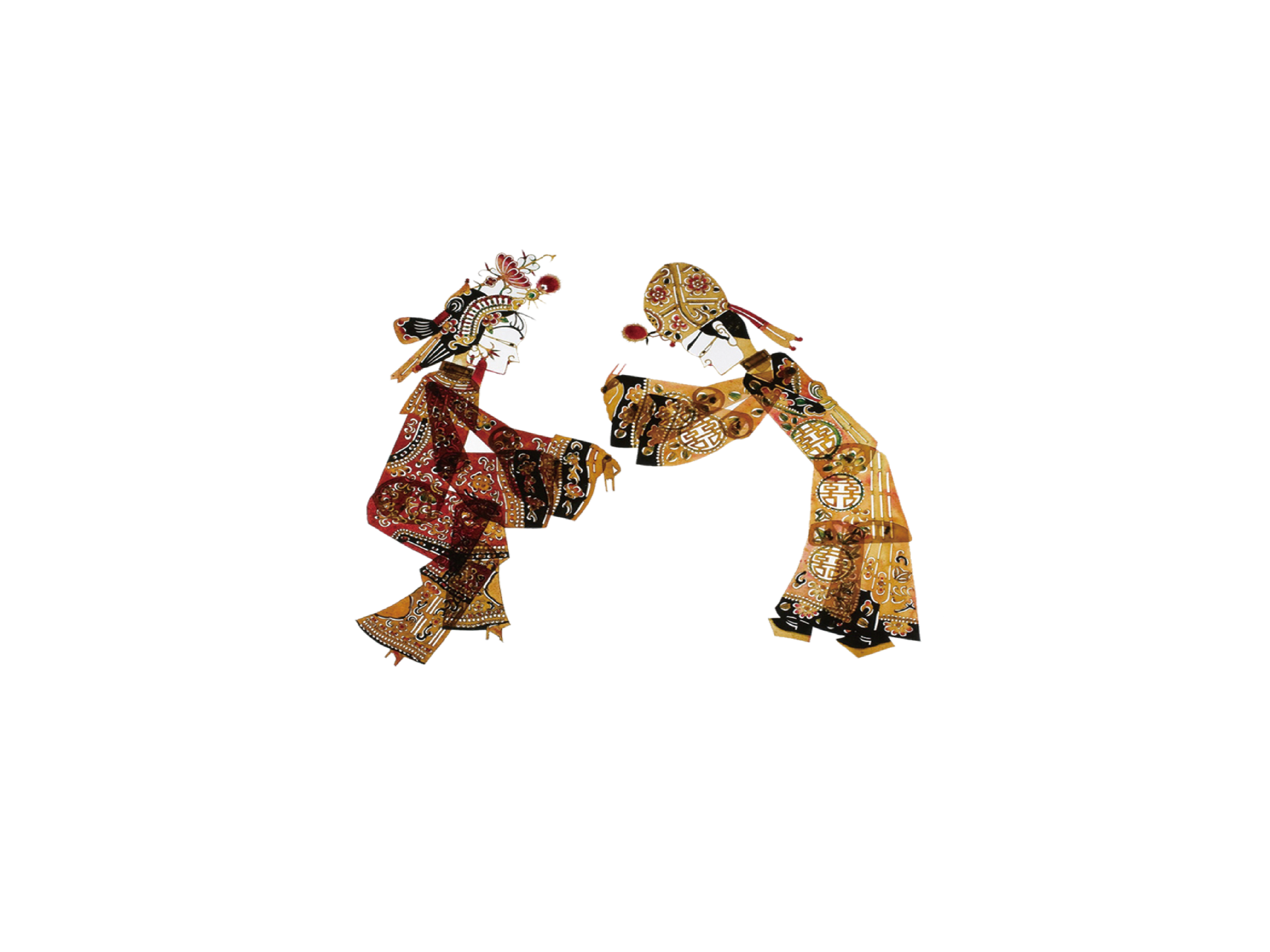
Two shadow puppets in full costume. The rods attached to their bodies allow the puppeteer to make them walk, bow, and gesture during a performance.
Making a puppet
Creating a shadow puppet is a long craft. A single figure may require dozens of hours and thousands of cuts. The traditional process has eight main steps.
Selecting the hide. Craftspeople choose donkey, cow, sheep, or pig skin. Donkey hide is prized for its smooth grain and pale color. The skin is soaked, scraped, stretched, and dried until it is thin and translucent.
Treating the leather. The hide is rubbed with oil or wax and pressed flat. Some traditions dye the leather a deep amber or brown before carving; others leave it pale and paint it afterward.
Drawing the design. The puppet's outline is drawn on the leather with a fine brush or stylus. The drawing must account for the joints: shoulders, elbows, wrists, hips, knees, and ankles all need separate moving parts.
Carving. Using sharp knives of different sizes, the carver cuts away the negative space. This is the most demanding step. Fine lines for hair, embroidery, and facial features require steady hands and years of practice.
Coloring. The carved puppet is painted with mineral pigments. Red means loyalty and courage; black means integrity; yellow means royalty; green means youth or wildness. The colors are translucent, so they glow when light passes through.
Assembling. The body parts are joined with small rivets or thread, leaving enough slack for movement. Rods are attached to the head, hands, and back so the puppeteer can control the figure.
Faces and costumes
Shadow puppet faces follow the conventions of Chinese opera. A face shown in profile is the standard view; the audience always sees the figure from the side. Heroes usually have straight noses and calm eyes. Villains have crooked features or colored faces. A red face means loyalty, black means honesty, white means treachery, and gold or silver means a god or demon.
Costumes are covered with patterns that identify the character's role. Dragons, phoenixes, clouds, and waves appear on nobles. Flowers and butterflies appear on young women. Armor patterns identify generals. Each cut is both decoration and storytelling.
The bodies are usually exaggerated: long sleeves, flowing robes, and elaborate headdresses. These shapes cast dramatic shadows and allow the puppeteer to create the illusion of movement with minimal motion.
Regional schools
China is large, and shadow puppetry looks different in each province. The music, dialect, carving style, and puppet proportions all change with the region.
Shaanxi shadow puppetry is one of the oldest and most influential schools. The puppets are large, with bold outlines and strong colors. The music uses local opera styles, and the stories often come from historical romances.
Tangshan, Hebei puppets are famous for their fine carving and delicate faces. The figures are smaller and more refined, and the singing is closer to northern opera.
Haining, Zhejiang uses thinner leather and lighter colors. The carving is extremely fine, and the figures often have a graceful, almost calligraphic quality.
Sichuan shadow puppetry is known for its humor and quick dialogue. The puppets have rounder faces, and the stories include local legends and folk tales.
Hunan and Hubei schools use taller, more slender figures and emphasize acrobatic fighting scenes. The puppeteers here are often praised for their speed and precision.
Stories on the screen
Traditional shadow plays draw from the same sources as Chinese opera: historical novels, mythology, and folklore. The most popular stories include the Romance of the Three Kingdoms, Journey to the West, and the Investiture of the Gods. Love stories, ghost tales, and comedies are also common.
A single play might last several hours. The puppeteer not only controls the figures but also sings all the roles, imitating male and female voices, old and young, human and demon. Children in the audience often sat closest to the screen, trying to peek behind it to see the magic.
Some plays were performed for specific occasions. Wedding celebrations might include a comic play about a clumsy bridegroom. Funerals could include solemn historical dramas. New Year performances usually chose stories of victory and good fortune.
Shadow puppetry today
Shadow puppetry faced serious decline in the twentieth century. Wars, political campaigns, and the rise of film and television reduced the number of troupes. Many old puppeteers retired without passing their skills to a new generation.
In recent decades, the art has been protected as national and UNESCO-level intangible cultural heritage. Museums collect old puppets, schools offer workshops, and young artists experiment with new materials and stories. Some troupes now use projection and digital sound, while others insist on traditional lamps and live music.
The challenge today is the same as for many folk arts: how to stay authentic while finding a new audience. Shadow puppetry survives because its core idea is still powerful — a light, a screen, and a story are all you need to make a world appear from nothing.
FAQ
What material are Chinese shadow puppets made from? Traditional puppets are made from treated animal hide, usually donkey, cow, sheep, or pig skin. Modern puppets may use paper, plastic, or synthetic leather, but heritage performers still prefer real hide.
How old is Chinese shadow puppetry? The earliest recorded origin story dates to the Han dynasty, roughly two thousand years ago. The art became widespread during the Tang and Song dynasties and reached its peak in the Ming and Qing dynasties.
Is shadow puppetry the same as Chinese opera? Not exactly. Shadow puppetry is a related art form that shares stories, music, and face-painting conventions with Chinese opera, but it uses flat puppets and light instead of live actors.
Can I see shadow puppetry today? Yes. Traditional performances still take place in rural areas of Shaanxi, Hebei, Sichuan, and other provinces. Heritage centers, museums, and festivals in major cities also host performances and workshops.
Author
This article was prepared by the team at ChineseFolkCrafts.com. We are not intangible-cultural-heritage inheritors or museum researchers. Our job is to find authoritative Chinese sources, understand them, and explain them clearly for international readers.
If you spot an error — a date, a translation, a misattributed custom — please let us know and we will correct it. Last updated 2026-07-27.