The Five Colors of Chinese Knots: What Red, Gold, Blue, White, and Black Mean
Slug: chinese-knots-five-colors
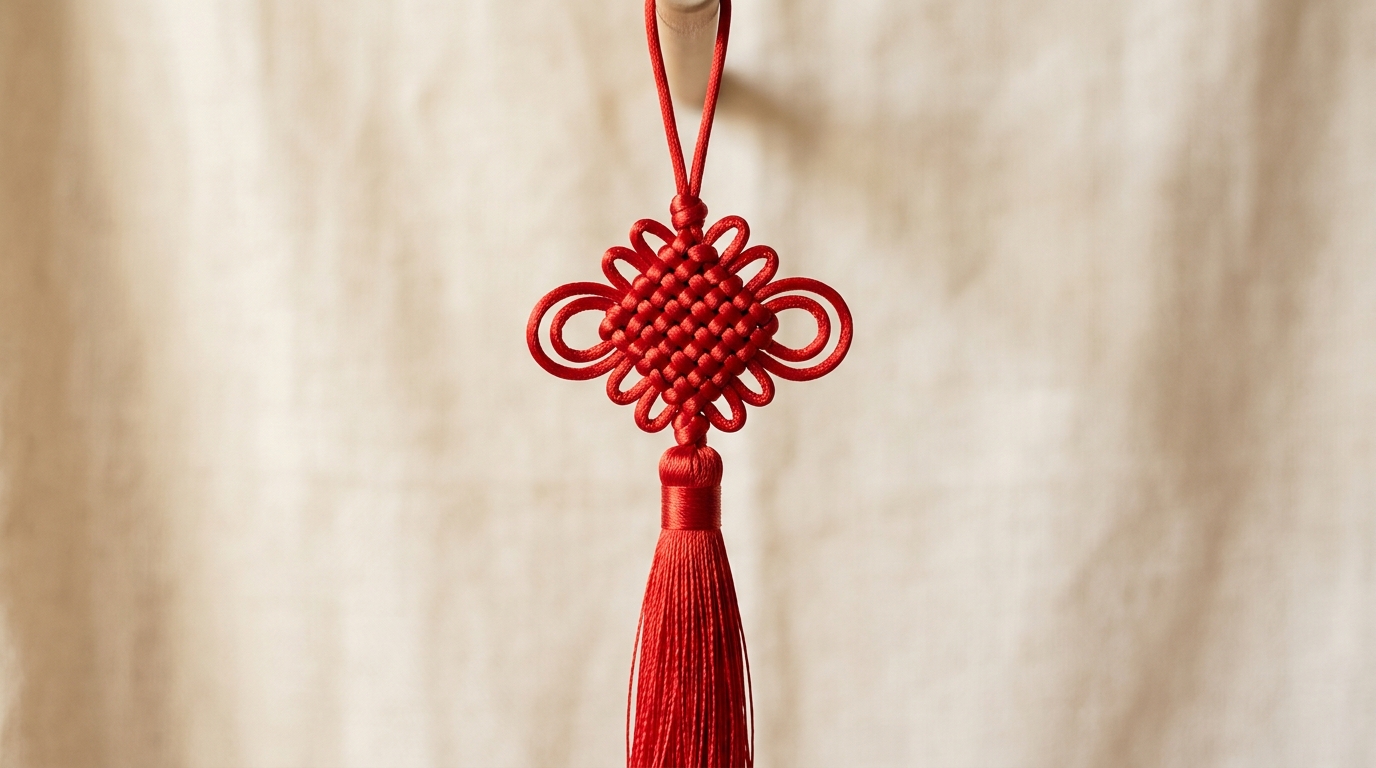
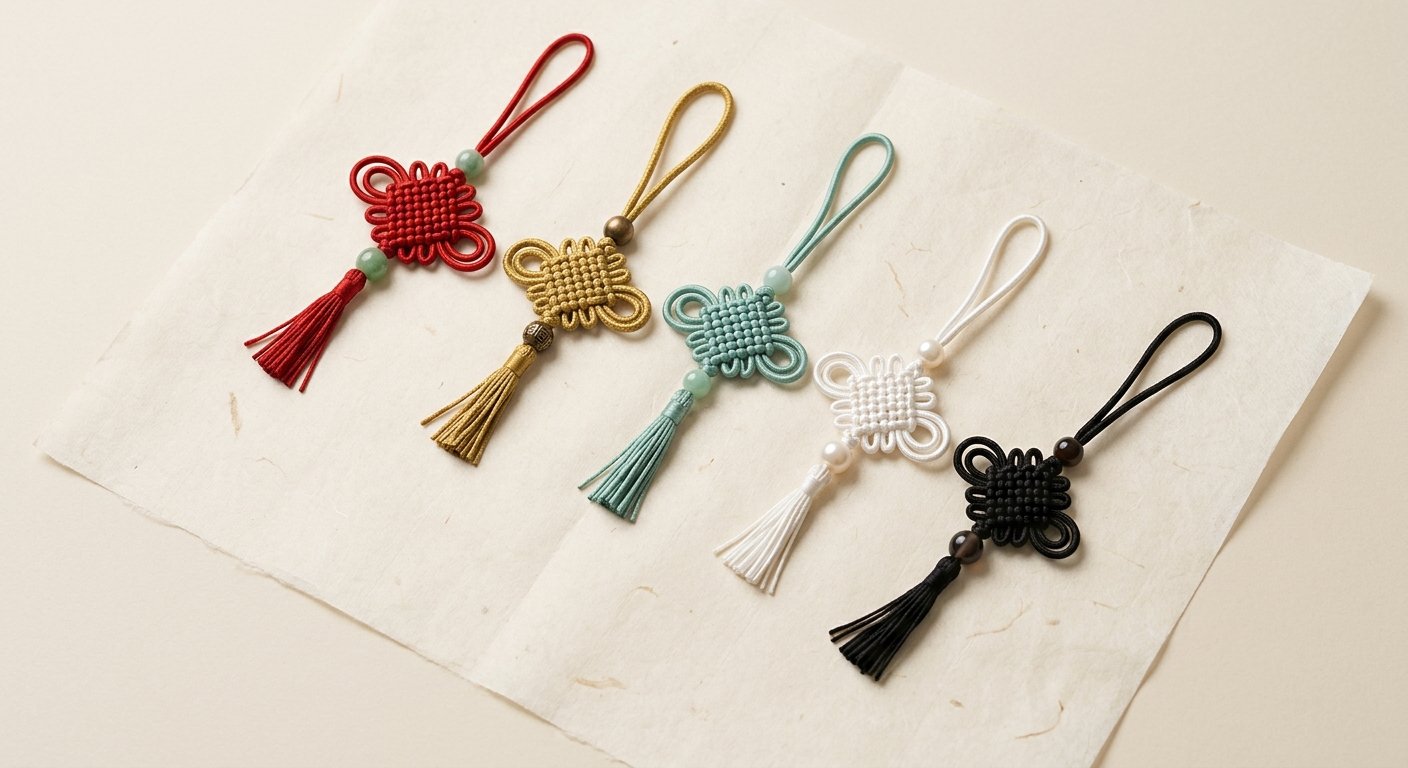
Walk into any shop selling Chinese knots and you will see red. Red everywhere — red pan chang knots, red double coin pendants, red tassels swaying from red cord. Red is the default. But look longer and the other colors surface: a blue-green cloverleaf knot, a gold button knot, a white plum-blossom pendant, a black cord wrapping a jade piece. These are not random choices. They come from a color system that has organized Chinese visual culture for over two thousand years.
The system is the wu se (五色) — the Five Colors of Chinese folk art. It is older than Chinese knotting itself, rooted in the Five Elements cosmology of the Warring States period. And it governs, quietly and consistently, what a knot means when you change its color. For the shapes those colors are tied into, see our guide to common Chinese knots and their meanings.
The Five Colors and Where They Come From
The Five Colors are blue-green (qing, 青), red (chi, 赤), yellow (huang, 黄), white (bai, 白), and black (hei, 黑). They are not an arbitrary palette. They are the visual expression of the Five Elements (wu xing, 五行): Wood, Fire, Earth, Metal, and Water.
| Color | Element | Direction | Season | Association |
|---|---|---|---|---|
| Blue-green (青) | Wood (木) | East | Spring | Growth, vitality, youth |
| Red (赤) | Fire (火) | South | Summer | Joy, vitality, protection |
| Yellow (黄) | Earth (土) | Center | Late summer | Honor, stability, the imperial |
| White (白) | Metal (金) | West | Autumn | Purity, clarity, mourning |
| Black (黑) | Water (水) | North | Winter | Depth, solemnity, the unknown |
The system appears everywhere in Chinese folk art — in paper cutting, embroidery, temple painting, opera masks, and festival decorations. Chinese knotting adopted it wholesale. A knot tier chooses a color the way a painter chooses a palette: each color carries a specific set of meanings, and combining them layers those meanings into a single ornament.
Red: Joy and Protection
Red is the anchor. It is the color of Chinese New Year, of wedding dresses, of the banners hung on doors to invite good fortune. In folk belief, red wards off evil — the story goes that the nian monster feared the color red, which is why every household hangs red decorations at the year's turning.
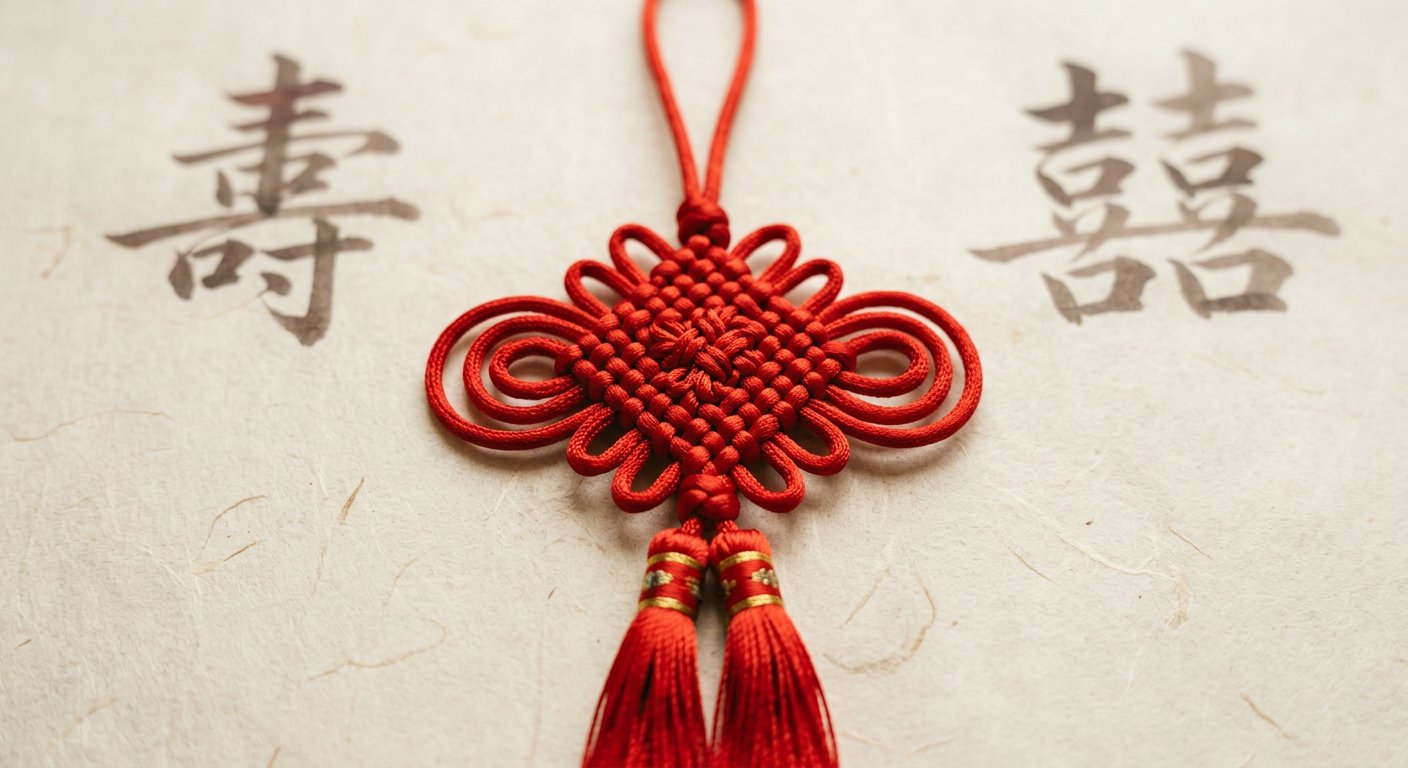
In Chinese knotting, red is the unmarked default. A red pan chang knot on a door is a general-purpose blessing for the household. A red double coin knot given at New Year wishes wealth. A red butterfly knot on a bridal sachet wishes love. Red says: may good things come, and may bad things stay away.
But red is not neutral. It is emotionally loud. A red knot on a business gift is celebratory; a red knot at a funeral would be an offense. The color is so strongly associated with joy that using it in a somber context reads as deliberate disrespect.
The shade matters too. The classic zhongguo hong (中国红, "Chinese red") is a deep, slightly warm crimson — not orange-red, not pink-red. It is the color of the national flag, of lacquerware, of the Forbidden City walls. Lighter reds and pinks read as romantic or youthful rather than ceremonial.
Gold: Wealth and Distinction
Gold is red's partner. A red knot with gold thread woven through its ears is the most traditional festive combination — red for joy, gold for prosperity. The pairing appears on New Year decorations, wedding gifts, and the knots given at business openings.
Gold also carries a quieter meaning: distinction. In imperial China, bright yellow-gold was reserved for the emperor; deeper, muted golds were worn by nobility. A gold knot on a scholar's fan tassel was a small declaration of refinement. Today, gold cord is widely available and no longer restricted, but the association with quality and care persists. A knot tied in gold says: this was made with intention, and the wish inside it is for something substantial.
Gold is rarely used alone. A purely gold knot can read as ostentatious or cold — the color needs red's warmth to feel auspicious rather than merely expensive.
Blue-Green: Growth and Harmony
Qing (青) is the most ambiguous color in the Chinese palette, spanning the range that English splits into blue and green. It is the color of young plants, of spring mountains seen through mist, of the sky just after rain. It belongs to Wood, the element of growth and upward movement.
In Chinese knotting, blue-green cord is chosen for wishes of health, longevity, and harmonious family life. A blue-green cloverleaf knot given to a new parent wishes the child strong growth. A blue-green endless knot hung in a study wishes steady, patient advancement. The color is cool, calm, and life-affirming — the opposite of red's passionate intensity.
Blue-green knots also appear in Buddhist contexts. Temple ornaments and prayer-bead cords often use deep blue or green cord, the colors of meditation and the natural world. The pan chang knot as a Buddhist endless knot is sometimes tied in indigo rather than red, shifting its meaning from folk blessing to spiritual continuity.
In modern usage, lighter blues and greens have become popular for casual accessories — bracelets, phone charms, car mirror pendants — where red would feel too formal. The meaning softens but does not disappear: a blue knot still carries the wish for things to grow well.
White: Purity and Paradox
White is the most context-sensitive color in Chinese knotting. In the Five Elements system, white belongs to Metal, associated with autumn, clarity, and the west — the direction of the afterlife. It is the color of mourning, worn at funerals and avoided at celebrations.
And yet white is also the color of purity. In Buddhist tradition, white lotus flowers symbolize spiritual perfection. White jade is the most prized. A white knot on a meditation mala is not mournful — it is serene.
The practical rule is simple: do not give a white knot as a festive gift, and do not hang a white knot at a wedding or New Year celebration. A white knot is appropriate for personal contemplation objects, for jewelry with white jade, or for gifts in contexts where the Western meaning of "purity and simplicity" is the intended message — for example, a white knot given to a non-Chinese recipient along with an explanation.
Silver-gray cord, a modern variation, is often a safer substitute, carrying white's sense of clarity and modernity without its funerary weight.
Black: Solemnity and Depth
Black is Water — deep, quiet, and powerful. In traditional Chinese folk art, black is used sparingly but deliberately: the ink of calligraphy, the black lines that outline paper cuts, the dark background that makes red pop.
In Chinese knotting, black cord is chosen for formal, serious, or protective purposes. A black pan chang knot hung in a study wishes deep, sustained wisdom rather than cheerful luck. Black cord threaded with a jade pendant emphasizes the stone's gravity. During the twentieth century, when decorative knotting survived quietly among older artisans, black cord was sometimes preferred simply because it did not draw attention.
Black knots also appear in martial and protective contexts. A black button knot on a martial artist's sash is functional and understated. A black double connection knot at the base of a sword tassel is about grip, not display.
Today black cord is popular in contemporary Chinese knot jewelry, especially when paired with silver or dark jade. The combination reads as modern, minimalist, and quietly intentional — a knot that carries its meaning without announcing it.
The Five-Color Thread: Duanwu and Protection
The Five Colors are not only a palette for individual knots — they appear together in one of the oldest Chinese knotting traditions: the chang ming lü (长命缕), the "long-life thread" worn at the Dragon Boat Festival (Duanwu jie, 端午节).
On the fifth day of the fifth lunar month — the height of summer, when diseases and pests were believed to be most active — children were given bracelets or anklets braided from five threads in blue-green, red, yellow, white, and black. The five colors together formed a protective circle, warding off illness and evil. The child wore the thread until the first heavy rain after the festival, then cut it off and let the water carry it away — and with it, any misfortune that had been absorbed.
This practice dates back at least to the Han dynasty and is recorded in the Yanjing suishi ji (燕京岁时记), a Qing dynasty record of Beijing seasonal customs. It is one of the purest expressions of the Five Colors in knot form: each color an element, the five together a complete universe, wrapped around a child's wrist as a shield.
Choosing Colors by Occasion
Chinese knot tiers internalize these associations, but the rules are not rigid. A general guide:
| Occasion | Recommended | Avoid |
|---|---|---|
| Wedding | Red + gold, pink | White, black |
| New Year | Red, gold, red + gold | White, black |
| Birthday (elder) | Red, gold, blue-green | White |
| New baby | Red, blue-green, five-color thread | White |
| Business opening | Red + gold, gold | White, black |
| Housewarming | Red, blue-green, yellow | White |
| Personal accessory | Any — follow the meaning you want | — |
| Funeral / mourning | White, black, plain cord | Red, gold, bright colors |
The most important rule is simpler than the chart: when in doubt, red is safe. It is the universal Chinese blessing color, and a red knot given with good intention is always appropriate for a happy occasion.
Beyond the Five: Modern Colors, Same Logic
Modern Chinese knotting uses colors well outside the traditional five — pink, purple, orange, teal, and variegated rainbow cord. These colors were not part of the classical system, but the underlying logic — that a knot's color is part of its meaning — persists.
Pink knots are given for romance, softening red's intensity into something sweeter. Purple, historically an expensive dye associated with Daoist immortality and, later, with Western-style luxury, ties wishes for spiritual depth or refined taste. Orange, a warm and energetic color, reads as youthful and optimistic — popular for graduation gifts. Rainbow cord, a recent innovation, carries no traditional meaning but is chosen simply for visual delight.
The color system is not a cage. It is a vocabulary, and vocabularies grow. What matters is the consistency: a knot tier who ties a rich purple endless knot for a philosopher friend is making exactly the same kind of choice as a Qing dynasty court artisan who chose indigo for a meditation-room wall hanging. Color plus shape equals message. That equation is the knot tier's art.
A Note Across Cultures
The Five Colors are not culturally universal. A white knot, which reads as "mourning" in a Chinese context, means "purity and new beginnings" to a Western recipient. A red knot, joyous in China, might read as aggressive or overly bold in a culture where bright red carries no festive association.
Chinese knot artists working for a global audience sometimes navigate this consciously. A knot intended for export or for a non-Chinese recipient might substitute silver for white, or add a small gold accent to a red knot to soften its intensity. The meaning is not lost — it is translated.
Frequently Asked Questions
Why is red the most common color in Chinese knotting?
Red is the color of joy, luck, and protection in Chinese folk culture. It wards off evil spirits (the nian monster legend), it dominates festival decorations, and it is the traditional color of weddings and New Year celebrations. A red Chinese knot is a general-purpose blessing — it says "may good things come" without needing to specify what.
What do the five colors together mean?
Together, blue-green, red, yellow, white, and black represent the Five Elements — Wood, Fire, Earth, Metal, Water — and by extension the complete universe in balance. A knot or thread that uses all five colors is a protective charm that covers every direction and every force. This is the principle behind the Dragon Boat Festival five-color thread.
Can I give a white Chinese knot as a gift?
Only in very specific contexts. In traditional Chinese culture, white is associated with mourning and funerals. Giving a white knot at a wedding, birthday, or New Year celebration would be inappropriate. A white knot is acceptable as a personal item (especially with white jade), as a meditation object, or when given to a non-Chinese recipient with the "purity" meaning explained. When in doubt, choose red.
What color should I choose for a wedding gift?
Red and gold, together. Red for joy and protection, gold for wealth and distinction. Pink can be added for romance. Avoid white and black entirely.
Do the Five Colors still matter in modern Chinese knotting?
Yes, but flexibly. Traditional tiers observe the color associations carefully for ceremonial pieces. Modern hobbyists and jewelry designers use a wider palette but still tend to follow the basic rules — red for celebration, gold for wealth, blue-green for health — because the meanings are widely understood. The system is cultural literacy, not law.
Author
This article was written by the ChineseFolkCrafts.com team. Last updated 2026-07-23.
Sources and Further Reading
- 中國結 — 维基百科 — 色彩规约符号章节
- 中国结 — 百度百科
- 中国结蕴含古老智慧的编织艺术 — 新华网/北京日报 — 端午节长命缕
- Chinese knotting — Wikipedia
- Yanjing suishi ji (燕京岁时记), Qing dynasty — Dragon Boat Festival customs -靳之林. 绵绵瓜瓞. 广西师范大学出版社, 2002 — 五色体系与民间艺术
Author
This article was prepared by the team at ChineseFolkCrafts.com. We are not intangible-cultural-heritage inheritors or museum researchers. Our job is to find authoritative Chinese sources, understand them, and explain them clearly for international readers.
If you spot an error — a date, a translation, a misattributed custom — please let us know and we will correct it. Last updated 2026-07-23.