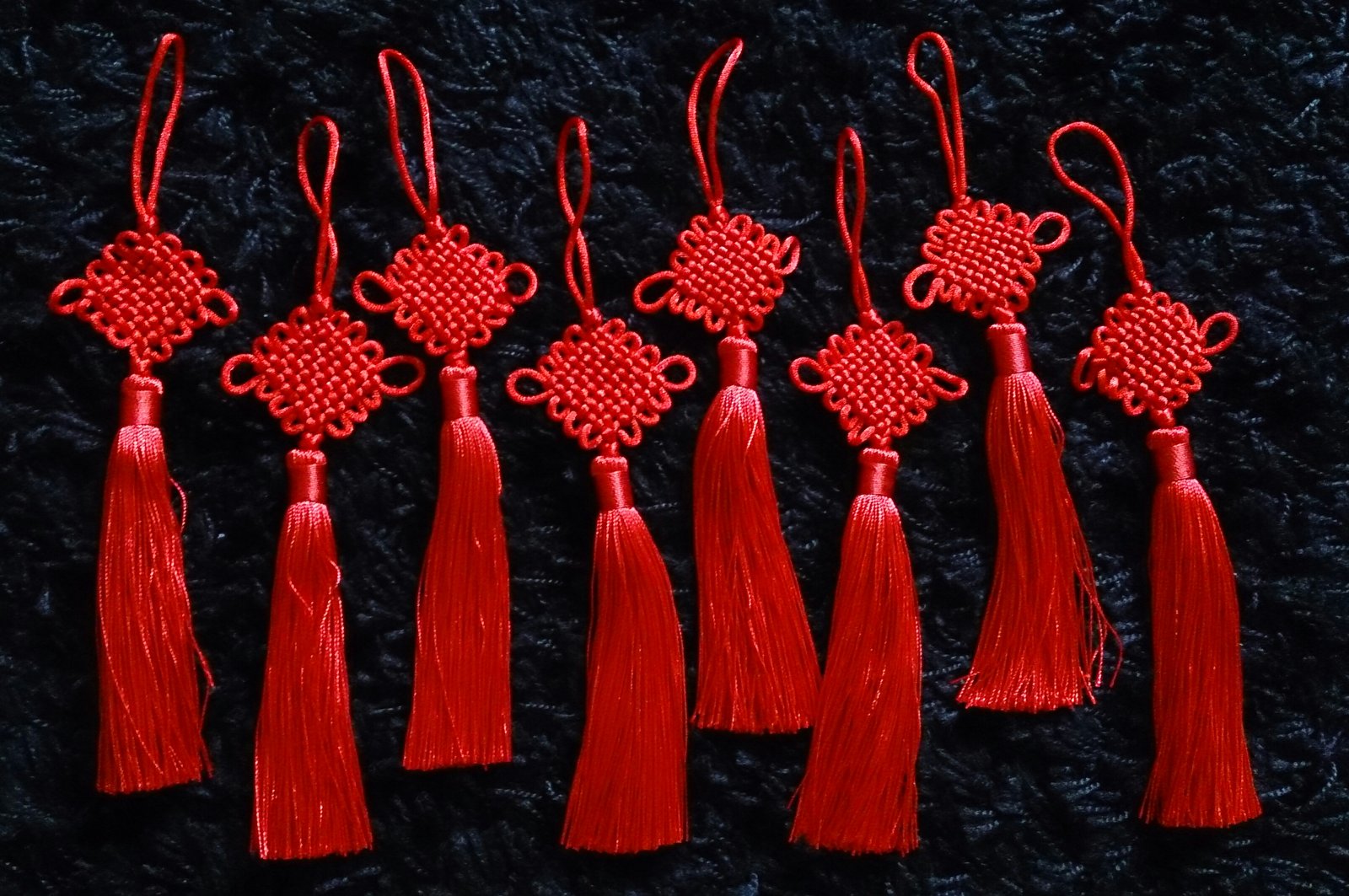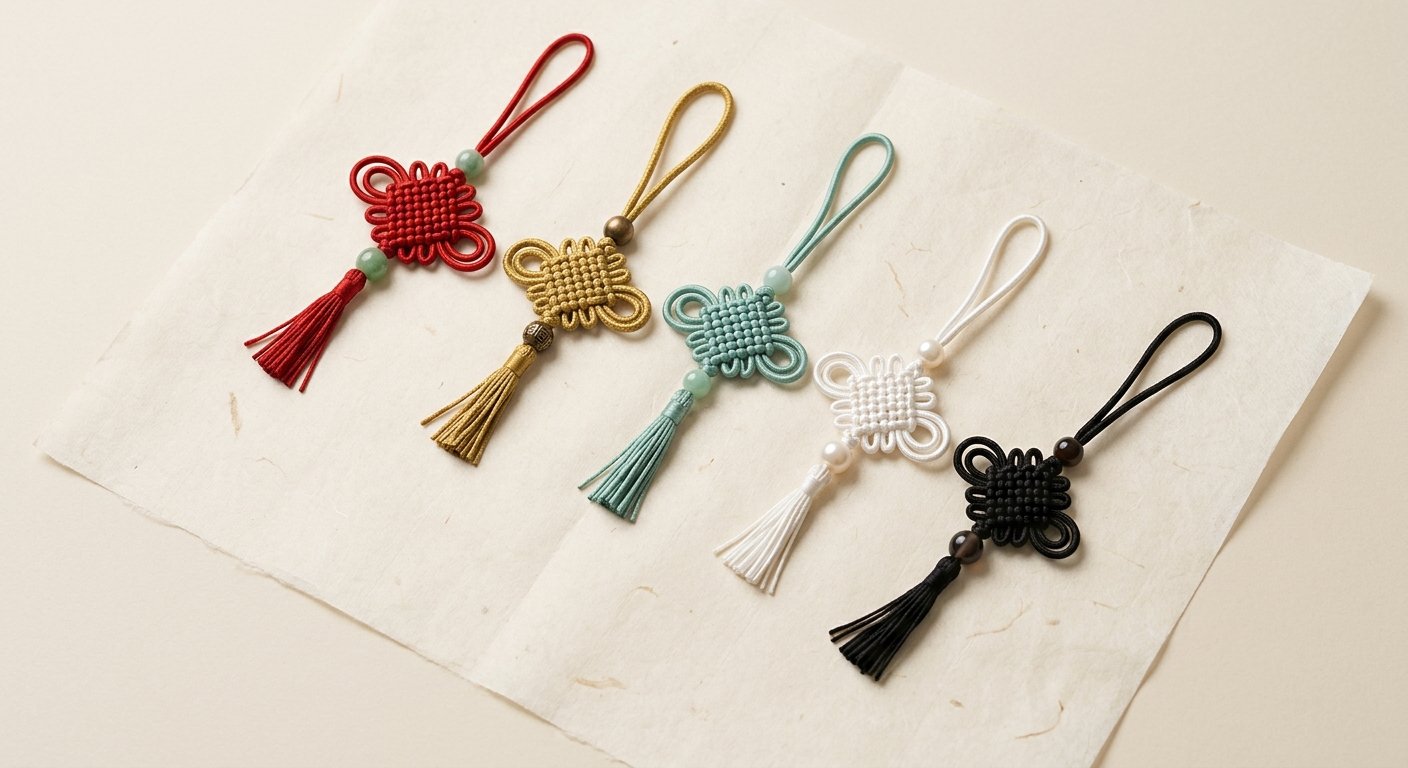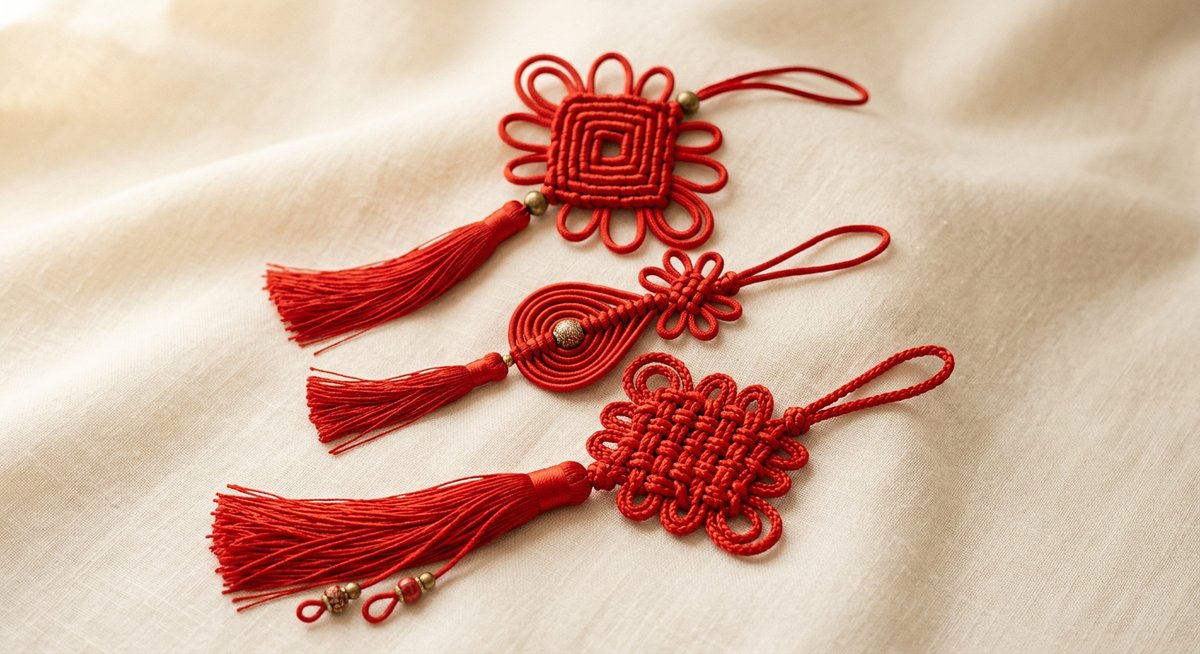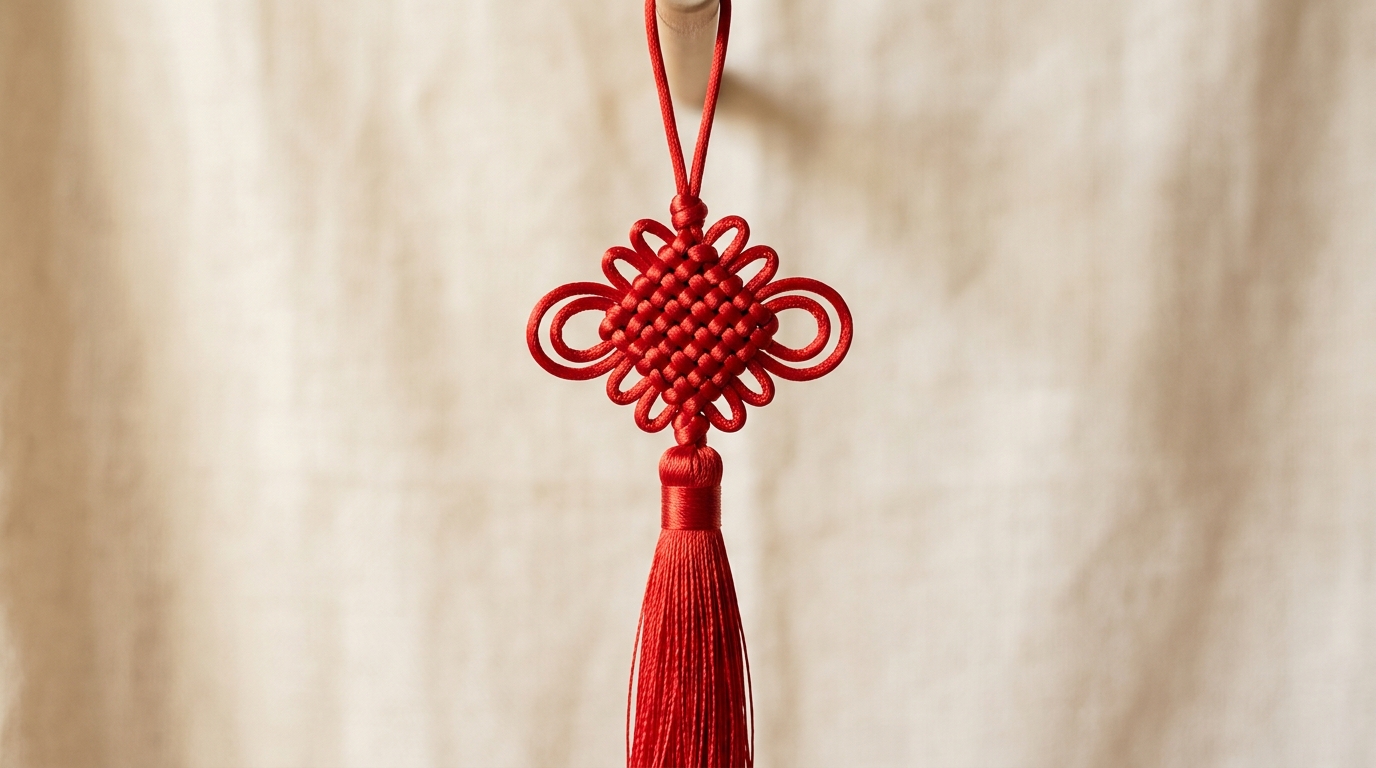
Walk through a Chinese market during festival season, and you will see knots everywhere: red cords twisted into symmetrical shapes, hanging from doorways, bags, and car mirrors. Each knot has a name, and each name is a wish.
Chinese knotting, or zhongguo jie (中国结), is an ancient decorative art. For thousands of years, a single cord was looped, crossed, and tightened into patterns that carried blessings for long life, wealth, love, and good fortune. Unlike weaving or embroidery, a true Chinese knot is made from one continuous length of cord. There are no separate pieces to sew together — only loops, crossings, and a single elegant finish. That is part of the meaning: one cord, one unbroken wish.
From record-keeping to ornament
The Chinese knot began as a tool. The Yijing (Book of Changes) records that "in high antiquity, people governed by tying knots in cords" — before writing, knots served as memory devices, with different knots marking different events. Archaeology supports an even older story: sewing and lashing require knotting, so knotted cord is as old as the bone needles and perforated shell ornaments found at Paleolithic sites. Though ancient cord itself has rotted away, knot patterns survive impressed on pottery and cast into bronze, growing more refined from the Neolithic through the Shang and Zhou.
By the Warring States period, knots decorated clothing and the silk cords from which men hung their jade pendants. Through the Tang and Song, knotting spread across garments and household objects, and by the Ming and Qing it had become a full art form, with hundreds of named knots for every purpose — buttons, sashes, fan pendants, sachet toggles, and bridal ornaments.
The twentieth century nearly broke the chain. On the mainland the craft faded for decades, surviving quietly in Hong Kong and among hobbyists. Its revival began in late-1970s Taiwan, where Chen Xiasheng of the National Palace Museum researched surviving Qing dynasty knotwork, founded a promotion center, and co-edited a landmark book with Echo (Han Sheng) magazine. That book, published in the early 1980s, coined the modern umbrella name by which the whole art is now known: zhongguo jie, "the Chinese knot." Today the craft is popular on both sides of the strait and around the world — counted by China's intangible cultural heritage community among the traditional handicrafts the nation must not abandon.
Here are five of the most common Chinese knots and what they mean.
Video: Shenzhen's Intangible Cultural Heritage — Chinese knotting, via YouTube.
The endless knot
The endless knot — pan chang jie (盘长结) — looks like a square loop with no beginning and no end, its cord doubling back on itself in perfect symmetry. It represents long life, eternal blessing, and the interconnected nature of all things.
It is one of the most important basic knots in the entire system, and it is also known by older names: the coil knot, the temple knot, the "2×2 mystic knot." Folk philosophy reads its unbroken line as the image of a universe without start or finish, which is why the knot appears in Buddhist tradition as one of the Eight Auspicious Symbols, standing for infinite wisdom and the endless cycle of life. Brides' bedcurtain hooks once carried a pan chang knot to wish the couple an unbroken bond. If the pattern looks familiar outside China, it may be because the China Unicom logo is a stylized pan chang knot, chosen to suggest communication flowing without end. If you want to tie one yourself, follow our step-by-step endless knot tutorial.
The double coin knot
Named because it resembles two ancient round coins overlapped side by side, the double coin knot — shuang qian jie (双钱结) — is a wish for wealth and prosperity. It is one of the easiest knots for beginners to learn and one of the most useful, serving as the base for countless larger designs.
The puns stack up deliberately. Paired coins mean "good things come in twos," and the old word for coin, quan (泉), sounds like the word for "complete" or "both" (全), so the knot also wishes the recipient "may you have both" — both happiness and longevity, both love and success. The Bank of China logo is built on the double coin motif, playing on exactly these sound-alikes. The knot is popular as a pendant, keychain, or the crown of a tassel, and it is commonly given at Lunar New Year or to someone opening a business. If you want to tie one yourself, follow our step-by-step beginner knots tutorial.
The butterfly knot
Shaped like a butterfly with outspread wings, this knot symbolizes love, joy, and a happy marriage. It is a favorite for bridal accessories and gifts between couples.
A traditional butterfly knot is built from a "treasure knot" body shaped like an old gold ingot, with a small double coin knot tied into each wing — so the butterfly literally carries wealth on its back. In several southern dialects the word for butterfly, hu, sounds like fu, blessing: a butterfly knot thus reads as "fortune and riches before your eyes," and a cluster of five butterflies wishes the recipient the Five Blessings — longevity, wealth, health, virtue, and a peaceful end. In wider Chinese culture the butterfly is also an emblem of joy and transformation, which makes a pair of butterfly knots a quiet wish for a relationship to grow and flourish.
The cloverleaf knot
The cloverleaf knot — cu jiang cao jie (酢浆草结), named for the wood-sorrel plant — is made of three round ears radiating from a center, like the leaves of clover. It is sometimes called the Chinese bow knot, and it represents good luck and harmony.
Because it is small, flat, and symmetrical, the cloverleaf knot has been used for centuries on the ribbons and sashes of traditional dress, on sachets, and as a component inside larger ornaments. The three ears also invite auspicious readings: in Chinese number symbolism, three is a number of growth and completeness — the three powers of heaven, earth, and humanity. Knot tiers often set a bead at the center, turning the little knot into a flower with a jeweled heart.
The good luck knot
The good luck knot — ji xiang jie (吉祥结) — is one of the oldest ornamental knots, developed as an extension of the simple cross knot. Its name is its meaning: jixiang is the standard Chinese phrase for auspiciousness, the word printed on red banners and spoken in New Year greetings.
Structurally it is a cross knot pulled out into four symmetrical ears, which makes it easy to learn and endlessly adaptable: tied small, it finishes a bracelet or fan pendant; tied large in stiff cord, it becomes a wall ornament in its own right. A practical tip from the manuals: because the knot is open and airy, it can deform if it bears weight, so decorative pieces are often stiffened with a little craft glue. Hung on a main door, a red good luck knot is understood as a wish for the whole household — great fortune and rising luck for everyone inside.
Reading wishes in cord
Once you can recognize these five, the rest of the knot vocabulary starts to open up, because Chinese knots are named by shape and intention, then combined like words into sentences. The round tuan jin knot gathers six loops into a brocade flower for completeness and reunion. The tong xin or "one-heart" knot, tied from two interlocked strands, is the classical emblem of lovers — the medieval play The Story of the Western Wing already mentions folding a letter into a one-heart shape. The shou knot bends cord into the character for longevity, the standard birthday gift for an elder. The ruyi knot imitates the wish-granting scepter. And the double-happiness knot writes the wedding character 囍 in cord.
Traditional tiers assembled these into compound blessings with names like "joy and abundance," "happiness and longevity complete," and "may everything go your way." A red knot on a door is a blessing for the household. A gold knot on a bag is a wish for wealth. A pair of butterfly knots on a gift is a quiet declaration of love.
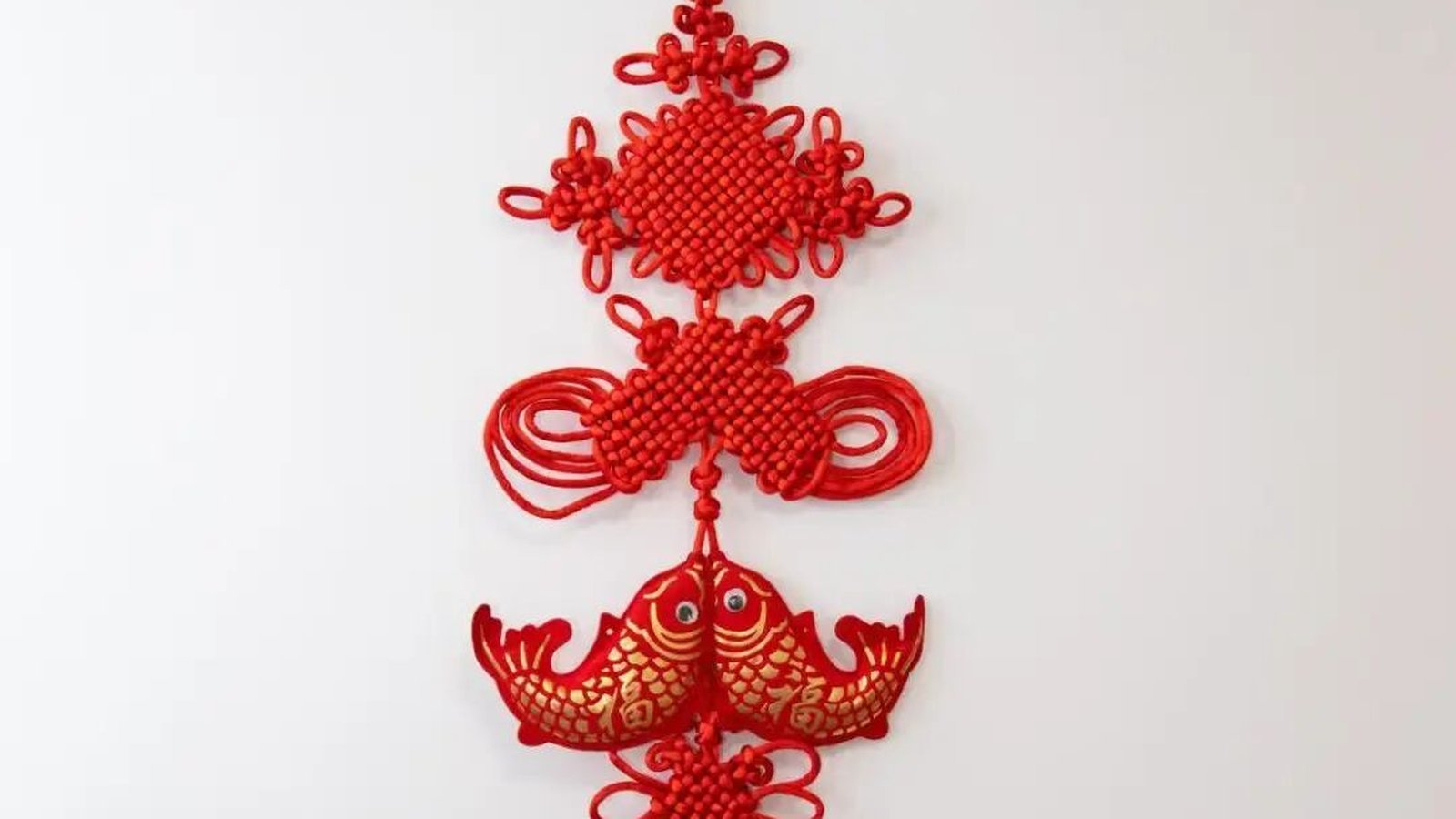
A compound hanging of pan chang knots with double fish — knots and lucky motifs are combined to stack blessings, here "abundance year after year."
One cord, one wish
The techniques behind the poetry are surprisingly few: coiling, knotting, threading, plaiting, winding, wrapping, drawing tight, and trimming. A single cord passes through these operations in a programmed sequence until the pattern closes on itself — which is why knot tiers speak of the number one as the art's first rule: one cord, one breath, one continuous intention. Color is the second rule. The traditional palette follows the five colors of Chinese folk art — blue-green, red, yellow, white, and black — with red dominant for joy. Cords of silk, cotton, linen, and modern nylon all work; beginners usually start with 2–3 mm satin rat-tail cord. Finished knots are often crowned with beads of jade, ceramic, or cloisonné, and finished below with a tassel.
The beauty of Chinese knots is that they turn something as simple as a cord into a language of care. Every loop is deliberate. Every tightening is a wish made solid.
Want to go deeper? Explore the full taxonomy of Chinese knot types and categories, learn what each color means, or read about knots shaped like Chinese characters.
Frequently asked questions
What is a Chinese knot (zhongguo jie)?
A Chinese knot is a decorative knot tied from a single continuous cord, named for its shape and auspicious meaning. The art grew from prehistoric knot-keeping and garment knots into a mature folk craft by the Ming and Qing dynasties, and was revived and renamed zhongguo jie in the early 1980s. Knots are given as blessings for luck, wealth, love, and long life.
What does a red Chinese knot mean?
Red is the color of joy and protection in Chinese folk culture, so a red Chinese knot is a general-purpose blessing: good fortune for the household, safety for a traveler, happiness for a marriage. Specific meanings come from the knot type — a pan chang knot for unbroken continuity, a double coin knot for wealth, a butterfly knot for love.
How many types of Chinese knots are there?
There is no fixed number. Manuals commonly teach fifteen to thirty basic knots, but each basic knot can be varied and combined with others, so the total runs into the hundreds. Traditional works group them into basic knots, variation knots, and compound ornaments that join several knots with beads and tassels.
Is the good luck knot the same as the pan chang knot?
Not always. In English craft kits, "good luck knot" often means the pan chang (endless) knot, the closed interlaced square. In the Chinese system, the ji xiang knot is a separate, open, four-eared knot also translated as "good luck knot." Look at the shape to tell them apart — closed square is pan chang; four open ears is ji xiang.
Is Chinese knotting hard to learn?
The basic knots are not hard — most beginners tie a presentable double coin knot within half an hour. The challenge is tension: keeping every loop even, so the finished knot lies flat and symmetrical. Start with the double coin or good luck knot in 2–3 mm satin cord, then progress to the pan chang and compound ornaments.
What cord should beginners buy?
Look for satin rat-tail cord (also sold as Chinese knotting cord) in 2 or 2.5 mm thickness. Red is the traditional starting color. One meter of cord is plenty for practice knots; buy scissors and a little clear craft glue to seal the cut ends.
Author
This article was prepared by the team at ChineseFolkCrafts.com. We are not intangible-cultural-heritage inheritors or museum researchers. Our job is to find authoritative Chinese sources, understand them, and explain them clearly for international readers.
If you spot an error — a date, a translation, a misattributed custom — please let us know and we will correct it. Last updated 2026-07-30.