Chinese Knots: A Complete Guide to Types, Categories, and the Art of Reading Cord
Slug: chinese-knots-types-categories
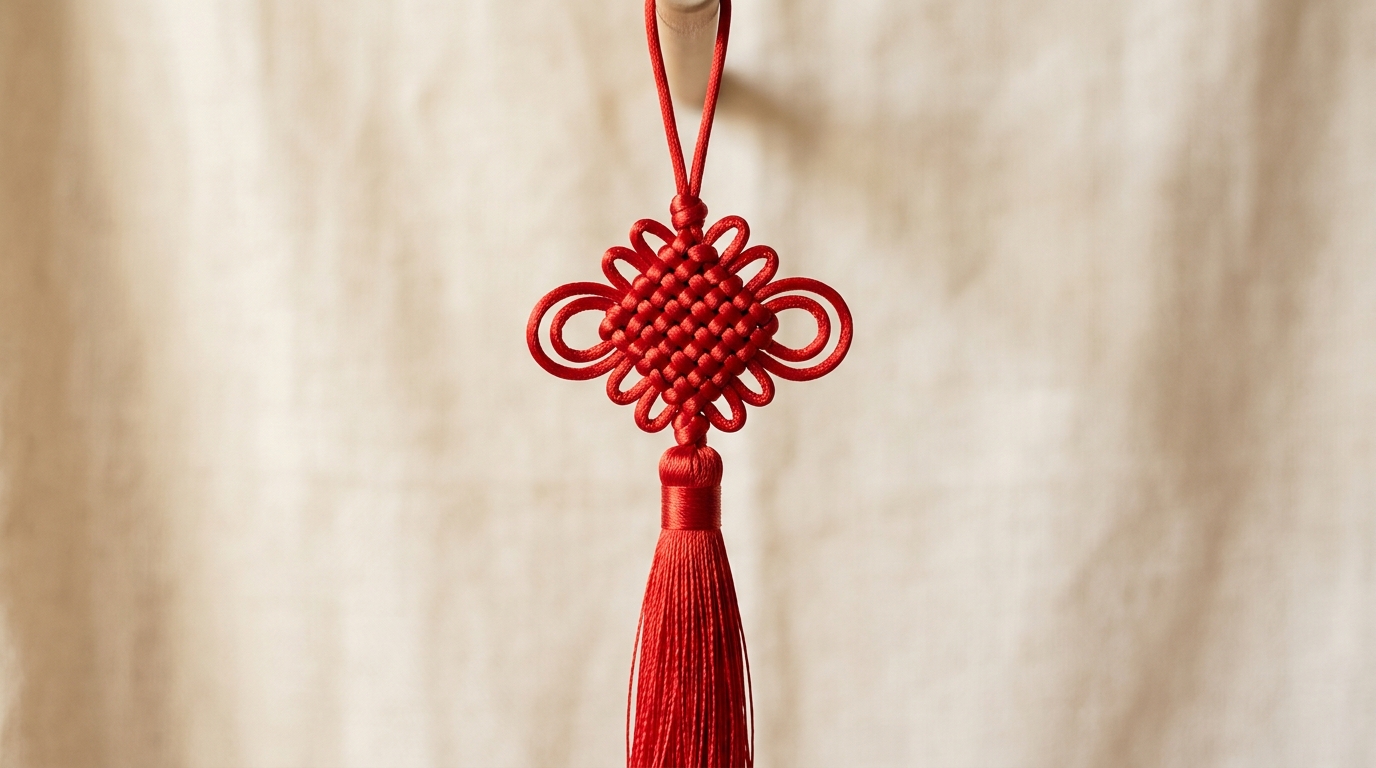
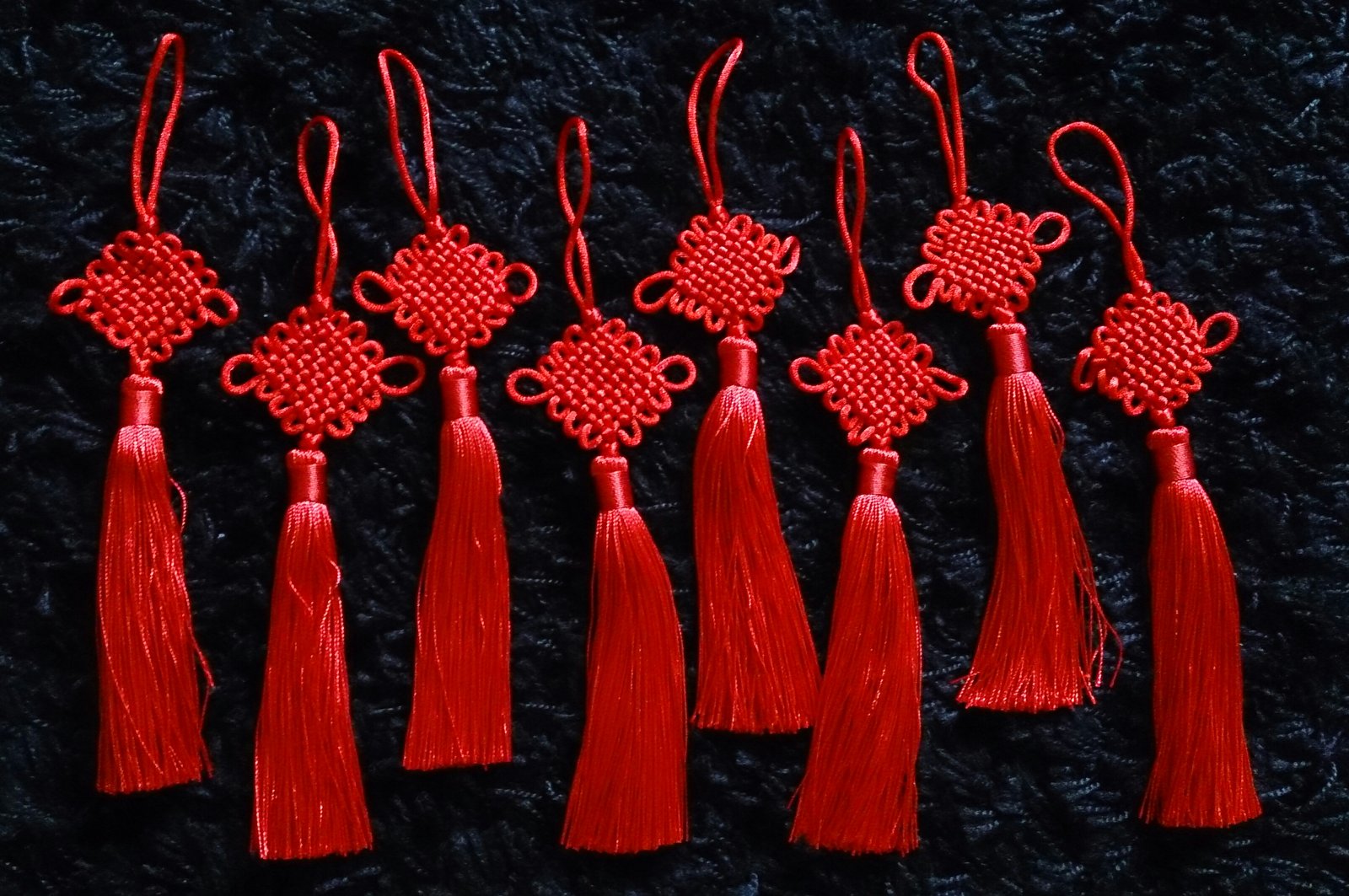
Walk through a Chinese craft market, and you will see dozens of red knots — some flat and square, some round like flowers, some shaped into butterflies, coins, or the character for long life. Each has a name. Each name carries a wish. And every single one of them was tied from one continuous length of cord.
That one-cord rule is the first thing to understand about Chinese knotting. Unlike macramé, weaving, or embroidery, a true Chinese knot — zhongguo jie (中国结) — uses no cuts, no joins, and no separate pieces sewn together. A single cord passes through a programmed sequence of loops, crossings, and tightenings until the pattern closes on itself. If the cord breaks, the knot is not a Chinese knot.
This principle has held for at least four thousand years. The oldest surviving Chinese knot — a double coin knot woven from vine, excavated from a late Liangzhu culture site near Hangzhou — dates to roughly 2000 BCE. Since then, the craft has grown from a memory aid and a garment fastener into a full decorative language with hundreds of named forms. Here is where that language came from, how it is organized, and how to read the shapes that have carried Chinese wishes for millennia.
If you prefer to start with the most useful knots rather than the full taxonomy, read the five most common Chinese knots first.
The Long Thread of History
Chinese knotting began before writing. The Xici Zhuan (系辞传), a commentary on the Book of Changes compiled around the fourth century BCE, records that "in high antiquity, people governed by tying knots in cords" — shang gu jie sheng er zhi (上古结绳而治). The Eastern Han scholar Zheng Xuan elaborated: "For important matters, they tied a large knot; for small matters, a small knot." Before oracle bones, before brush and ink, knots were memory.
Archaeology supports an even older story. Bone needles and perforated shell ornaments from the Upper Cave at Zhoukoudian (circa 18,000 BCE) show that late Paleolithic people were already piercing, threading, and tying. Knotting is as old as the needle itself.
By the Shang and Zhou dynasties (1600–256 BCE), knots had moved from utility into ritual and display. The Book of Rites instructs that "a gentleman must wear jade" (junzi bi pei yu, 君子必佩玉), and jade pendants were suspended from the waist by knotted silk cords. The character of those knots — their tightness, symmetry, and complexity — signaled the wearer's rank. A Warring States bronze mirror excavated from a Chu tomb still bears the imprint of the cord that once passed through its knob.
The Qin and Han dynasties (221 BCE–220 CE) formalized this into a full bureaucratic system. Officials wore shou (绶) — silk ribbon sashes knotted at the waist — whose color, width, and weave pattern were prescribed by rank. One seal, one sash: the knot was a public credential.
The Tang and Song dynasties (618–1279 CE) saw a decorative explosion. Tang court paintings show women in flowing robes tied with elaborate butterfly knots at the waist, chest, and shoulders. The swastika knot (wan zi jie, 万字结) — shaped like the character 卍, adopted as a Chinese character under Empress Wu Zetian in 693 CE with the meaning "ten thousand" or "infinity" — became a popular clothing ornament. The cloverleaf knot appeared in the Song, its three small round ears decorating the ribbons and sashes of everyday dress. A famous Song painting, The Knick-Knack Peddler by Su Hanchen, shows a street vendor's cart laden with ready-made knot ornaments for sale — evidence that the craft had already commercialized.
The Ming and Qing dynasties (1368–1912) brought the craft to its peak. Knots proliferated onto every surface of daily life: hat finials, sedan-chair curtains, fan tassels, sachets, spectacle cases, tobacco pouches, and the hanging scroll weights of calligraphy and painting. Chapter 35 of Dream of the Red Chamber — the great eighteenth-century novel — devotes an extended scene to a maid named Yinger discussing how to knot a laozi (络子), a decorative net-bag for holding personal items, and reeling off a dozen pattern names. By the Qing, a wealthy household might own hundreds of knotted objects, and every bridal gift came wrapped in a knot.
Then the twentieth century nearly broke the chain. War, revolution, and industrialization swept away the daily customs that had sustained decorative knotting. On the mainland the craft faded sharply; it survived quietly in Hong Kong, among older artisans, and among hobbyists.
The revival came from Taiwan. In the late 1970s, Chen Xiasheng (陈夏生), a researcher at the National Palace Museum in Taipei, began systematically studying surviving Qing dynasty knotted objects from the museum's collection. In 1980, she collaborated with Echo (Hansheng, 汉声) magazine to publish a landmark book titled simply Chinese Knots (中国结). That book gave the entire craft its modern umbrella name — zhongguo jie, "the Chinese knot" — and ignited a revival on both sides of the Taiwan Strait. The name first appeared in an official Republic of China government document in January 1982. Today, Chinese knotting is practiced and taught across China, and several regional traditions — including the Yimeng knotting of Shandong and the Manchu rope-knotting of Qing dynasty Western Tombs — have been inscribed on China's intangible cultural heritage lists. At the closing ceremony of the 2022 Beijing Winter Olympics, an augmented-reality Chinese knot wrapped itself around the snowflake cauldron, broadcast to a global audience.
One Cord, Four Elements
Before the categories, the anatomy. A Chinese knot is built from four elements:
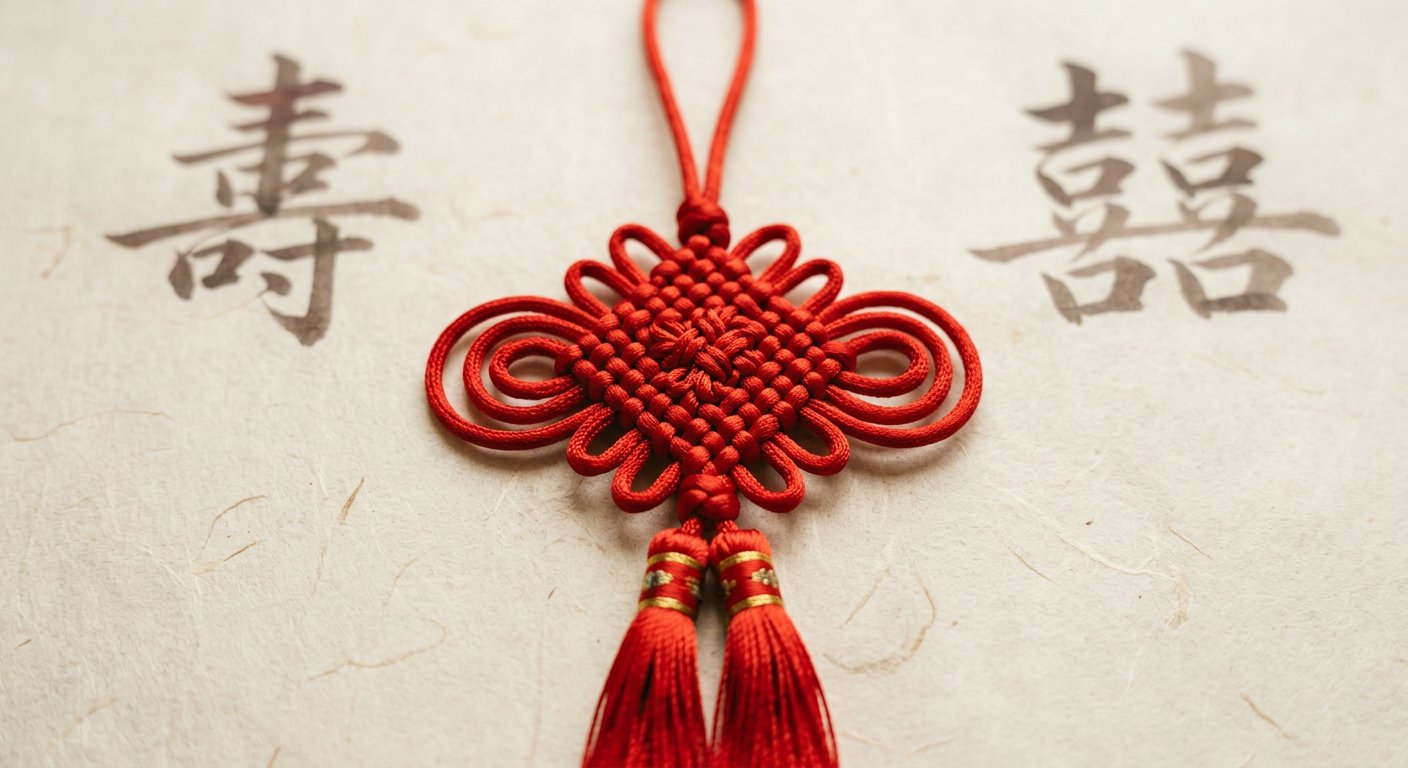
The body (jieti, 结体) is the central woven structure — the dense, symmetrical core where most of the cord's path is consumed. It is the knot's architecture, and it must read clearly as an interlaced pattern.
The ears (eryi, 耳翼) are the loops that extend outward from the body. On a pan chang knot they form four neat arcs on the four sides; on a butterfly knot they spread into wings. Ears can be left empty or filled with smaller knots, beads, or ornaments.
The gaps (jianxi, 间隙) are the negative spaces between cord strands and between sub-knots in a compound design. They are not accidental. Chinese aesthetic tradition values the interplay of solid and void — xu shi jie he (虚实结合) — and a knot pulled too tight becomes a dead knot, airless and illegible. The gaps are where the knot breathes.
The tassel (liusu, 流苏) hangs below, completing the vertical line. A tassel is usually made separately from finer, looser fiber and attached after the knot body is finished. It extends the knot's movement and adds a note of softness against the cord's structured geometry.
The Three-Tier Classification
Chinese knot manuals organize the hundreds of named knots into three tiers:
Basic knots (jiben jie, 基本结) are the smallest independent units. Each basic knot can stand alone as a finished ornament. Remove one step from the tying sequence, and the knot either collapses or becomes unrecognizable. They are the vocabulary of the language.
Variation knots (bianhua jie, 变化结) extend a basic knot by adding ears, increasing the number of loops, changing proportions, or adjusting the weave pattern. A two-return pan chang knot can become a four-return, a six-return, or an elongated rectangular version. A six-ear cloverleaf can grow to eight ears. Variation knots sit on a spectrum between basic and compound.
Combination knots (zuhe jie, 组合结) join multiple basic or variation knots into a larger composition. A butterfly knot is a combination: a treasure-knot body with two double-coin-knot wings. A ruyi (如意) knot combines four cloverleaf knots around a central body. A wall hanging might stack a pan chang, a double coin, a row of cloverleaf knots, beads, and a long tassel into a single vertical chain. Remove one component and the piece still reads as a Chinese knot — diminished, but not destroyed.
This is the difference between the tiers: a basic knot cannot be reduced without breaking; a combination knot can be.
The Eleven Basic Knots
The Chinese knot scholar Lydia Chen, whose English-language books introduced the craft to a global audience, identifies eleven basic knots. They are the starting point for every tier who wants to read — or tie — Chinese knots:
-
Cloverleaf knot (cujiangcao jie, 酢浆草结) — A small knot with three (or sometimes four) round ears radiating from a center, like the leaves of a wood-sorrel plant. Used for centuries on ribbon and sash ends.
-
Pan chang knot (pan chang jie, 盘长结) — The "endless knot": a flat, symmetrical square of interlaced cord with no visible beginning or end. It is the most recognizable Chinese knot, appearing on the China Unicom logo and in Buddhist art as one of the Eight Auspicious Symbols.
-
Round brocade knot (tuan jin jie, 团锦结) — Six loops gathered into a round, flower-like form. Small, compact, and unlikely to loosen, it is often set with a bead at the center.
-
Constellation knot (xing chen jie, 星辰结) — A more complex circular knot named for its radiating, star-like points.
-
Good luck knot (ji xiang jie, 吉祥结) — An open, four-eared knot developed from the cross knot. Its four symmetrical ears are pulled outward from a small central body. Quick to tie and endlessly adaptable.
-
Buddha knot (shi jia jie, 释迦结) — A compact, rounded knot whose name references the Buddha.
-
Double connection knot (shuang lian jie, 双联结) — Two single knots interlocked into a firm, small connector. Because it holds tight, it is often tied at the start and end of a compound piece to anchor the design.
-
Plafond knot (zao jing jie, 藻井结) — Named after the decorated ceiling panels (zaojing) of Chinese palace architecture, this knot features a central "well" shape with symmetrical diagonal lines radiating outward.
-
Flat knot (ping jie, 平结) — An ancient, practical knot tied by wrapping two ends around a central core. Flat, stable, and widely used in macramé and bracelet-making.
-
Double coin knot (shuang qian jie, 双钱结) — Two interlinked round loops resembling ancient Chinese coins. The easiest knot for beginners and the base for many larger designs. Named for its shape and its pun: quan (泉, "coin" in old usage) sounds like quan (全, "complete").
-
Button knot (niu kou jie, 纽扣结) — A round, compact ball used worldwide as a lanyard knot and, in China, as the classic garment fastener. The pipa knot (琵琶结) is its most famous decorative variation, coiled into a lute-shaped disk for the frog buttons of the qipao.
The Four Families: An Alternative View
Some Chinese tiers prefer a different taxonomy, grouping basic knots not by individual identity but by shared structural logic. The craft writer behind the influential tutorial site Shouzuoshe (手作社) proposes four great families:
The Pan Chang family — the "backbone" of Chinese knotting. These knots use a "double-branch" (shuang zhi) method, where two segments of the same cord run side by side through a grid, weaving over and under in strict alternation. The pan chang knot itself is the prototype; the family includes multi-return pan chang, elongated pan chang, triangular pan chang, and the qing (磬) knot shaped like an ancient stone chime. Because the grid logic is so regular, the pan chang family scales cleanly — a four-return pan chang is simply a larger grid following the same rules. This scalability is why the pan chang appears at the center of most large compound ornaments.
The Cloverleaf family — the "little jewel" of Chinese knotting. A cloverleaf knot can be understood as a one-return pan chang — the simplest possible expression of the same weaving logic. But the cloverleaf is more flexible than its larger cousin. It can be tied with three, four, five, or six ears, and made hollow or solid. Its small size lets it fit into tight spaces where a pan chang would overwhelm, so in compound designs, rows of cloverleaf knots often decorate the ears of a main pan chang, like flowers blooming inside a frame.
The Double Coin family — the "single-branch" (dan zhi) exception. Unlike the pan chang and cloverleaf families, which are built from two cord segments running in parallel, the double coin family is worked from a single active end that coils and crosses itself into decorative patterns. These knots are generally not pulled tight — their beauty lies in the open, visible loops. A single double coin knot is a two-coin pendant; a long double coin chain becomes a belt; a cluster of double coin knots forms a flower head. The family also includes the long double coin, the four-sided pineapple knot, and the elaborate treasure (bao) knots.
The Tong Xin family — the "practical" root. This family traces back to knots that served a function before they served decoration: the button knot that closed a robe, the double connection that anchored a pendant, the slip knot that secured a bundle. Unlike the other three families — whose members can be understood by following a geometric logic — the knots in this family resist visual prediction. Before the final tightening, it is nearly impossible to imagine what the finished knot will look like. These are the knots of experience and muscle memory, passed down through apprenticeships rather than diagrams. The pipa frog button, the auspicious cloud knot, and the halberd knot all belong here.
Reading a Knot: Branches and Leaves
Chinese knot tiers describe their work with a pair of deceptively simple concepts:
Single branch vs. double branch (dan zhi vs. shuang zhi). When one end of the cord does all the moving — coiling, crossing, and returning in a single active pass — that is single-branch work. The double coin family is built this way. When two segments of the same cord run side by side, following the same path but offset — one going over where the other goes under — that is double-branch work. The pan chang and cloverleaf families are built this way. The distinction matters because it determines whether the finished knot will have a distinct front and back (single branch tends to create two different faces) or identical faces on both sides (double branch is symmetrical front to back).
Inner leaf vs. outer leaf (nei ye vs. wai ye). When two cord segments run in parallel, the space between them — where they touch — is an inner leaf. When the parallel segments separate and curve outward, that curve is an outer leaf. Tightening the inner leaves forms the knot body; pulling out the outer leaves forms the ears. The rule is kou er xiang cheng (口耳相承): mouth and ear carry each other. Every inner mouth feeds an outer ear, and every outer ear returns to an inner mouth.
From Vocabulary to Sentences
A basic knot is a word. A combination knot is a sentence. And the grammar — the rules for combining — is surprisingly simple.
The most common pattern is vertical stacking: a button knot at the top for the hanging loop, a pan chang in the center for the main body, a double coin knot below for accent, and a tassel beneath. Beads of jade, ceramic, or cloisonné separate the layers and add color.
A more sophisticated grammar works horizontally through the ears. The ears of a pan chang knot can each be filled with a cloverleaf knot, turning four empty loops into four small flowers. The ears of a cloverleaf knot can be pulled long and tied into double coin knots, and those double coin knots can sprout their own cloverleaf ears. The pattern recurses.
Named combinations encode specific wishes. A ruyi knot — four cloverleaf knots arranged around a center — is named after the wish-granting scepter and means "may everything go as you wish." A fang sheng (方胜) knot combines a pan chang and a stone-chime knot into a layered diamond; its name is a pun on "victory" and it is tied for success in examinations. The butterfly knot marries a treasure-knot body and coin-knot wings, so the butterfly carries wealth. Tie five butterflies together, and you have the Five Blessings — longevity, wealth, health, virtue, and a peaceful end — all in cord.
A Living Taxonomy
Chinese knotting is not a fixed museum of forms. It is a generative system. New knots are still being invented — the osmanthus knot (guihua jie) was created by the contemporary knot artist Hu Bo as recently as 2007. Old knots are adapted to new materials: nylon and parachute cord sit alongside silk and cotton. The classification system itself — basic, variation, combination — is a modern analytical tool, not an ancient prescription. Traditional tiers simply learned knots in apprenticeship order, from easy to hard.
But the structure holds because it mirrors the way the knots are actually made. You learn a basic knot, vary it — more ears, a different proportion, a tighter weave — and combine it with others. Every Chinese knot tier, whether a Qing dynasty court artisan or a hobbyist watching a YouTube tutorial in Kansas City, follows the same path. Start with one cord. Learn the words. Then write your own sentences.
Frequently Asked Questions
How many types of Chinese knots are there?
There is no fixed number. Manuals commonly list eleven to fourteen basic knots, but each basic knot can generate dozens of variations, and combinations run into the hundreds. The Wikipedia Chinese entry documents twenty-six named types; the comprehensive 92-knot tutorial published on Sohu lists nearly a hundred named forms, and even that is not exhaustive.
What is the difference between a basic knot and a combination knot?
A basic knot is the smallest independent unit — remove one step and it collapses. A combination knot joins multiple basic or variation knots into a larger design and can survive the removal of a component (though it will be diminished).
What is the most important Chinese knot?
Most tiers would name the pan chang (endless) knot. It is the most visually recognizable Chinese knot, it sits at the center of most large compound designs, and its scalable grid logic makes it the structural backbone of the craft. It also carries the deepest symbolic weight — in Buddhist tradition it is one of the Eight Auspicious Symbols, representing infinite wisdom and the endless cycle of life.
What is the easiest Chinese knot for beginners?
The double coin knot. It requires only one short length of cord, no pinning board, and no special tools. Most beginners tie a recognizable double coin within fifteen minutes.
Why are Chinese knots made from a single cord?
The single cord is both a technical constraint and a symbolic choice. Technically, it ensures that the knot is structurally unified — no seams can slip, no joins can separate. Symbolically, one unbroken cord represents one unbroken wish: continuity, eternity, and the hope that fortune runs without interruption.
Author
This article was written by the ChineseFolkCrafts.com team. Last updated 2026-07-23.
Sources and Further Reading
- 中國結 — 维基百科
- Chinese knotting — Wikipedia
- 中国结基本知识:原理与技法概论 — 手作社
- 中国结 — 百度百科
- 中国结蕴含古老智慧的编织艺术 — 新华网/北京日报
- 为何要叫"中国结" — 北京晚报·五色土
- Chinese Knotting Home Page
- 19 Popular Types of Chinese Knots — AnyOfChina
- Chen, Lydia. The Complete Book of Chinese Knotting. Tuttle Publishing.
- Chen, Lydia. Chinese Knots. Echo Magazine (汉声), 1980.
Author
This article was prepared by the team at ChineseFolkCrafts.com. We are not intangible-cultural-heritage inheritors or museum researchers. Our job is to find authoritative Chinese sources, understand them, and explain them clearly for international readers.
If you spot an error — a date, a translation, a misattributed custom — please let us know and we will correct it. Last updated 2026-07-23.