Writing Wishes in Cord: The Character Knots of Love, Longevity, and Good Fortune
Slug: chinese-knots-character-knots-love-longevity
Some Chinese knots are named for what they look like — a coin, a butterfly, a leaf of clover. Others are named for what they mean — good luck, endless blessing, double happiness. And then there is a third category: knots that write Chinese characters in cord. These character knots do not merely symbolize a wish. They spell it out.
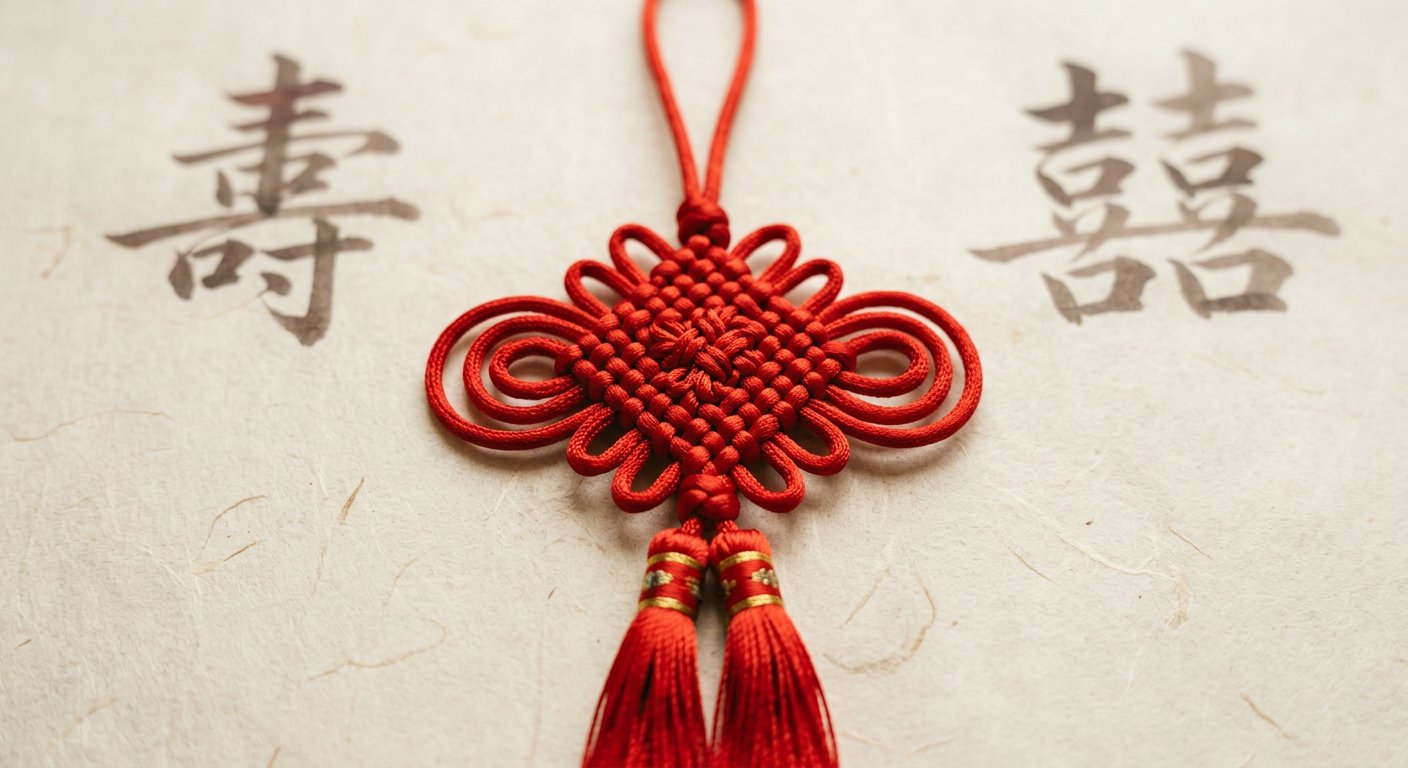
A knot shaped like the character shou (寿, "longevity") is a birthday gift that cannot be misread. A knot shaped like xi (囍, "double happiness") is a wedding decoration that declares its purpose in its very outline. Character knots are the most explicit branch of Chinese knotting, the point where the craft stops suggesting and starts speaking.
Five of them matter most: the round brocade knot, the one-heart knot, the longevity knot, the ruyi knot, and the double happiness knot. Together, they form a small dictionary of wishes written in cord — for reunion, for love, for long life, for things going your way, and for the joy that comes in pairs.
If you are new to Chinese knotting, start with the five most common Chinese knots before exploring these character-shaped forms.
The Round Brocade Knot: Reunion in a Flower
The tuan jin jie (团锦结) — "round brocade knot" or "six-flower knot" — is one of the most beautiful basic knots in the Chinese system. Its six loops gather into a round, petal-like form, a tightly woven flower that holds its shape without loosening. A bead set at the center turns it into a jeweled blossom.
Its name carries its meaning. Tuan (团) means "round," "to gather," "to reunite" — the same character used in tuanyuan (团圆), family reunion. Jin (锦) means "brocade," the rich silk fabric of celebration and ceremony. A tuan jin knot therefore reads as a double wish: may your family be gathered, and may the gathering be splendid.
Lydia Chen lists the round brocade knot among the eleven basic knots. Chinese manuals describe it as "结形圆满,变化多端" — its form is complete and round, and its variations are many. It can be tied with four, five, six, or eight ears. The five-ear version is sometimes called the plum blossom knot. The eight-ear version approaches the complexity of a small pan chang.
Because it is compact and secure, the round brocade knot is often used in jewelry. A small round brocade knot threaded onto a cord becomes a pendant. Set with a pearl at the center, it becomes an earring. In compound designs, it often appears as the crown of a tassel or the centerpiece of a multi-knot arrangement — a small, perfect circle of completion at the heart of a larger work.
The knot is also popular for gifts between family members. A round brocade knot given to someone leaving home carries the wish for safe return and reunion. Hung in a home, it is a quiet prayer that those who are away will come back.
The One-Heart Knot: Love Tied in Cord
The tong xin jie (同心结) — "same-heart knot" or "one-heart knot" — is the classical emblem of lovers in Chinese culture. Unlike the single-cord knots that make up most of the Chinese system, the one-heart knot is tied from two separate strands that interlock into a single, inseparable form. The two strands enter as individuals and emerge as one knot — the image is exactly what it means.
The knot appears in Chinese poetry as early as the Liang dynasty (502–557 CE). The emperor and poet Xiao Yan (梁武帝) wrote:
Yao zhong shuang qi dai, meng wei tong xin jie. 腰间双绮带,梦为同心结 "Two silk ribbons at the waist — in my dreams, a one-heart knot."
By the Tang dynasty, the one-heart knot was a recognized love token. Liu Yuxi, the great Tang poet, wrote of knotting one as a farewell gift. And by the Yuan dynasty, the knot had evolved into a folded-paper form: the tong xin fang sheng (同心方胜), a flat, diamond-shaped love note folded from a strip of paper and sealed with a knotted center. Wang Shifu's fourteenth-century play The Story of the Western Wing — one of the most famous love stories in Chinese literature — has the heroine fold a letter into a tong xin fang sheng for her lover. The gesture says: my words and my heart are one continuous thread.
Today, the one-heart knot is still tied for weddings, anniversaries, and gifts between couples. A pair of one-heart knots, one given to each person, is the Chinese knotting equivalent of a paired ring. And because the knot can be tied flat and small, it often appears as a hidden detail — sewn into the lining of a wedding dress, tucked into a love letter, or knotted into the drawstring of a gift pouch.
The Longevity Knot: A Character You Can Hold
The shou zi jie (寿字结) — the longevity character knot — is the most literal of all Chinese knots. Its cord is bent into the shape of the Chinese character 寿 (shou, "long life"), and the result is a flat, recognizable character that can be hung on a wall, sewn onto clothing, or given as a birthday gift.
The shou character itself is one of the most important symbols in Chinese culture. It appears on birthday cakes and banners, embroidered on robes, carved into furniture, and painted on ceramics. The knot version turns that two-dimensional symbol into a three-dimensional object — a shou you can touch, hold, and give.
The shou knot is typically tied in red or gold cord for celebratory gifts. A shou knot given to an elder on their birthday is a direct, unambiguous wish for long life. Paired shou knots — two characters side by side — mean "double longevity," a wish for both the recipient and their spouse. In some designs, the shou knot is combined with a pan chang knot, layering "endless" on top of "long life": not just a long life, but one without end.
The knot is challenging to tie, because the character 寿 has a complex structure — a top component, a middle horizontal stroke, and a bottom component, all of which must be shaped from a single continuous cord while remaining legible. Experienced tiers sometimes use a slightly stiffened cord to help the character hold its shape. The result, when done well, reads instantly as the character it is — a word made physical.
The Ruyi Knot: May Everything Go Your Way
The ruyi jie (如意结) is named after the ruyi (如意) — the ceremonial scepter whose name means "as you wish." The ruyi scepter itself is an ancient object, shaped like a curved wand with a cloud-shaped head, originally used as a back-scratcher and later as a symbol of authority and good fortune. Its shape appears across Chinese decorative art, and its name — ru yi, "according to [your] wishes" — makes it a perfect vessel for blessings.
The ruyi knot is a combination knot. It typically joins four cloverleaf knots around a central body, producing a symmetrical shape that echoes the cloud-head curve of the scepter. The four cloverleaf knots point outward in the four directions, enclosing a small central panel that can be left empty or filled with a bead.
Legend associates the ruyi with the lingzhi (灵芝) — the glossy ganoderma mushroom believed to grant immortality. The knot's shape is sometimes described as "状似灵芝" (shaped like the lingzhi fungus), layering a wish for long life onto the wish for things going one's way.
A ruyi knot is a popular gift for someone starting a new chapter — a new job, a new home, a new year. It says: may everything you encounter turn out as you would wish it. In compound wall hangings, a ruyi knot is often the centerpiece, surrounded by smaller good-luck knots, as if the entire composition radiates from that single, generous wish.
The Double Happiness Knot: A Wedding in Red Cord
The shuang xi jie (双喜结) — the double happiness knot — writes the character 囍 in cord. That character is a doubling of the character 喜 (xi, "happiness" or "joy"), and it is the universal symbol of Chinese weddings. It appears on wedding invitations, red envelopes, door decorations, and bridal chamber ornaments. To tie it in cord is to make the symbol itself a gift.
The structure of the double happiness knot is complex. The character 囍 is symmetrical — two identical halves side by side — and the knot must reproduce that symmetry from a single cord. It is usually tied flat, on a board, with the cord carefully shaped into the strokes of the character and then tightened to hold the form.
Because of its complexity, the double happiness knot is rarely a beginner's project. It is the kind of knot a tier makes for a specific occasion — a wedding, an engagement, a major anniversary — and invests the time to get right. The finished knot is often framed or mounted as a permanent keepsake.
In traditional practice, a double happiness knot is presented to the couple on their wedding day, usually in red and gold cord. It is hung in the bridal chamber above the bed, where it stays throughout the wedding month. Some families pass a double happiness knot down through generations — a knot tied for a grandmother's wedding, preserved and displayed at a granddaughter's.
The Grammar of Character Knots
These five knots share a structural principle: they sacrifice the pure geometric abstraction of knots like the pan chang or the cloverleaf in favor of legibility. A shou knot must read as the character 寿 before it reads as a knot. A double happiness knot must show the two halves of 囍 clearly, even if that means breaking the "one continuous cord" rule that governs most Chinese knots — some versions of the double happiness knot do use a second cord to complete the more complex strokes.
This is the key difference between a shape knot and a character knot. A double coin knot looks like two coins, but it could also be described as two interlocked rings — the shape is suggestive, not literal. A shou knot, by contrast, is either legible as the character 寿 or it has failed. Character knots are held to a higher standard of representation.
The trade-off is worth it. Character knots carry the densest information of any knot type. A shou knot placed on a birthday gift does not merely suggest longevity — it states it, in the standard written character that every Chinese-literate person can read. The knot is a word.
Frequently Asked Questions
What is the difference between the round brocade knot and the cloverleaf knot?
The round brocade knot (团锦结) is larger and more complex, with typically six or more ears forming a round, flower-like shape. The cloverleaf knot (酢浆草结) is smaller, with three or four ears, and is named for a specific plant rather than for brocade. Both are used as components in larger designs, but the round brocade knot is more often a centerpiece, while the cloverleaf more often fills ears and edges.
Why is the one-heart knot tied from two cords when most Chinese knots use one?
Because the meaning requires two. The one-heart knot represents two individuals joining into one bond. Using two separate cords that interlock is a literal enactment of the wish: two become one. This makes it unique among the basic Chinese knots, almost all of which follow the "one cord" rule.
Is the longevity knot considered a basic knot or a combination knot?
It is usually classified as a combination knot, because it often uses elements of other basic knots (such as double connection knots at the character's corners) in addition to the shaped cord that forms the character itself. However, some manuals list it alongside the basic knots because it is a building block for more complex character-knot designs.
What occasions are ruyi knots given for?
The ruyi knot is appropriate for almost any happy occasion where the giver wants to express a general wish for things to go well: new jobs, new homes, graduations, New Year, and housewarmings. It is less specifically tied to weddings (like the double happiness knot) or birthdays (like the longevity knot), making it the most versatile of the character and near-character knots.
Can beginners tie character knots?
The ruyi knot (which is a combination of cloverleaf knots) and the round brocade knot are accessible to intermediate tiers who have mastered the basic cloverleaf and double coin knots. The shou and double happiness knots are advanced projects. The one-heart knot is structurally different from other Chinese knots (two cords, not one) and can be learned at an intermediate level with patience.
Author
This article was written by the ChineseFolkCrafts.com team. Last updated 2026-07-23.
Sources and Further Reading
- 中國結 — 维基百科
- Chinese knotting — Wikipedia
- 中国结 — 百度百科
- 中国结蕴含古老智慧的编织艺术 — 新华网
- 为何要叫"中国结" — 北京晚报
- Chen, Lydia. The Complete Book of Chinese Knotting. Tuttle Publishing.
- Wang Shifu. The Story of the Western Wing (西厢记), Yuan dynasty — 同心方胜 reference
- Xiao Yan (梁武帝). "腰间双绮带,梦为同心结" — Liang dynasty poem
Author
This article was prepared by the team at ChineseFolkCrafts.com. We are not intangible-cultural-heritage inheritors or museum researchers. Our job is to find authoritative Chinese sources, understand them, and explain them clearly for international readers.
If you spot an error — a date, a translation, a misattributed custom — please let us know and we will correct it. Last updated 2026-07-23.