The Chinese lantern is one of the oldest forms of portable light in the world. For more than two thousand years, it has guided travelers, decorated palaces, marked weddings and births, and turned festival nights into seas of color. What began as a practical windshield for an open flame grew into one of the most recognizable symbols of Chinese culture — and into a family of regional crafts so refined that several of them are now protected as national intangible cultural heritage.
Early lights
The first Chinese lanterns solved a simple problem: fire hates wind. A candle or oil lamp carried outdoors gutters and dies, so people enclosed the flame in a frame covered with a translucent material. The frame blocked the wind; the covering let the light through. Early lanterns used bamboo or wooden frames wrapped in silk, gauze, or thin paper, with a hook or hoop on top so they could be carried or hung outside doorways, along corridors, and on the paths between farm fields.
The principle was so useful that lanterns quickly spread from soldiers, farmers, and night travelers into every layer of society. By the Western Han dynasty (206 BCE–9 CE), written records already connect lamps and lanterns with important ritual moments. One early tradition held that on the fifteenth night of the first lunar month, lights should be burned in honor of Taiyi, the supreme deity of the Han pantheon — a custom many historians see as one seed of the later Lantern Festival.
Palace and temple
By the Han dynasty, lanterns had escaped pure utility and become decorative objects in palaces and temples. Imperial workshops produced lanterns from expensive materials: carved hardwood, painted silk, colored glaze, and fine gauze. They were shaped like animals, flowers, and palace halls, and the best of them were engineering marvels. The most ingenious was the zou ma deng (走马灯), the "galloping horse lantern": the heat of the candle drove a small paper wheel inside the shade, so silhouettes of horses and riders seemed to circle endlessly around the light.
Temples used lanterns in ritual. A lit lantern could represent wisdom driving away ignorance, or a prayer carried upward to ancestors and gods. Lighting a lantern before a deity was an act of offering, and the custom of dedicating lanterns at temples persists to this day.
The city of Luoyang, an ancient capital, became so famous for its palace lanterns that "Luoyang gongdeng" (洛阳宫灯) remains a protected craft. The classic Luoyang lantern is a round gauze lamp: strips of green bamboo from nearby Luoning county form a flexible skeleton that can be opened or collapsed for storage, covered with silk gauze painted with calligraphy or motifs. A single traditional Luoyang palace lantern passes through more than seventy steps before it is finished.
Festival lanterns
The fifteenth day of the first lunar month — the first full moon of the new year — turned lanterns into a public art form. The Lantern Festival grew steadily from Han dynasty ritual into the grand finale of the Chinese New Year season, and cities competed to build the most elaborate displays.
The Tang dynasty (618–907) set the standard for spectacle. In the capital, craftsmen erected a "lantern wheel" said to stand twenty zhang high — perhaps thirty meters — draped in brocade, decorated with gold and silver, and carrying tens of thousands of lamps that clustered like a flowering tree. The Song dynasty added two beloved customs: the commercial lantern market, where families browsed stalls of painted shades, and the riddle game, in which strips of paper bearing poems and word puzzles were tied to lanterns for passersby to solve. The poet Xin Qiji left the most famous description of a Song festival night: "The east wind set a thousand trees ablaze at night, and blew down stars like rain."
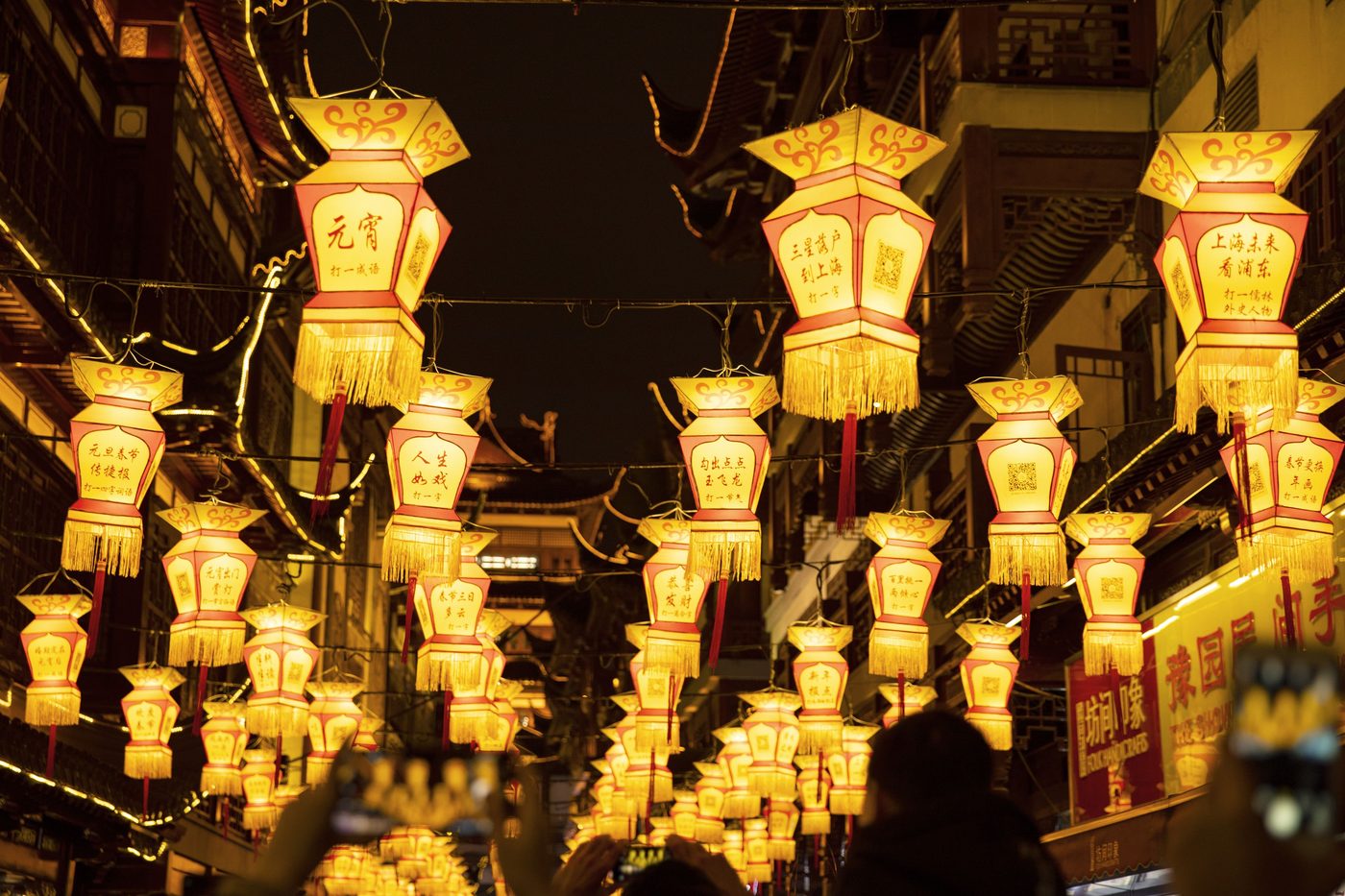
The Ming dynasty went further still, extending the official lantern display from three nights to ten. Ordinary families hung red lanterns outside their doors, and the phrase "fire trees and silver flowers" became the fixed poetic image of the festival. You can read the full story of that night in our article on the Lantern Festival.
Regional schools of lantern craft
Across the centuries, different regions developed their own lantern dialects. Several are now listed as national intangible cultural heritage under the collective craft of dengcai (灯彩), decorative lantern art.
- Beijing lanterns were classified by use — hanging lanterns, standing lanterns, wall lanterns, and hand-carried lanterns — and by material, from gauze lamps and palace lanterns to revolving zou ma deng and three-dimensional animal lanterns. Beijing makers drew on a rich toolkit: bamboo framing, pasting, knotting, embroidery, carving, paper cutting, calligraphy, and painting.
- Qinhuai lanterns, from Nanjing and neighboring Jurong, appear in documents as early as the Eastern Jin dynasty. They absorb paper craft, painting, calligraphy, paper cutting, shadow-puppetry, embroidery, and sculpture into one tradition. Classic forms include the lotus lantern and the lion lantern, and the Qinhuai lantern fair is still one of the great Spring Festival events in China.
- Suzhou lanterns trace back about 1,500 years to the Northern and Southern Dynasties. Modeled on the pavilions of Suzhou's classical gardens, covered in fine local silk, and painted in the manner of the Wu school of painting, they range from ten-centimeter ornaments to installations more than thirty meters long.
- Xiashi lanterns, from Haining in Zhejiang, were famous across the Jiangnan region by the late Tang and were sent to the Southern Song court as tribute. They are built with eight techniques — painting, bending, engraving, framing, needle-piercing, mounting, pasting, and knotting — and their needle-pierced patterns glow like lace when lit.
- Xianju "boneless" lanterns, also from Zhejiang, use no frame at all. Legend calls them "Tang lanterns," and their shades are made of folded paper panels joined edge to edge, with pictures formed entirely by tiny knife- and needle-punched holes. They combine painting, embroidery, and architecture in a single object and are considered a masterpiece of the needlework tradition.
In the south, Guangdong developed parade lanterns and dragon lanterns carried through the streets, while Sichuan's city of Zigong grew into the modern capital of the giant festival lantern, exporting illuminated displays around the world.
How a traditional lantern is made
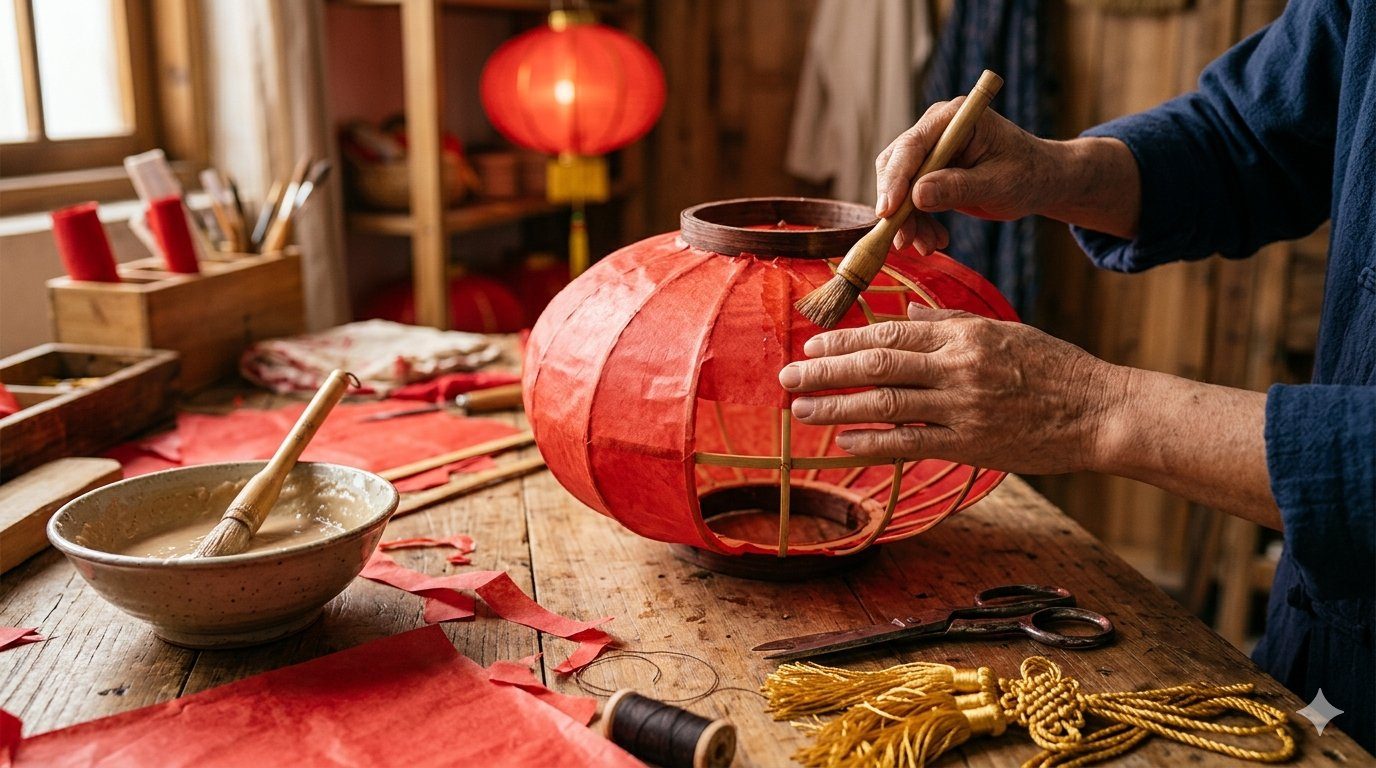
Despite regional differences, most traditional lanterns share a common construction logic that has changed little in centuries. First comes the frame: bamboo is split, shaved, and bent into shape, then tied or glued into a skeleton — round for a palace lantern, articulated for an animal. Second comes the skin: paper, gauze, or silk is pasted over the frame in sections. Third comes the decoration: painting, calligraphy, cut paper, or needle-pierced patterns. Finally, the lantern is fitted with its top hoop, tassels, and — historically — a candle or oil dish, now almost always an LED.
If you want to experience the basic idea yourself, our guide to making a simple red paper lantern recreates the fold-and-cut principle with nothing more than a sheet of paper.
The meaning of light
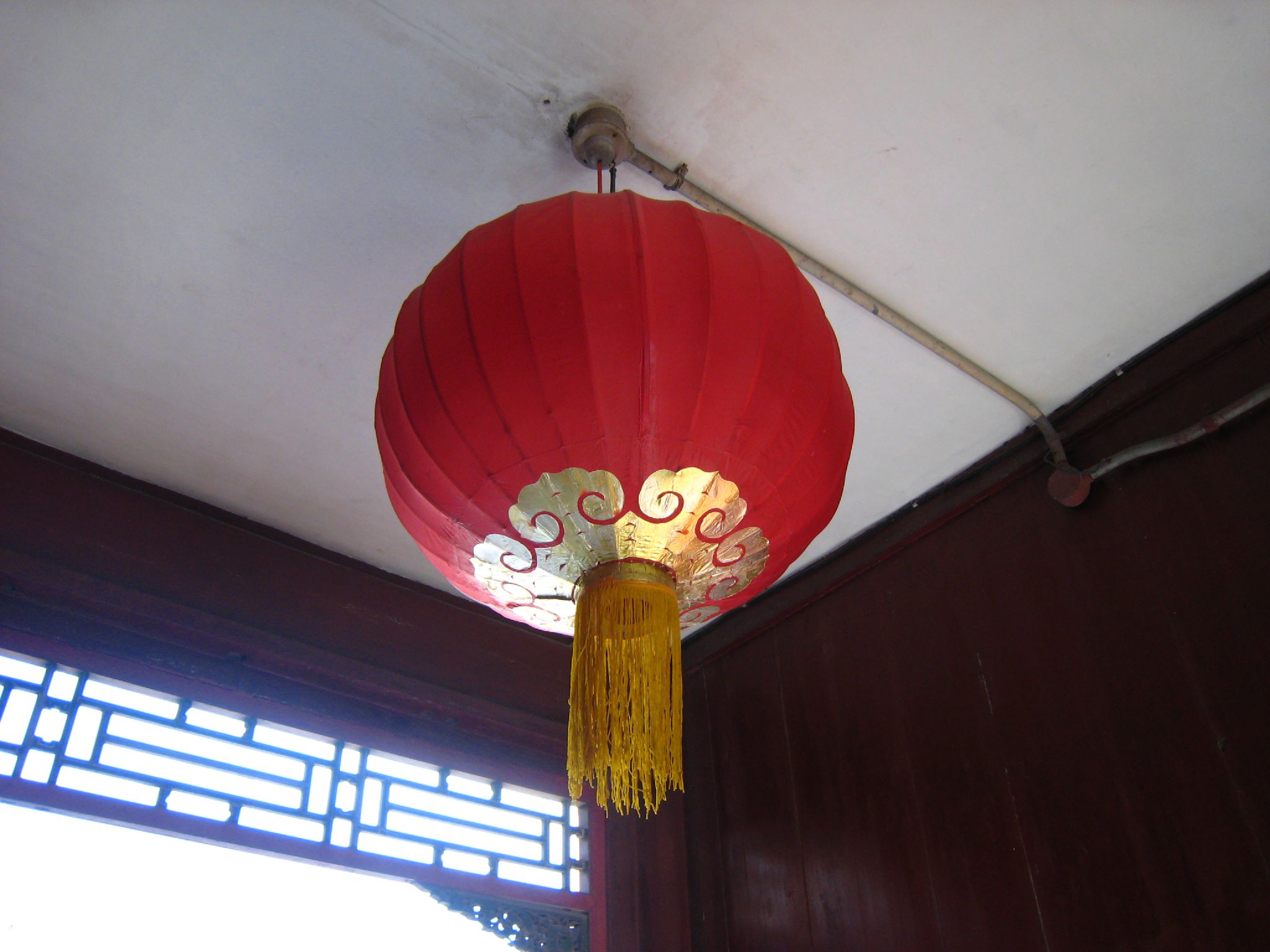
A Chinese lantern has never been only a lamp. Red, the default color, signals joy, vitality, and protection from evil. Roundness echoes the full moon and family reunion. And in several southern dialects, the word for lantern (deng, 灯) sounds like the word for a male child or family member (ding, 丁), so "adding a lantern" came to mean "adding to the family." In Foshan, families who welcomed a newborn son traditionally hung a lantern in the ancestral hall to announce the news — a custom called bao ding.
That is why lanterns appear wherever Chinese life celebrates: New Year and the Lantern Festival above all, but also weddings, shop openings, temple birthdays, and the Mid-Autumn night when children carry rabbit lanterns through the streets.
Modern times
Electric light has replaced candles in nearly all festival lanterns, and mass-produced plastic shades crowd city markets. Yet traditional lantern craft has not vanished — it has been reframed. In 2006, lantern art entered China's first national list of intangible cultural heritage, and later expansions protected regional schools from Beijing and Luoyang to Suzhou, Xiashi, Xianju, and the Qinhuai tradition. Zigong's colossal lantern fair now tours internationally, and heritage masters still split bamboo and stretch silk by hand.
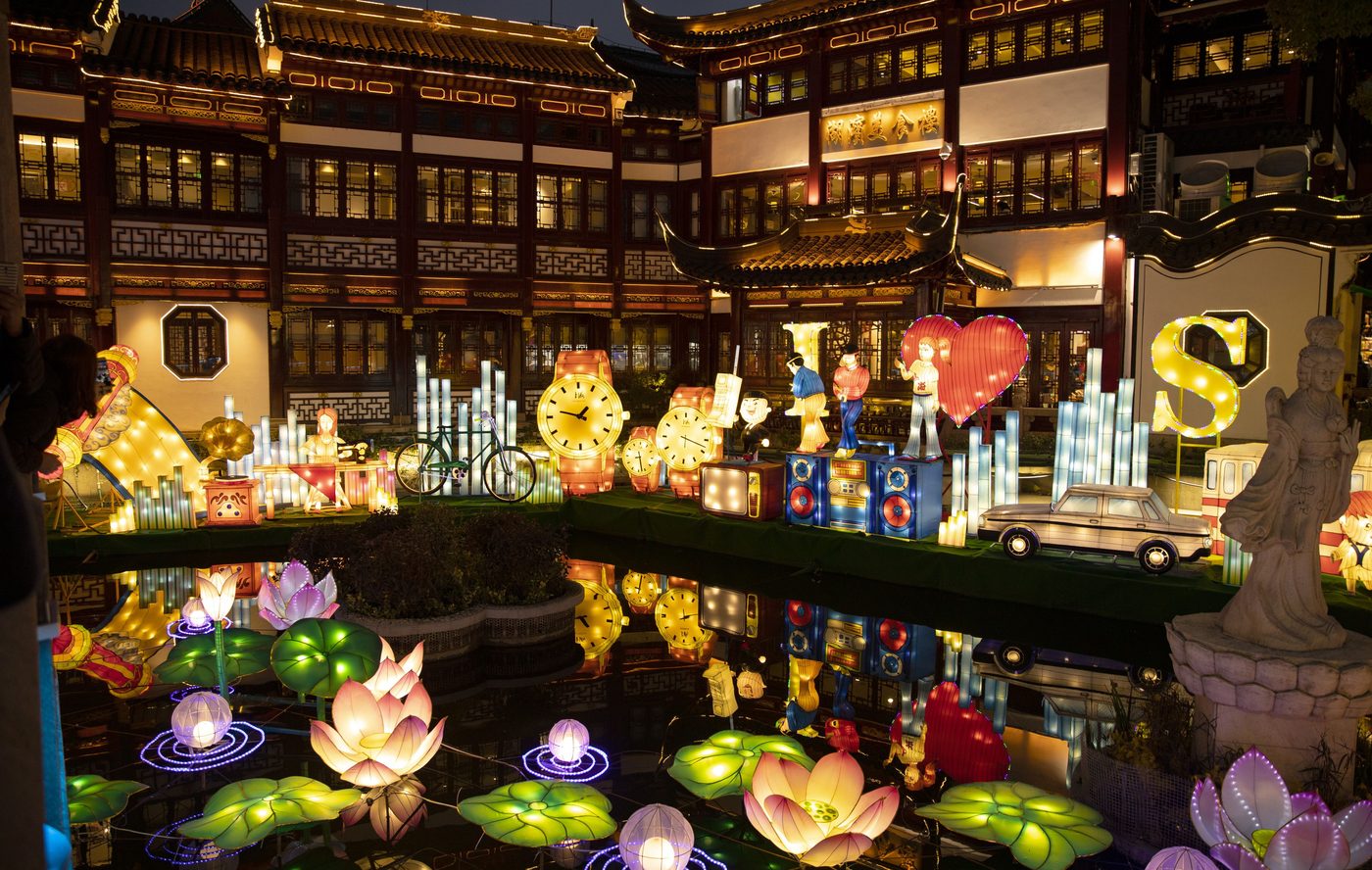
In homes, meanwhile, a single red paper lantern still does the quiet work it has always done: signaling celebration, warmth, and reunion at the door of an ordinary family.
Frequently asked questions
How old is the Chinese lantern?
The Chinese lantern is at least two thousand years old. Written records link lanterns to Han dynasty (206 BCE–220 CE) palaces, temples, and rituals, and the craft of decorative lantern making was already sophisticated by the Tang dynasty. Some regional traditions, such as Suzhou lantern making, claim about 1,500 years of continuous history.
What are traditional Chinese lanterns made of?
A traditional lantern has a skeleton of bamboo or wood, sometimes wire, covered with paper, silk, or gauze. It is decorated with painting, calligraphy, paper cutting, or needle-pierced patterns, and finished with tassels. Candles and oil lamps have largely been replaced by LED lights, but heritage workshops still use the old materials and methods.
Why are Chinese lanterns red?
Red is the color of joy, luck, and protection in Chinese culture, believed to ward off evil and welcome good fortune. A red lantern at the door announces a celebration. Lanterns do come in many other colors and shapes — palace lanterns in particular can be hexagonal or octagonal with painted silk panels — but the round red lantern became the universal emblem of festival China.
What is the difference between a palace lantern and a festival lantern?
A palace lantern (gongdeng) is a formal craft object: a rigid or collapsible wooden or bamboo frame, often hexagonal, covered with gauze or glass and painted with fine art, made for halls and temples. A festival lantern (huadeng or dengcai) is built for public display — bigger, brighter, often figural, from lotus flowers and rabbits to dragons and whole illuminated landscapes.
Where can I see traditional lantern craft today?
The great venues are the Zigong lantern fair in Sichuan, the Qinhuai lantern fair in Nanjing around the Lantern Festival, and heritage workshops in Suzhou, Luoyang, Haining (Xiashi), and Xianju. Many Chinese museums with folk-art collections also display historical lanterns.
Author
This article was prepared by the team at ChineseFolkCrafts.com. We are not intangible-cultural-heritage inheritors or museum researchers. Our job is to find authoritative Chinese sources, understand them, and explain them clearly for international readers.
If you spot an error — a date, a translation, a misattributed custom — please let us know and we will correct it. Last updated 2026-08-03.