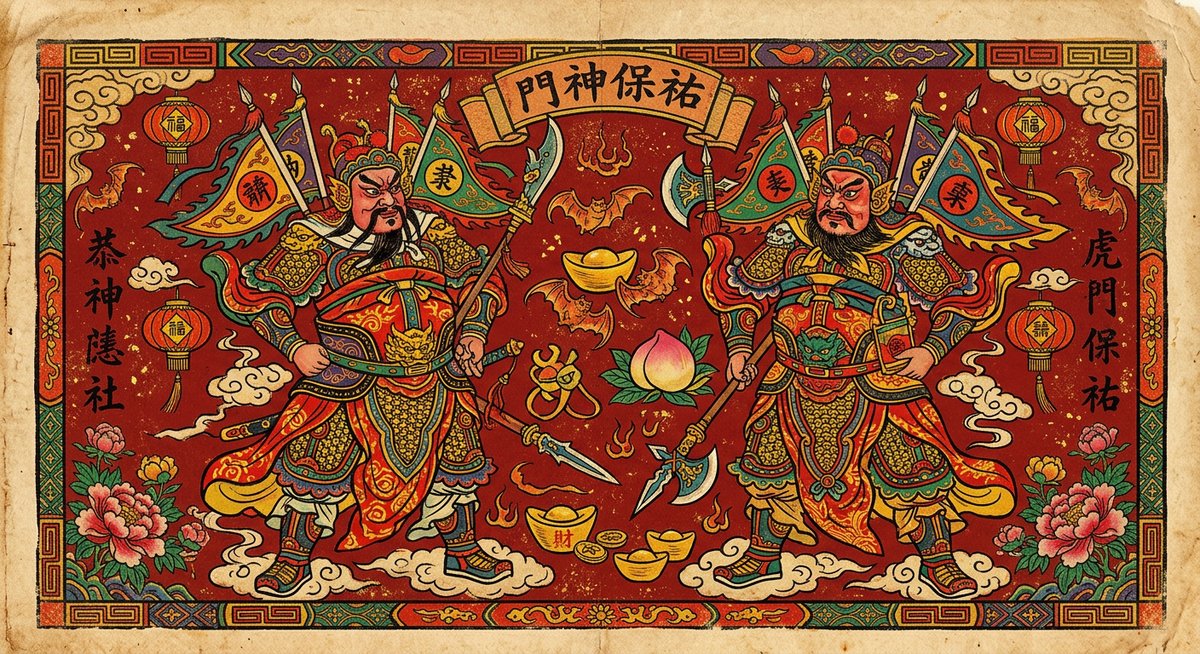
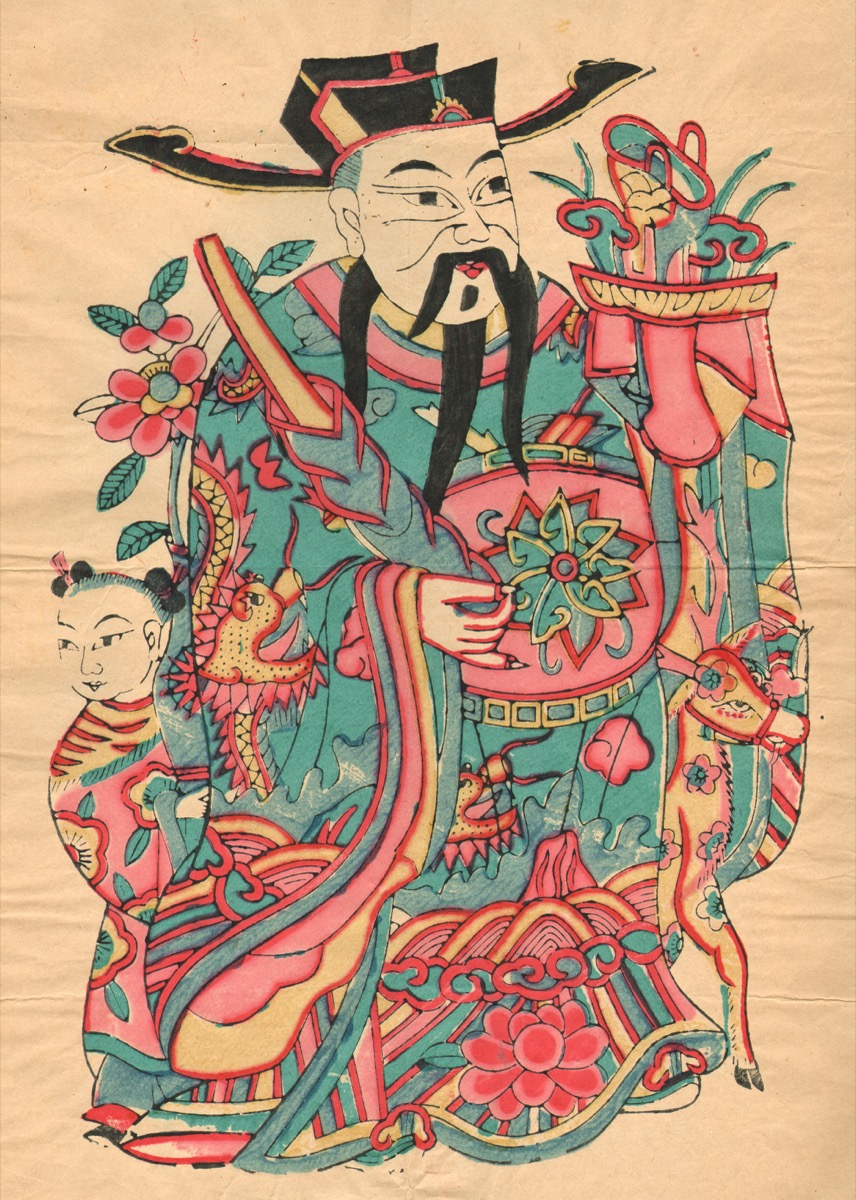
Every Lunar New Year, millions of Chinese families still press bright paper images onto their doors and walls. A pair of armored guardians, a chubby child clutching a carp, a cluster of peonies and bats — these are not mere decorations. They are nianhua (年画), woodblock New Year pictures that turn a home into a spoken wish for safety, plenty, and joy [source:1].
Known in English as Chinese woodblock New Year prints, nianhua are one of China's oldest popular art forms: every picture is a story, every color a symbol, and every regional style a local accent. For the broader story of how these prints evolved, see our article on the history of Chinese New Year pictures.
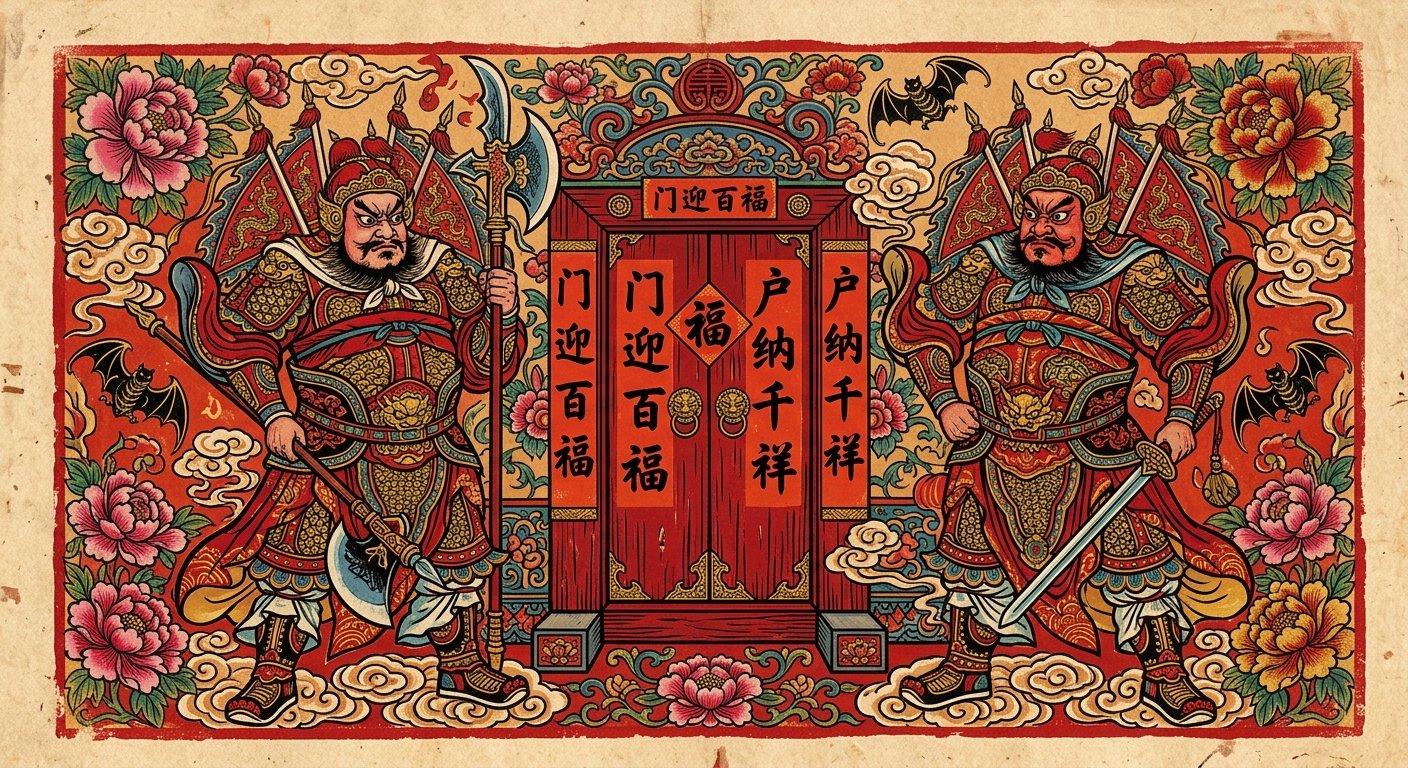
A classic woodblock print of door gods, the guardians most often seen on Chinese New Year pictures.
From peachwood talismans to paper
The roots of nianhua reach back to the Han dynasty, when people believed that evil spirits moved at night and the door was the weakest point of any house. Families carved or painted images of Shen Shu and Yu Lei, the divine gatekeepers of the giant peach tree on Mount Dushuo, onto peachwood boards and hung them on either side of the entrance [source:2][source:3]. These talismans were the ancestors of the New Year picture.
By the Tang dynasty, woodblock printing had matured, and by the Song dynasty paper had replaced peachwood for most uses. The guardians moved from carved boards to printed sheets. Song-dynasty records describe busy "picture markets" (hua shi) selling printed door gods, Kitchen Gods, Gods of Wealth, and auspicious images for the new year [source:2]. The Ming dynasty brought color woodblock printing and popular novels, which gave nianhua richer subjects and a national audience [source:7]. What began as a protective charm became a festive art that ordinary families could afford.
How woodblock New Year pictures are made
Traditional production follows a classic woodblock sequence that has changed remarkably little over the centuries [source:2][source:4]:
- Design and drawing. An artist draws the image on thin paper.
- Block carving. A carver pastes the drawing face-down onto a hardwood block and cuts away the negative spaces, leaving raised lines that will hold ink.
- Outline printing. The block is inked — usually in black or dark brown — and pressed onto paper to create the drawing's skeleton.
- Color application. Some schools add each color with a separate carved block; others paint color by hand after the outline is printed.
- Finishing. The print is dried, sometimes backed with paper, and trimmed for sale.
A complex print may use five or six blocks, one for each color. Register — the exact alignment of each block — is critical: shift the red block by a hair, and a warrior's cheeks or robe will blur. Master printers develop a feel for humidity, paper stretch, and ink viscosity that machines cannot copy [source:2].
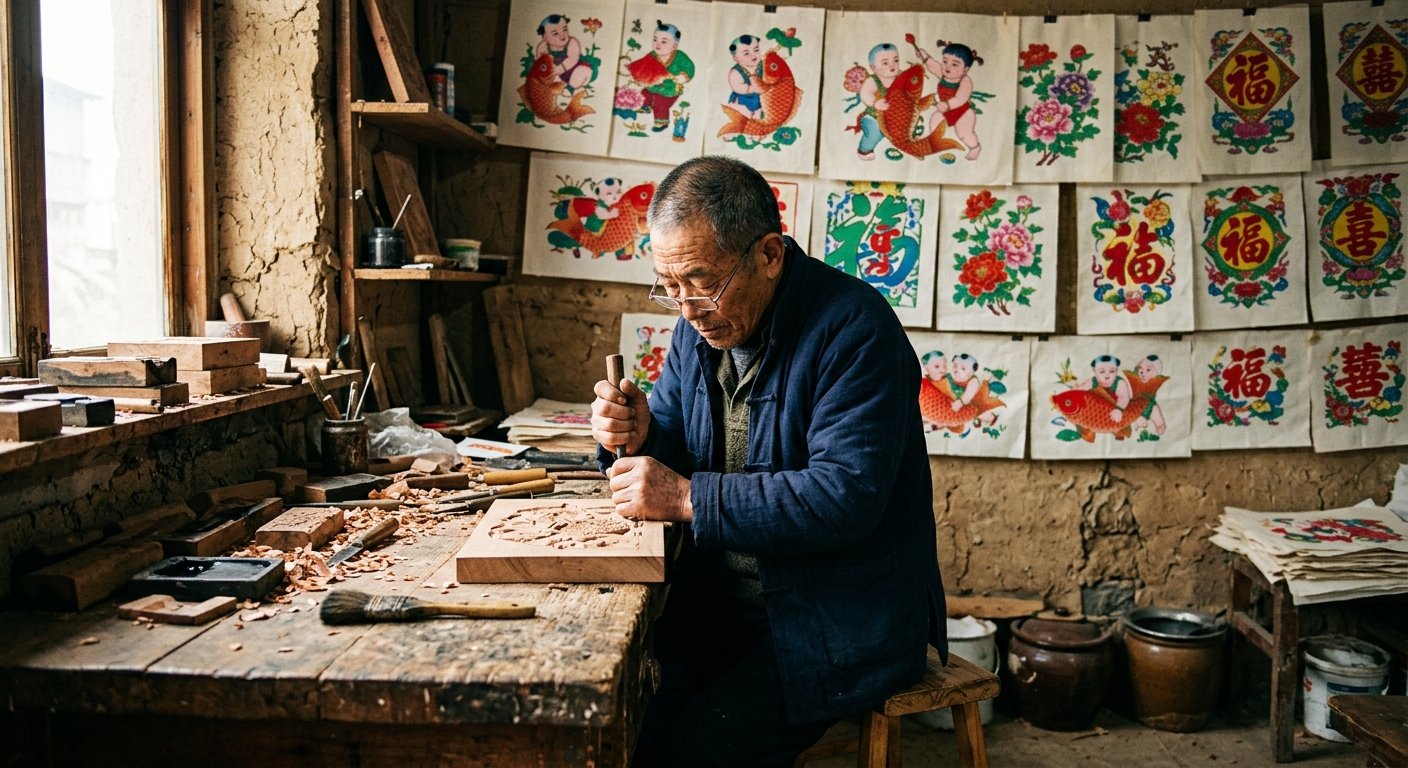
A folk artist carves the outline block for a woodblock New Year picture; every raised line will later carry ink to paper.
Door gods and guardian figures
No nianhua subject is more famous than the door god. The earliest guardians were Shen Shu and Yu Lei, but the pair most people recognize today are the Tang-dynasty generals Qin Shubao and Yuchi Gong [source:3][source:4]. Legend says the Tang emperor Taizong was troubled by nightmares; he ordered the two generals to stand guard outside his bedchamber, and slept peacefully. When the emperor had their portraits painted and posted on the doors, the custom spread across the empire.
Over time, door gods multiplied. Some were martial, others scholarly; some carried swords, others scrolls of good fortune. Their role expanded from frightening demons to welcoming blessings, and they became the centerpiece of Spring Festival decoration [source:3]. For a deeper look at this subject, read our article on door gods and New Year prints.
A language of symbols
Nianhua speak in visual puns. A single picture can layer several blessings at once, making it a kind of folk rebus [source:1][source:2].
- Bats (fu 蝠) sound like blessing (fu 福), so bats mean good fortune.
- Fish (yu 鱼) sound like surplus (yu 余); "every year has fish" (nian nian you yu) means "every year has surplus."
- Peonies stand for wealth and high rank.
- Lotus (lian) puns on "continuous" (lianlian), so a child holding a lotus wishes for an unbroken family line.
- Pomegranates, bursting with seeds, wish for many children.
- The God of Wealth invites prosperity and is often shown riding a black tiger or surrounded by gold ingots.
A favorite composition might show a chubby baby riding a carp toward a peony beneath a bat — four blessings in one image [source:1].
The four great schools
Over centuries, regional styles developed into recognizable schools. Four became especially celebrated [source:1][source:2][source:4][source:6]:
Yangliuqing (杨柳青), Tianjin. Known for delicate line carving and hand-painted color washes. Yangliuqing prints often show pretty children, elegant ladies, and theatrical scenes. Because the town lay near Beijing, its workshops absorbed courtly taste; the prints are sometimes called "half print, half paint" [source:2][source:4].
Yangjiabu (杨家埠), Shandong. The Weifang-area school is bolder and more rustic. Colors are flat and saturated — bright red, green, purple, and yellow. Subjects favor door gods, harvest scenes, and auspicious animals, reflecting the robust folk culture of the north China plain [source:2][source:6].
Taohuawu (桃花坞), Suzhou. A southern school with softer lines and more literary themes. Taohuawu prints influenced Japanese ukiyo-e and were among the first Chinese folk prints to travel abroad [source:2]. Subjects include city life, landscape, and refined seasonal blessings.
Mianzhu (绵竹), Sichuan. Named for the bamboo-paper town in Sichuan, this school uses a distinctive "drawing and coloring" process. Artists print only the ink outlines, then paint every print by hand with mineral pigments. Mianzhu nianhua are therefore closer to folk painting than to mechanical printing, and no two are exactly alike [source:2].
Each school was shaped by local paper, local pigments, local stories, and local taste. Together they made nianhua a genuinely national art with strong regional accents.
Other regional voices
The four famous schools are only the best known. China has named eighteen nianhua traditions as national intangible cultural heritage, including Zhuxianzhen in Henan, Wuqiang in Hebei, Fengxiang in Shaanxi, Foshan in Guangdong, Tantou in Hunan, and Pingyang in Shanxi [source:5][source:6]. Each carries a local identity, which is why nianhua remain such a rich field for study and collecting [source:5][source:6].
Woodblock New Year pictures today
The twentieth century was hard on traditional workshops. Wars, political campaigns, and commercial printing disrupted production, and many old blocks were lost [source:2]. But the craft survived where communities valued it, and today many regional nianhua traditions are protected as national intangible cultural heritage [source:5].
Younger artists are also reimagining the form. In Foshan, a "worry-free New Year picture shop" now pairs traditional printing with modern wishes: a "second-child god" print for growing families, an "exam-pass" print for students, an emoji set for messaging apps [source:5]. Workshops train new carvers, museums mount exhibitions, and designers adapt nianhua imagery for calendars, red envelopes, and phone wallpapers [source:1]. The paper may change; the wish does not.
Frequently asked questions
What are Chinese woodblock New Year prints called?
They are called nianhua (年画), literally "year pictures." They are colorful woodblock prints or paintings posted during Spring Festival to bring good fortune, protect the household, and celebrate the new year [source:3].
When did Chinese woodblock New Year pictures begin?
Their roots reach back to Han-dynasty door guardians painted on peachwood boards. By the Song dynasty, woodblock printing and paper had turned these guardians into the printed nianhua we recognize today [source:2][source:3].
What are the four famous schools of nianhua?
Tianjin Yangliuqing, Shandong Yangjiabu (Weifang), Jiangsu Taohuawu, and Sichuan Mianzhu. Each has its own palette, carving style, and regional themes [source:1][source:2].
Why are door gods so common in New Year pictures?
Door gods originated as spiritual protectors placed at the entrance to ward off evil spirits. Over time they became the most iconic nianhua subject, often showing legendary generals or auspicious figures [source:3][source:4].
Are woodblock New Year pictures still made today?
Yes. Many regional nianhua crafts are listed as national intangible cultural heritage, and workshops continue both traditional production and modern creative adaptations [source:5].
Sources and Further Reading
- [source:1] "年的记忆 画的传承" — https://www.ihchina.cn/details/29677.html
- [source:2] "新春话年画" — https://www.ihchina.cn/news_1_details/10351.html
- [source:3] "细说春节传统习俗" — https://www.ihchina.cn/project_details/10144.html
- [source:4] "杨柳丹青:婀娜多姿杨柳青年画" — https://www.ihchina.cn/art/detail/id/11254.html
- [source:5] "年轻人春节玩起了新年画" — https://www.ihchina.cn/project_details/18287.html
- [source:6] "传统美术类非物质文化遗产项目生产标准探微" — https://www.ihchina.cn/art/detail/id/22758.html
- [source:7] "New Year picture" — https://en.wikipedia.org/wiki/Nianhua
Author
This article was prepared by the team at ChineseFolkCrafts.com. We are not intangible-cultural-heritage inheritors or museum researchers. Our job is to find authoritative Chinese sources, understand them, and explain them clearly for international readers.
If you spot an error — a date, a translation, a misattributed custom — please let us know and we will correct it. Last updated 2026-07-28.