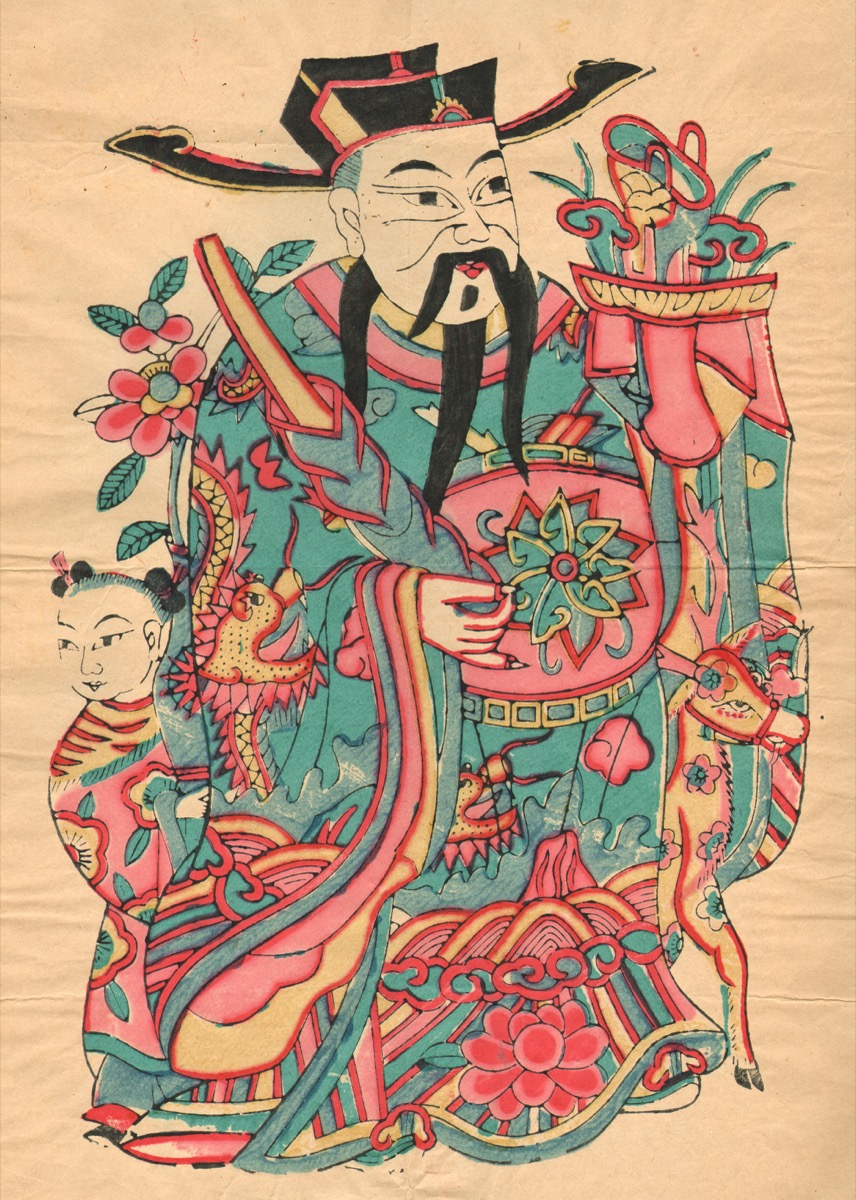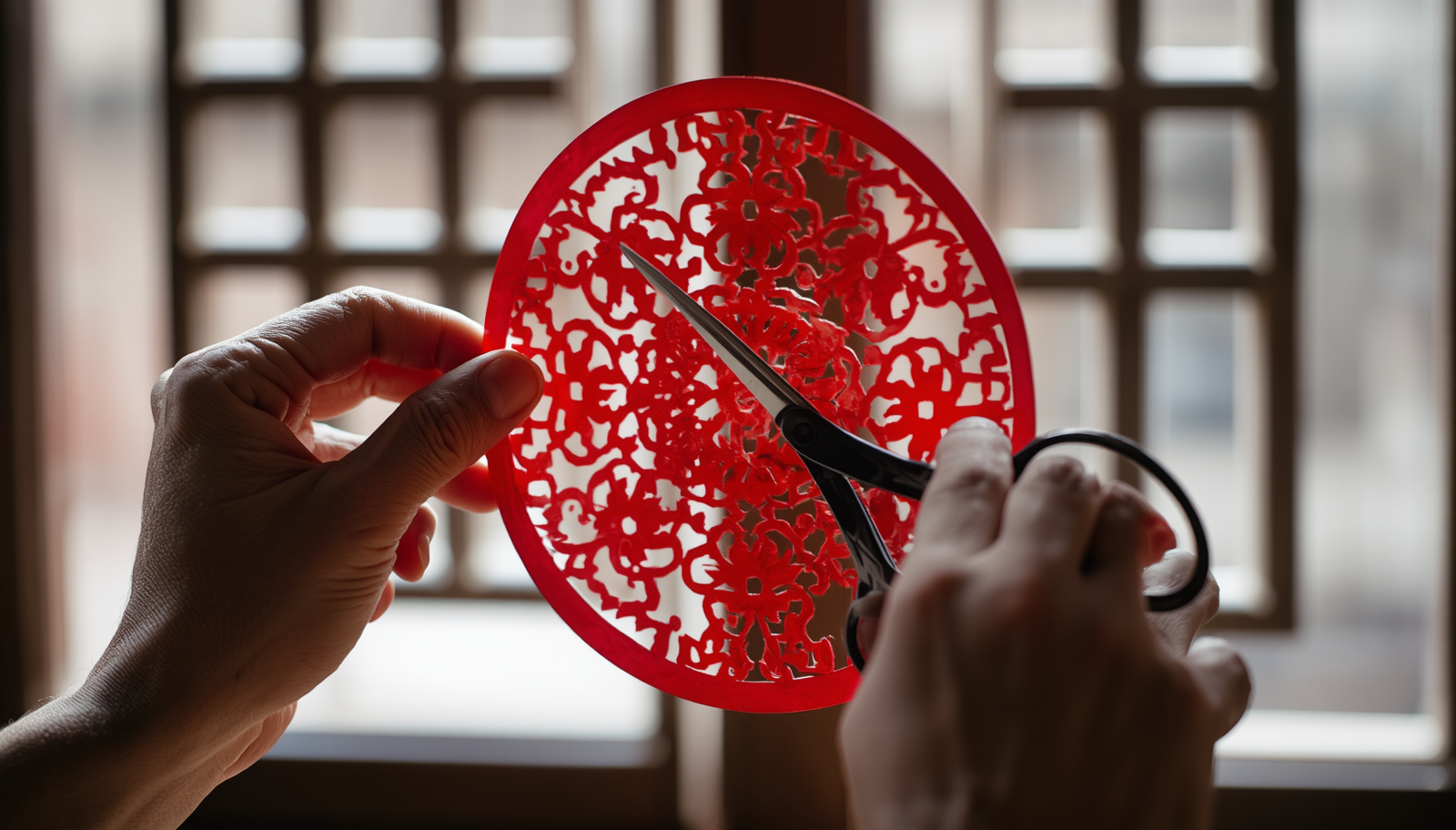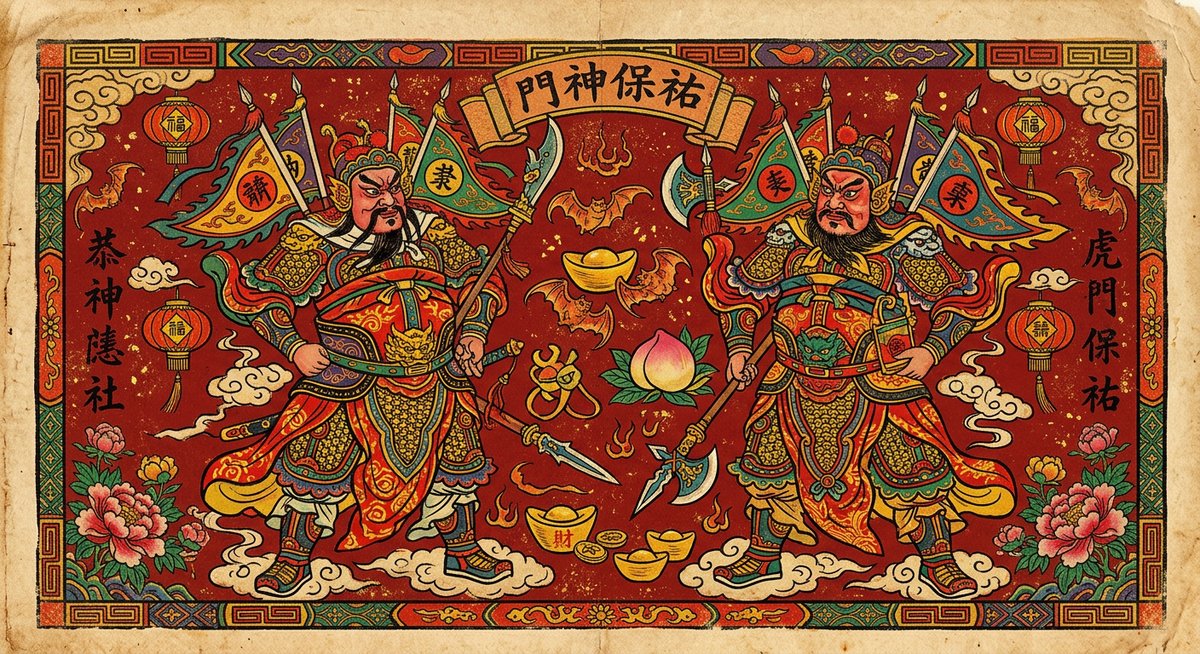
Every Spring Festival, millions of Chinese households still paste bright pictures beside their doors. Red-armored warriors, plump babies, golden fish, and blooming peonies look out from doorways and walls. These are nianhua (年画) — New Year pictures — and they are one of China's oldest forms of printed folk art.
Nianhua are more than decoration. They are a wish made visible: may the household be safe, prosperous, fertile, and happy in the coming year. Understanding their history means understanding how ordinary Chinese families have used images to speak blessings for more than a thousand years.
From door gods to paper
The story of nianhua begins with fear. In Han dynasty belief, evil spirits traveled at night, and the door was the most vulnerable point of any house. People carved or painted images of guardian figures on peachwood boards and hung them on either side of the entrance. The most famous pair was Shen Shu and Yu Lei, divine gatekeepers who bound evil spirits and fed them to tigers.
These peachwood talismans were the ancestors of nianhua. By the Tang and Song dynasties, paper had replaced wood for many uses, and woodblock printing had matured. The guardians moved from peach boards to paper prints. The Song dynasty saw the rise of specialized "picture markets" (hua shi) that sold printed images for the new year — the first true nianhua industry.
As printing spread, so did the subjects. Door gods remained central, but they were joined by images of the God of Wealth, the Queen Mother of the West, the Eight Immortals, plump children holding lotuses, and symbols of long life and abundance. A single print could carry a dozen layered puns: a bat (fu) for blessing, a fish (yu) for surplus, a peony for wealth and honor, a pomegranate for many children.
The four famous schools
Over centuries, regional styles developed. Four schools became especially celebrated:
Yangliuqing (杨柳青), Tianjin. Known for delicate line carving and hand-painted color washes. Yangliuqing prints often show pretty children, elegant ladies, and theatrical scenes. The town's location near Beijing gave it courtly influence; its nianhua are sometimes called "half print, half paint" because artisans carved the outlines in woodblock and then added color by hand.
Yangjiabu (杨家埠), Shandong. The Weifang-area school is bolder and more rustic. Colors are flat and saturated — bright red, green, purple, and yellow. Subjects favor door gods, harvest scenes, and auspicious animals. The style reflects the robust folk culture of the north China plain.
Taohuawu (桃花坞), Suzhou. A southern school with softer lines and more literary themes. Taohuawu prints influenced Japanese ukiyo-e and were among the first Chinese folk prints to travel abroad. Subjects include city life, landscape, and refined seasonal blessings.
Mianzhu (绵竹), Sichuan. Named for the bamboo-paper town in Sichuan, this school uses a distinctive "drawing and coloring" process rather than pure woodblock. Artists print only the ink outlines, then paint every print by hand with mineral pigments. Mianzhu nianhua are therefore closer to folk painting than to mechanical printing, and no two are exactly alike.
Each school was shaped by local paper, local pigments, local stories, and local taste. Together they made nianhua a genuinely national art with strong regional accents.
How they are made
Traditional nianhua production follows a classic woodblock sequence:
- Design and drawing. An artist draws the image on thin paper.
- Block carving. A carver pastes the drawing face-down onto a hardwood block and carves away the negative spaces, leaving raised lines that will hold ink.
- Printing. The block is inked and pressed onto paper, usually in black or dark brown, to create the outline.
- Color application. In some schools, each color requires its own block; in others, color is added by hand.
- Finishing. The print is dried, sometimes backed with paper, and trimmed for sale.
A complex print might use five or six separate blocks, one for each color. Alignment — register — is critical: if the red block shifts even slightly, the figure's cheeks or robe will blur. Master printers develop a feel for humidity, paper stretch, and ink viscosity that no machine can copy.
Symbols and meanings
Nianhua speak in symbols. Some of the most common:
- Door gods protect the home. Classic pairs include Qin Shubao and Yuchi Gong, Tang dynasty generals who became guardian figures.
- The God of Wealth invites prosperity. He often appears riding a black tiger or surrounded by gold ingots.
- Children and lotus wish for sons and family continuation. A baby holding a lotus (lian) puns on "continuous" (lianlian).
- Fish mean surplus. "Every year has fish" (nian nian you yu) sounds like "every year has surplus."
- Peonies stand for wealth and high rank.
- Bats mean blessing, because fu (蝠, bat) sounds like fu (福, blessing).
These symbols layer together into dense visual prayers. A single nianhua might show a child riding a fish toward a peony beneath a bat — four blessings in one image.
New Year pictures today
The twentieth century was hard on nianhua. Wars, political campaigns, and the rise of commercial printing disrupted traditional workshops. Many old blocks were burned or lost. Yet the craft survived in places where families kept carving and where communities still wanted Spring Festival pictures.
Today, many regional nianhua traditions are protected as national intangible cultural heritage. Workshops train young carvers, museums collect old prints, and contemporary artists reinterpret nianhua imagery for modern audiences. You can still buy hand-printed door gods in Yangliuqing and Mianzhu, and every year new designs appear on calendars, red envelopes, and phone wallpapers.
The medium changes; the wish stays the same. When a family pastes a nianhua on its door, it is still asking the old questions: keep us safe, give us plenty, let the new year be bright.
Frequently asked questions
What are Chinese New Year pictures called?
They are called nianhua (年画), literally "year pictures." They are colorful woodblock prints or paintings posted in homes during Spring Festival to bring good fortune, protect the household, and celebrate the new year.
When did Chinese New Year pictures begin?
Their roots reach back to Han dynasty door guardians painted on peachwood boards. By the Song dynasty, woodblock printing and paper had turned these guardians into the printed nianhua we recognize today.
What are the four famous schools of nianhua?
Tianjin Yangliuqing, Shandong Yangjiabu (Weifang), Jiangsu Taohuawu, and Sichuan Mianzhu. Each has its own palette, carving style, and regional themes.
Why are door gods so common in nianhua?
Door gods originated as spiritual protectors placed at the entrance to ward off evil spirits. Over time, they became the most iconic nianhua subject, often showing legendary generals or auspicious figures.
Are New Year pictures still made today?
Yes. Many regional nianhua crafts are listed as national intangible cultural heritage, and workshops continue both traditional production and modern creative adaptations.
Author
This article was prepared by the team at ChineseFolkCrafts.com. We are not intangible-cultural-heritage inheritors or museum researchers. Our job is to find authoritative Chinese sources, understand them, and explain them clearly for international readers.
If you spot an error — a date, a translation, a misattributed custom — please let us know and we will correct it. Last updated 2026-07-25.