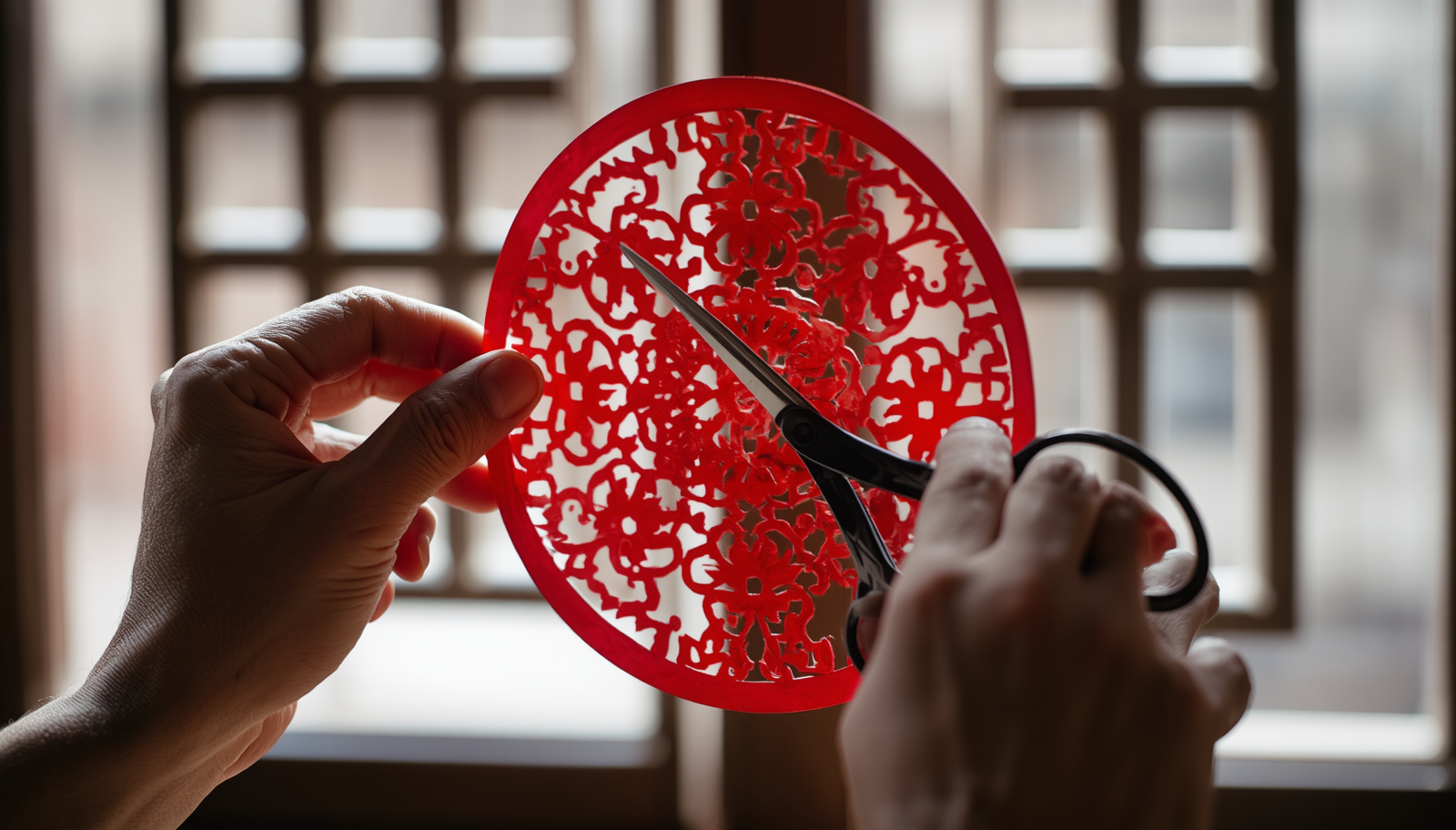
On the twenty-third day of the twelfth lunar month, just after the Kitchen God returns to heaven to report on the household, families across northern China begin their Spring Festival preparations in earnest. Houses are swept, windows are papered, and New Year's goods are laid in. But of all these rituals, none is more charged with meaning than the moment when the old door gods are peeled from the gate and a fresh red pair pressed into place.
To the Chinese, this is not mere decoration. It is the renewal of an invisible shield: evil shall not enter; fortune shall stay within. This is the face of nianhua — the Chinese New Year picture — an art that has packed the nation's beliefs, wishes, aesthetics, and stories into a single sheet of paper.
The first blessing at the door
The Chinese have always treated the door as more than an entrance. It is the boundary between home and the world, the threshold through which both blessings and harm must pass. So the earliest "New Year pictures" were not pictures at all. They were peachwood carvings of two guardian spirits, Shenshu and Yulü.
According to the Han dynasty text Duduan by Cai Yong, at year's end people would "paint Shenshu and Yulü and hang reed ropes on the door to ward off evil." These legendary brothers were said to catch demons and feed them to tigers. Over time, their carved images gave way to paper prints, and the guardians multiplied into historical generals, Daoist immortals, and auspicious figures. Through every transformation, one purpose remained: guard this door, protect this family.
From Shenshu and Yulü to Qin Qiong and Yuchi Gong
After Shenshu and Yulü, the roster of door gods grew. Han dynasty images showed fierce warriors; during the Sui and Tang dynasties, Buddhist and Daoist figures — yakshas, heavenly kings, and Zhong Kui — joined them. But the most famous door gods of all came from a Tang dynasty court legend.
The story says that Emperor Taizong of Tang, haunted by the ghosts of those he had killed in battle, could not sleep at night. His generals Qin Qiong (Qin Shubao) and Yuchi Gong (Yuchi Jingde) volunteered to stand armed outside his bedchamber. The emperor slept peacefully. Grateful for their loyalty, Taizong ordered artists to paint their portraits and hang them on the palace gates. The practice soon spread to common households, and Qin Qiong and Yuchi Gong replaced the mythic Shenshu and Yulü as the most widely pasted door gods in China.
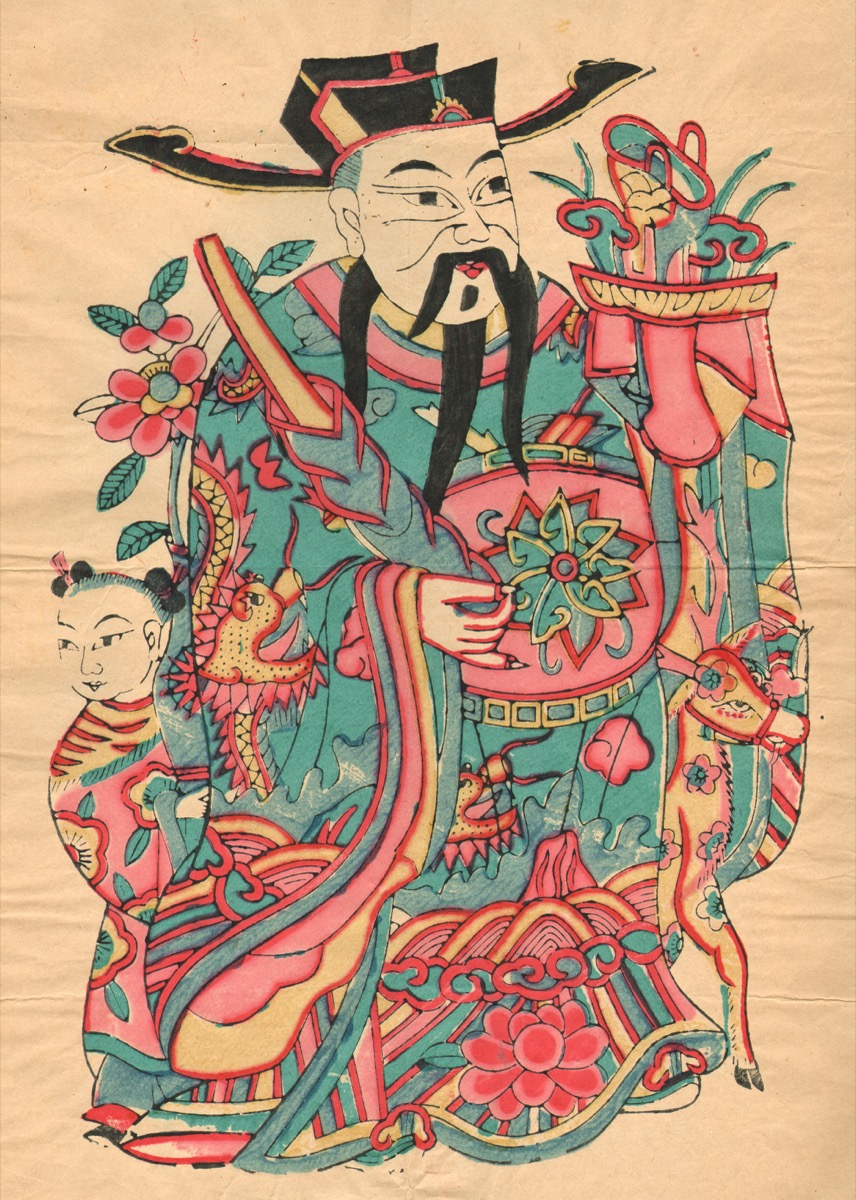
There are also civil door gods, who wear official hats and hold auspicious objects; the Kitchen God, who oversees the household's moral ledger; and the God of Wealth, who promises prosperity. Different families chose different guardians. Merchants preferred the God of Wealth; scholars favored civil officials bearing blessings; ordinary households almost always chose Qin Qiong and Yuchi Gong — their fierce faces offering a security you could see and touch.
A folk history printed on paper
Door gods were only the beginning. With the spread of woodblock printing and the growth of urban commerce during the Song dynasty, New Year pictures became a popular folk industry. In the twelfth-month markets of Kaifeng, the Northern Song capital, vendors sold "printed door gods, Zhong Kui, peach boards, peach talismans, and wealth-bringing donkeys."
The Ming dynasty was the true springtime of nianhua. Popular novels flourished, woodblock illustration matured, and secular culture thrived. The range of subjects exploded: the Kitchen God, the God of Wealth, the Queen Who Bestows Children, opera heroes, historical tales, and lucky symbols. By the Qing dynasty, nianhua had entered its golden age, with regional schools developing distinct styles across the empire.
The term "nianhua" itself first appeared in writing in the early nineteenth century, in Li Guangting's Xiangyan Jieyi: "After sweeping the house, one pastes New Year pictures." With that single sentence, a scattered custom received its lasting name.
The four great centers of nianhua
New Year pictures were printed all over China, but a few places became legendary:
- Yangliuqing, near Tianjin: Known for combining woodblock printing with delicate hand-painting. Baby figures, beauties, and opera scenes were its specialties.
- Taohuawu, Suzhou: Influenced by refined Jiangnan aesthetics, with soft colors and elegant city scenes.
- Yangjiabu, Weifang, Shandong: Bold, bright, and earthy — a true northern folk style.
- Mianzhu, Sichuan: Famous for hand-painted color and festive, dramatic subjects.
- Fengxiang, Shaanxi: Ancient and rugged, with exaggerated forms and strong color contrasts.
- Tantou, Hunan: Used locally made powdered white paper and mineral-rich spring water, producing colors of unusual depth and warmth.
The look of a print could tell you where it came from. The same wish — prosperity, sons, long life — was painted in different accents from province to province.
Auspicious symbols and hidden meanings
Nianhua is a visual encyclopedia of Chinese folk symbolism. To read a picture, you must learn its code:
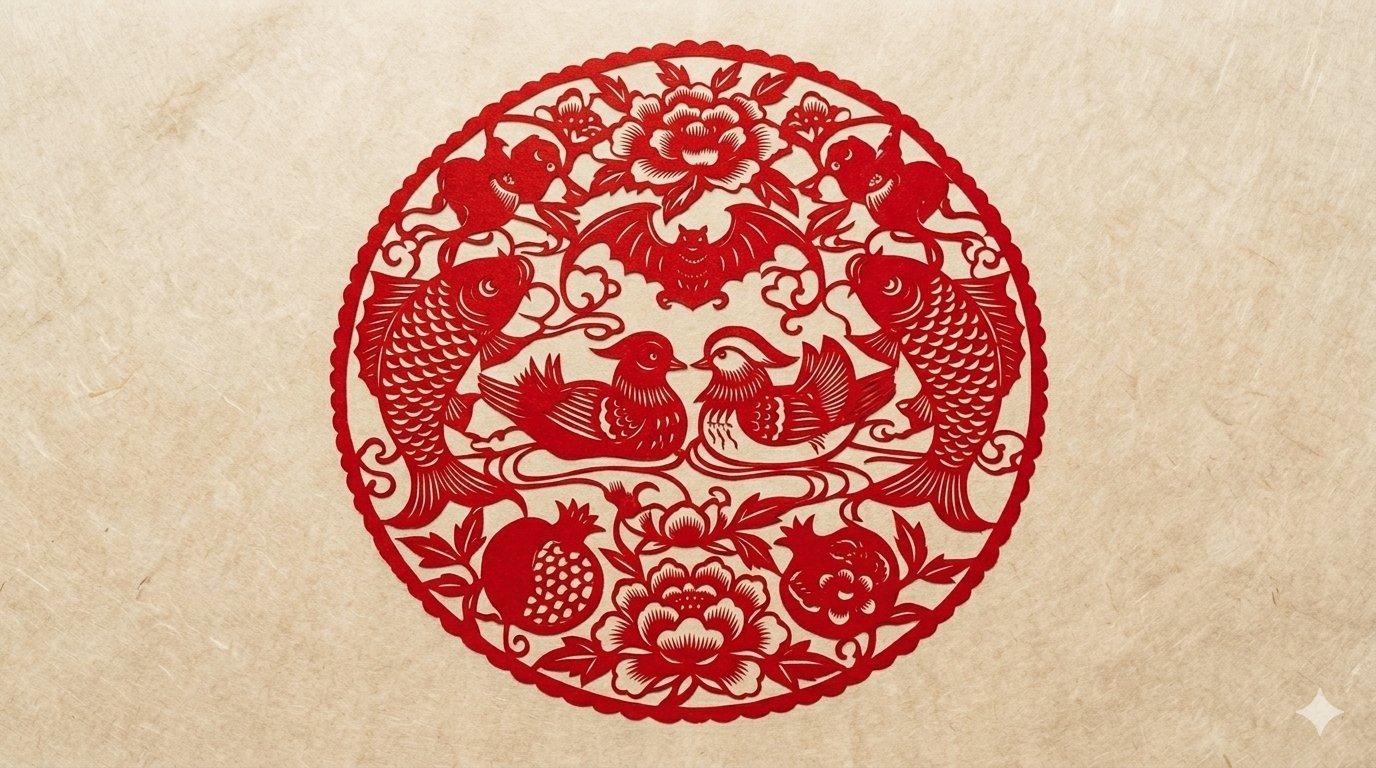
- Bat (fu 蝠): homophone for "blessing" (fu 福).
- Fish (yu 鱼): homophone for "surplus" (yu 余), wishing abundance year after year.
- Pomegranate: many seeds, meaning many children.
- Peony: the king of flowers, symbolizing wealth and honor.
- Baby holding a carp: fertility and abundance combined.
- Zhong Kui: the demon queller, protector of the home.
- Heavenly Official Bestowing Blessings (tian guan ci fu): wishes for rank, fortune, and divine favor.
These images were not chosen randomly. They were puns, rebuses, and prayers compressed into shape — a language anyone in the village could read.
The ritual of pasting: out with the old, in with the new
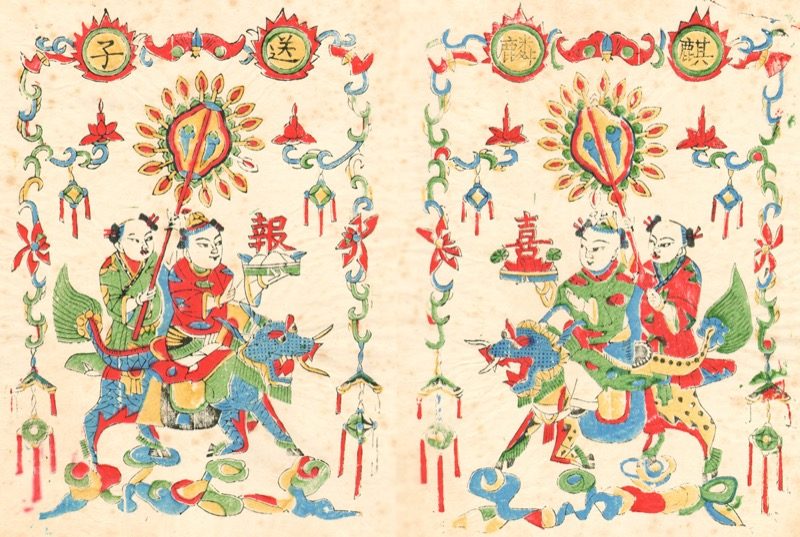
In traditional society, pasting New Year pictures was a serious annual rite. After the twenty-fourth-day house cleaning, old prints were removed and new ones applied: door gods on the gate, the Kitchen God in the kitchen, the God of Wealth in the main hall, and prints of grain abundance in the storehouse.
There were rules. A pair of door gods must face each other, weapons turned outward, ready to confront whatever approached. To paste them facing away from each other was called "shutting the door gods outside" — a mistake that could invite ridicule for a whole year.
In that simple act of tearing down and putting up, the household enacted the Chinese sense of time: bid farewell to the old, welcome the new.
Nianhua today: revival, innovation, and digital life
The twentieth century was hard on nianhua. Mechanized printing, urbanization, and changing customs pushed hand-made prints to the margins. During the Cultural Revolution, countless ancient woodblocks were burned, and many techniques were lost.
But nianhua did not die. In 2006, several major woodblock nianhua traditions were added to China's national intangible cultural heritage list. In 2019, the Ministry of Culture launched the "New Year Pictures Return to Spring Festival" campaign, encouraging contemporary designers and inheritors to bring nianhua back into daily life. Today the old images reappear on silk scarves, gift boxes, furniture, digital collectibles, video-game skins, and design-school projects. The ancient patterns have become a living design resource.
The goal, as scholars put it, is not to lock nianhua in museums but to let it once again hang on doors, sit on desks, and walk into people's lives.
How to read a New Year picture
When you look at a traditional nianhua, read it on three levels:
- The subject. Is it a door god, a deity, a baby, an opera scene, or a lucky symbol? The subject tells you what blessing is being asked.
- The origin. Northern prints tend to be bold and rustic; southern prints are delicate and refined. Style is geography.
- The symbols. Bats, fish, peonies, pomegranates, and qilin each carry a specific wish.
Once you can read these layers, a New Year picture is no longer just a bright decoration. It is a folk epic held in the hand, the most direct and joyful expression of what Chinese people hoped for: safety, prosperity, sons, longevity, and peace.
Today, when a family pastes a fresh pair of door gods at Spring Festival, they are not only keeping an old custom alive. They are honoring an age-old faith: that a sheet of red paper, pressed against a wooden gate, can still hold the world at bay and keep the blessing within.
Author
This article was prepared by the team at ChineseFolkCrafts.com. We are not intangible-cultural-heritage inheritors or museum researchers. Our job is to find authoritative Chinese sources, understand them, and explain them clearly for international readers.
If you spot an error — a date, a translation, a misattributed custom — please let us know and we will correct it. Last updated 2026-07-15.