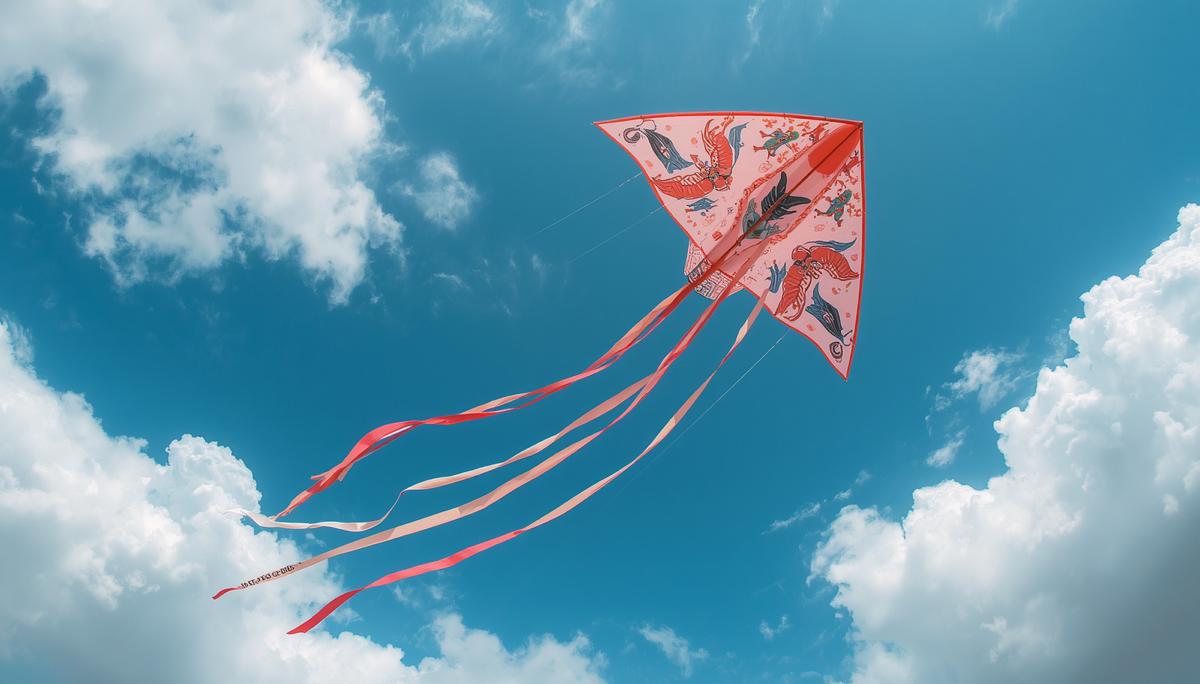
Cao-Style Beijing Kites: The Swallows That Flew Out of the Red Chamber
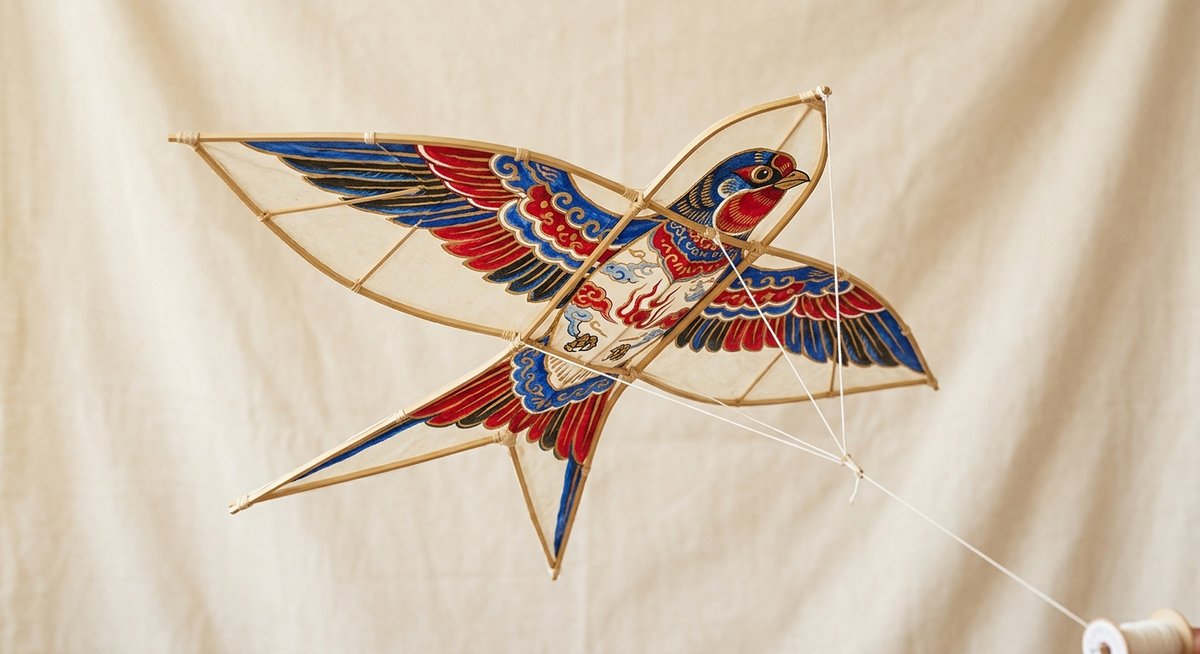
Old Beijing's kite trade had a saying: "In the south city, the great sand-swallow; in the north city, the black-pot-bottom" — referring to the Kite Ha shop at Liulichang and the Kite Jin stall at Di'anmen [source:2]. Today the most celebrated of Beijing's kite schools is the "capital's finest," the Cao-style kite: said to descend from a kite manual left by Dream of the Red Chamber author Cao Xueqin, it masters the four arts of framing, covering, painting, and flying, and its signature sand-swallow is built to exacting ratios — head to body at one to three, wingtips raised three degrees — so that in the air it can roll and circle like a living bird [source:5].
In 2006, Cao-style kite making entered Beijing's first municipal list of intangible cultural heritage; in 2011 it was added to the national list, third batch [source:1][source:4].
A kite manual from the world of the Red Chamber
The school's origin is the Nan Yao Bei Yuan Kao Gong Zhi — "A Study of Southern Yao and Northern Yuan" — the second volume of the Fei Yi Zhai Ji Gao (Drafts of a Studio for Neglected Arts). The manuscript is traditionally attributed to Cao Xueqin in his later years: the story goes that he compiled kite patterns and techniques to teach poor and disabled friends a livelihood, recording 43 framing and covering methods and condensing the whole craft into the four arts of framing, covering, painting, and flying [source:1][source:5]. The workshop passes down an even older legend — that Cao Xueqin's grandfather Cao Yin, who ran the imperial textile works at Jiangning, brought court-painting refinement into folk kite making [source:5].
A note of honesty: the authorship of the Fei Yi Zhai Ji Gao is still debated by scholars, and we present it as a lineage story rather than settled fact. Whoever wrote it, the manual's patterns, mnemonic rhymes, and its warmth — kites made to feed people — genuinely nourished a century of Beijing kite craft.
1943: the student who copied the book
Cao-style kites became a school in 1943. That year, a young student named Kong Xiangze — through the introduction of his Japanese art teacher Takami Kashichi — borrowed the Fei Yi Zhai Ji Gao and reverently hand-copied its kite volume. For the next sixty years he used that copy as his blueprint, combining it with the palace-kite pattern book of master Jin Fuzhong, organizing, studying, and recreating the designs, and giving the school the name "Cao" [source:4][source:5].
Tragically, Kong's handwritten copy was destroyed during the Cultural Revolution. Working from memory, he and his son Kong Lingmin reconstructed and recompiled the material into the book Cao Xueqin Kite Art — which later won a Leipzig "Most Beautiful Books" award [source:4].
The sha-yan family: every swallow a person
The signature Cao-style form is the sha-yan, the sand-swallow. It is not one bird but a whole family. The "fat yan" is endearingly plump, symbolizing many children and much happiness, its wings painted with a "hundred children" scene. The "thin yan" is light and graceful, its tail feathers dressed in flowers of the four seasons. The "twin yan" shows two swallows wing to wing — a wish for lovers [source:5]. Each posture follows strict standards: head-to-body ratio of one to three, wingtips raised three degrees, reducing drag so the swallow moves like a real bird [source:5].
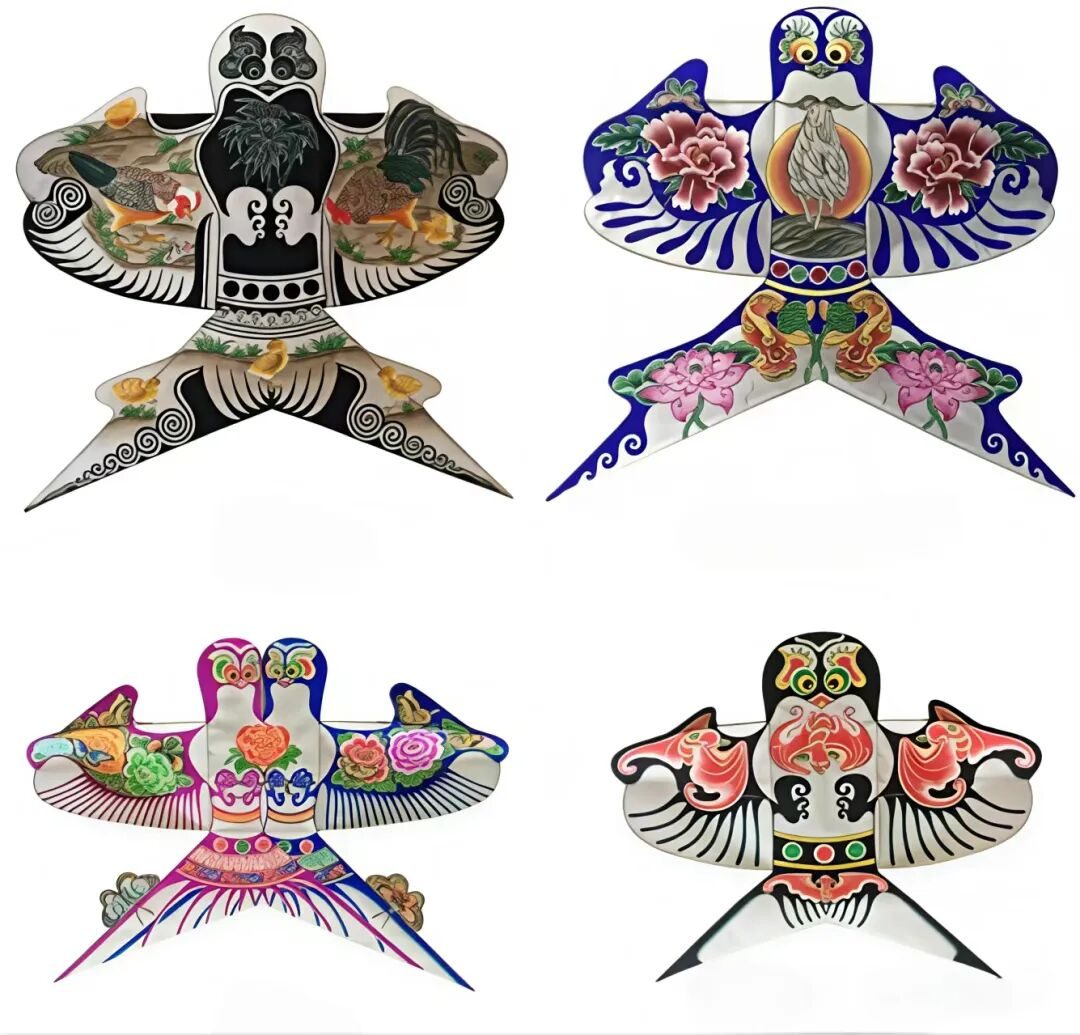
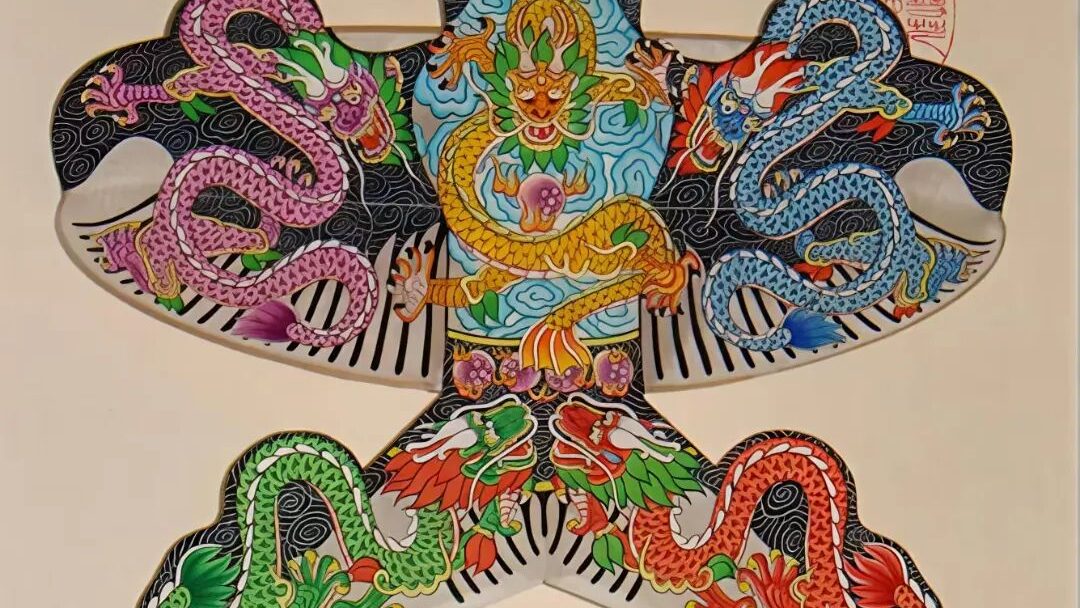
Beyond swallows, Cao-style subjects span historical tales, local legends, folk customs, and lifelike studies — such as the "dragon-eye fish" wishing abundance year after year, its scales glazed layer upon layer in gold so they ripple like sunlight on water [source:1][source:5].
Zha, hu, hui, fang: the Cao-style way
A complete Cao-style kite passes through four great processes and nearly a hundred individual steps [source:5].
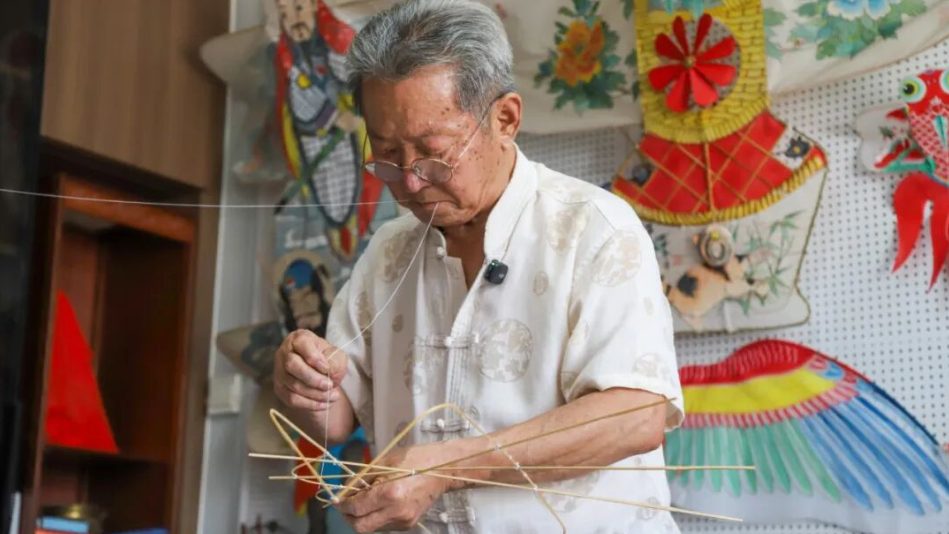
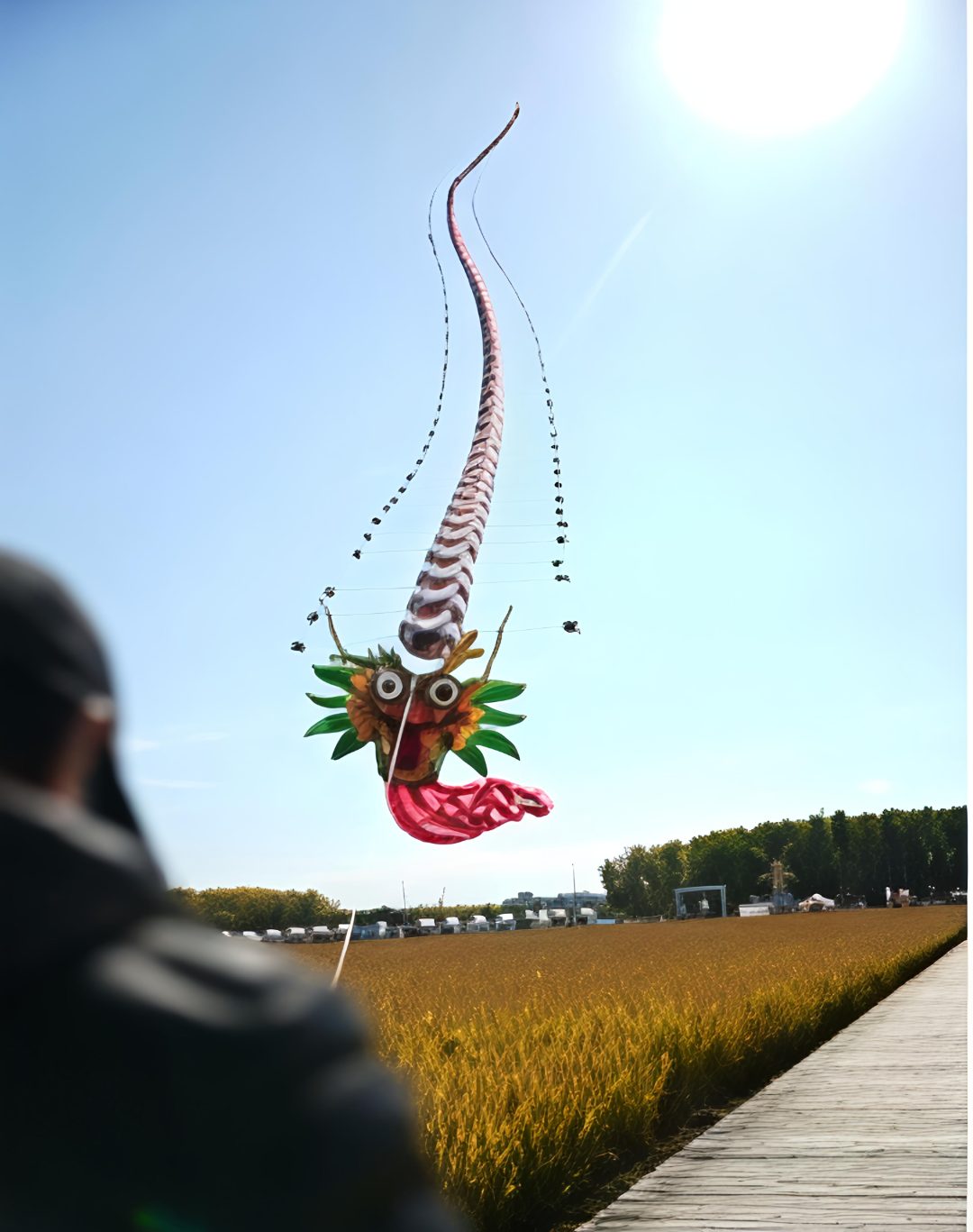
Framing. The skeleton uses no glue at all — only bamboo strips fitted, lashed, and joined with mortise-and-tenon joints. The bamboo must be three-year-old mao bamboo: younger snaps, older turns brittle. Strips are shaved along the fiber to tolerances under a millimeter, sawn into sections, softened over a gentle flame, and bent to the pattern's arcs. The workshop once restored a Qing-style dragon-head centipede kite: aligning the 21 body segments so the creature moved naturally took three months of adjusting bamboo curves alone — and the finished twelve-meter centipede "wagged its head and tail" in a light breeze [source:5].
Covering. The skin must lie "flat without a wrinkle, taut but not tight." Cao-style kites use traditional mulberry-bark paper — tough and breathable, but unforgiving: a brush loaded with diluted peach glue is worked from the center outward, and too light a touch fails to bond while too heavy a hand punctures the sheet. The finer trick is "silk edging": thin silk strips pasted along the paper's rim, adding strength and giving the kite a soft sheen in the sun [source:5].
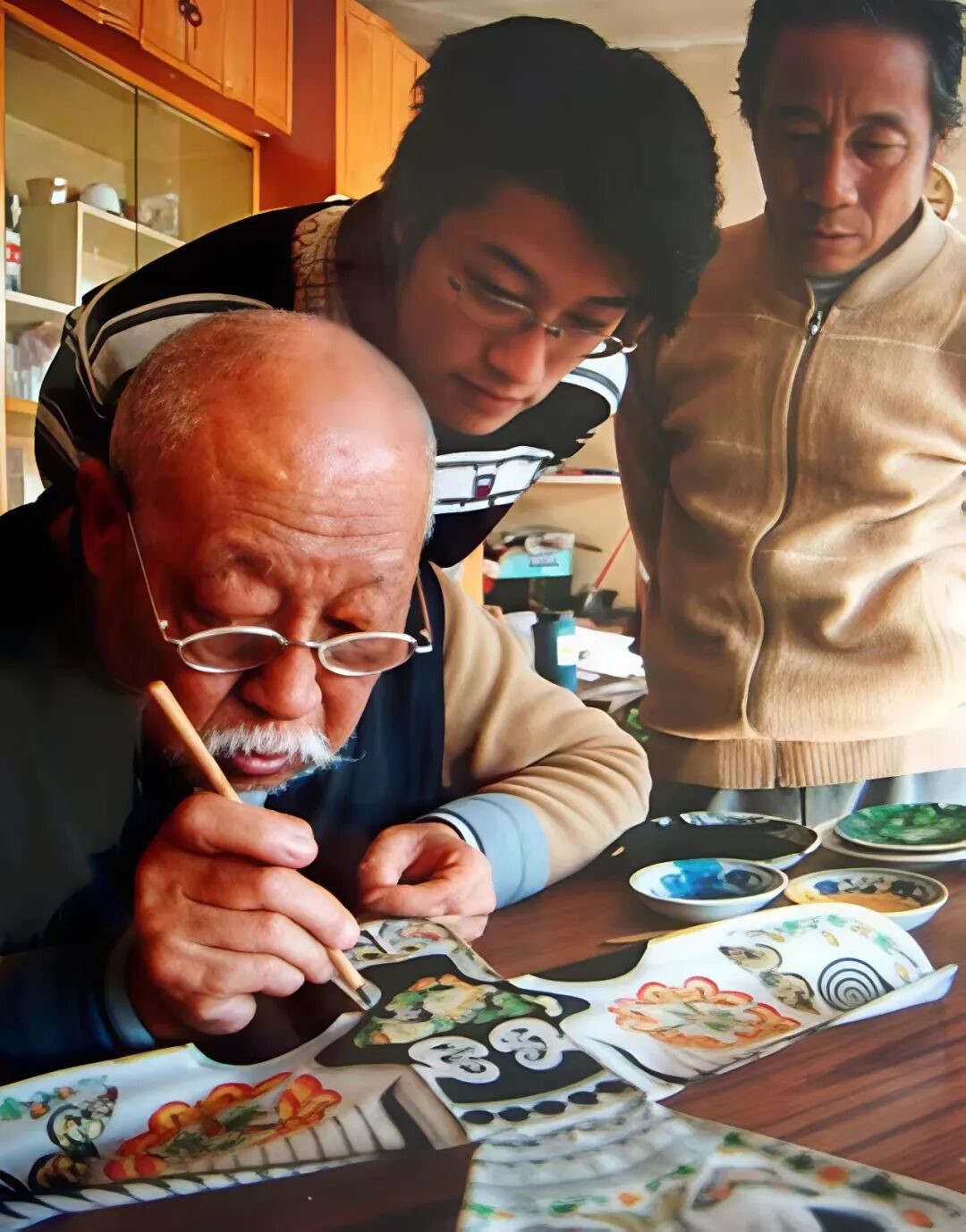
Painting. Painting is the soul of a Cao-style kite, blending fine-line gongbi, freehand xieyi, and paper-cut aesthetics in the five traditional colors. The boldest technique is deliberate "color clash" — vermilion against bright yellow, indigo beside pink — daring on paper, yet balanced so naturally that the kite blazes against the blue sky without losing its elegance [source:5].
Flying. The art of flying is to "borrow the wind, never chase it": in a light breeze, gentle tugs on the line let the kite climb slowly; in strong wind, pay out line to steady it. An experienced maker reads the kite's posture through the tension of the line, and can make a sand-swallow roll and circle like a playful bird [source:5].
Three generations, one workshop
The lineage is clear. After founder Kong Xiangze came his son Kong Lingmin (born 1946, a 76th-generation descendant of Confucius), who shaved bamboo beside his father in the hutong as a child and was recommended as a national-level ICH inheritor in 2017 [source:4]. Today the Cao-style Kite Workshop in Shangzhuang, Haidian district, is led by third-generation inheritor Ma Nianjiao, and the kites have flown to more than twenty countries [source:3].
Life at the workshop is living heritage: elders in reading glasses polishing bamboo strips, young people redrawing swallow patterns on tablets against the old pattern books, children pasting colored paper under their parents' guidance. The inheritors have also developed palm-sized mini kites and kite-themed cultural products, and they keep teaching in schools and communities [source:5].
"However high the kite flies, the line stays in the hand; however far the craft travels, its root stays in the heart." [source:5]
Frequently asked questions
What is the connection between Cao-style kites and Cao Xueqin?
Cao-style kites are based on the Nan Yao Bei Yuan Kao Gong Zhi, a kite manual traditionally attributed to Dream of the Red Chamber author Cao Xueqin, though the manuscript's authorship is still debated by scholars. In 1943 Kong Xiangze copied the manuscript and, combining it with Jin Fuzhong's palace-kite patterns, restored the school and named it "Cao-style" in honor of that lineage.
Are Cao-style kites on China's national heritage list?
Yes. Cao-style kite making entered Beijing's first municipal ICH list in 2006 and the national list (kite making, project VIII-88) in the third batch of 2011, registered by Haidian district, Beijing.
How is a Cao-style kite different from an ordinary kite?
The frame uses no glue — only lashed bamboo and mortise-and-tenon joints. The skin is mulberry-bark paper set with peach glue and edged with silk strips. The painting blends fine-line, freehand, and paper-cut styles with deliberate color clashes. Sand-swallow kites follow strict ratios (head-to-body 1:3, wingtips raised 3 degrees) and can roll and circle in flight.
Where can I experience Cao-style kites in Beijing?
The Cao-style Kite Workshop in Shangzhuang, Haidian district, runs regular hands-on sessions and teaches in schools and communities; Cao Xueqin kite displays can also be found at venues such as Beijing's Grand View Garden.
Sources and further reading
- Kite making (Beijing kite making) — China Intangible Cultural Heritage website
- Cao-style kites fly into ordinary homes: three generations of the Kong family — China Intangible Cultural Heritage website
- Decoding Beijing culture: heritage and renewal (Cao-style Kite Workshop) — The Beijing News
- A direct descendant of Confucius who kept Cao-style kites for 40 years — Beijing Toy Association
- Cao-style Kite Workshop introduction (site archive)