Zhang Xiaodong: The Weifang Kite Master Who Puts Rockets in the Sky
On June 13, 2025, an exhibition opened at the National Library of China in Beijing, marking ten years of the national program that documents China's intangible cultural heritage inheritors. Of the country's thousands of national-level inheritors, exactly one was invited to speak at the opening: Zhang Xiaodong, master of Weifang kite making from Shandong province [source:2].
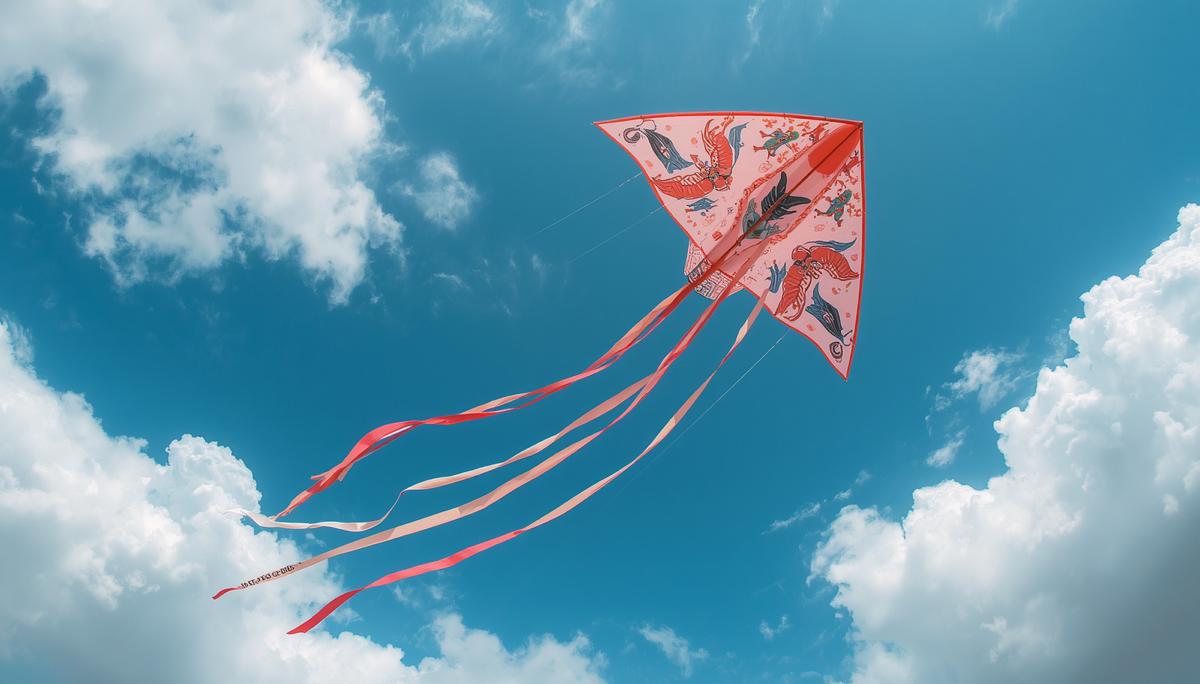
The 76-year-old is better known by his nickname — the "kite whiz," a name China Central Television gave him because his kites are not like other people's. They carry gears, lights, and sound. His Shenzhou-5 rocket kite separates its stages by remote control at 100 meters altitude. The enormous "dark bird" prop in the fantasy film Creation of the Gods was built in his courtyard [source:1][source:2][source:4].
In July 2026, we interviewed Zhang Xiaodong. This is his story.
The boy who sold kites at 5 a.m.
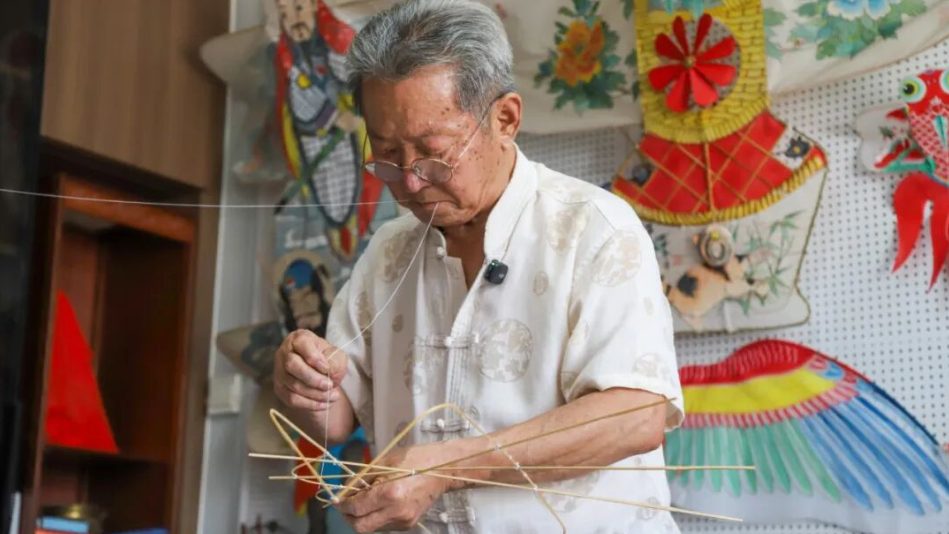
Zhang was born in October 1949 in Hanting district, Weifang. His grandfather was a carpenter who could paint, carve, and sculpt, and the eight-year-old Zhang learned at his side in secret — his parents forbade it, so he quietly persisted anyway [source:4].
Times were hard in the 1960s. His grandfather made kites in his spare hours, and the boy would sneak them to Weifang's beach market to sell. One kite fetched twenty cents, sometimes as little as five. Home was fifteen kilometers away with no transport, so he rose at five in the morning and walked. Selling kites also meant dodging the market inspectors — getting caught meant being accused of "taking the capitalist road" [source:4].
The older craftsmen on the beach saw how young he was and took him seriously anyway. Those furtive years became the foundation of his life.
The turn came after reform and opening. In 1984, Weifang organized its first International Kite Festival, and fellow makers urged him to enter: "Young Zhang, your kites are too good to stay home." He entered — and won first prize. He has competed every year since, forty-three years running, winning top prizes for both flying and innovation each time [source:2][source:4].
Weifang kites: 640 years, six families, four crafts
Chinese kites are more than two thousand years old; the Weifang tradition has been passed down for about 640 years. It rose in the early Ming dynasty in Yangjiabu village, where villagers already ran woodblock-printing workshops for New Year pictures. In the idle spring weeks they used the same paper and pigments to build kites — first for themselves and as gifts, and by the Qianlong era (1736–1795) kite making had become an important local industry. Weifang's spring winds, steady in direction with few gusts, are made for flying. In 2006, Weifang kite making entered China's first national list of intangible cultural heritage, as project VIII-88 [source:3].
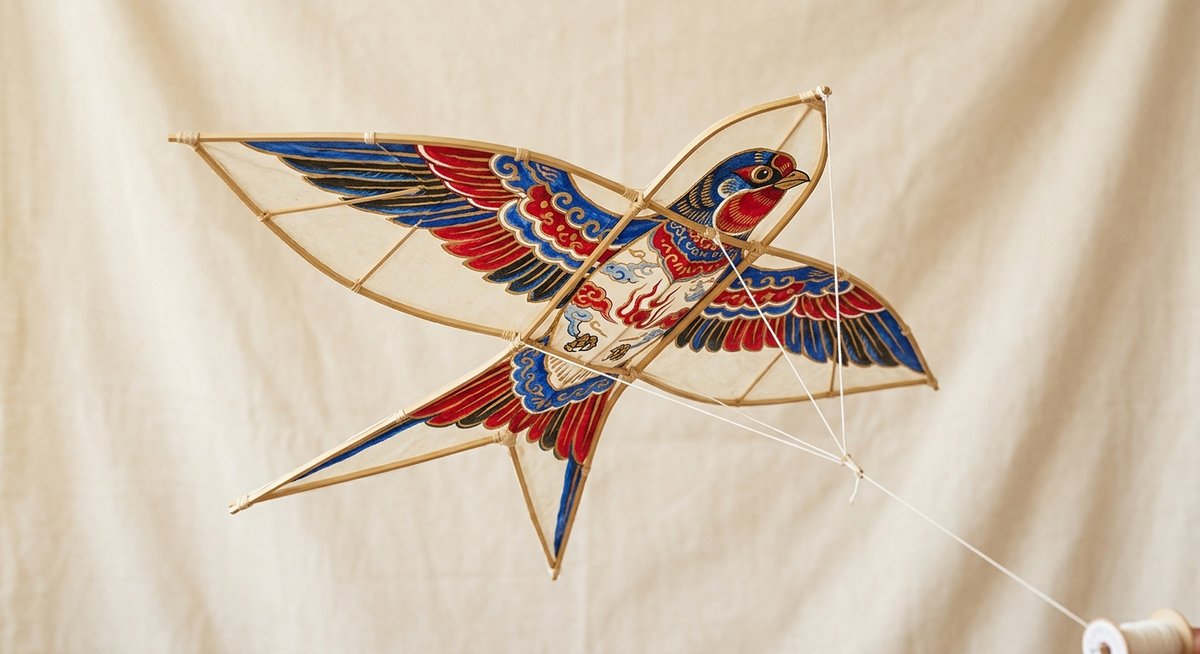
In Zhang's telling, Weifang kites come in six families: hard-wing kites are the most numerous, soft-wing kites the most ingenious, and alongside them flat-panel kites, barrel kites, hybrids, and heritage designs [source:4]. The hallmark of the Weifang style, he says, fits in four characters: light, clever, fine, true. Light, because a kite is held up by wind and every gram matters. Fine, because every lashing and spar must be polished smooth and precise. True, because a kite must look exactly like what it depicts — build a bird, and anyone should name the species at a glance [source:4].
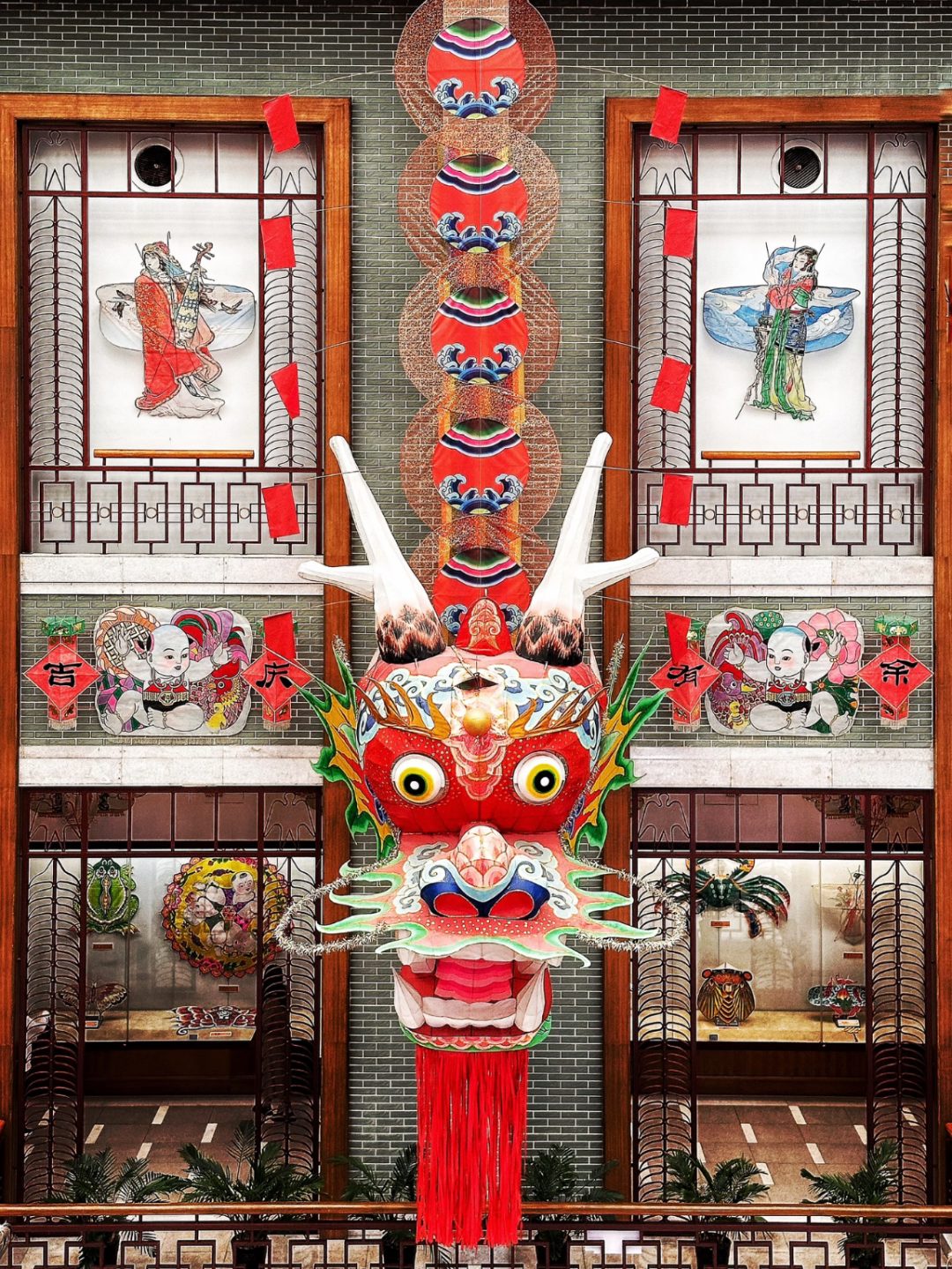
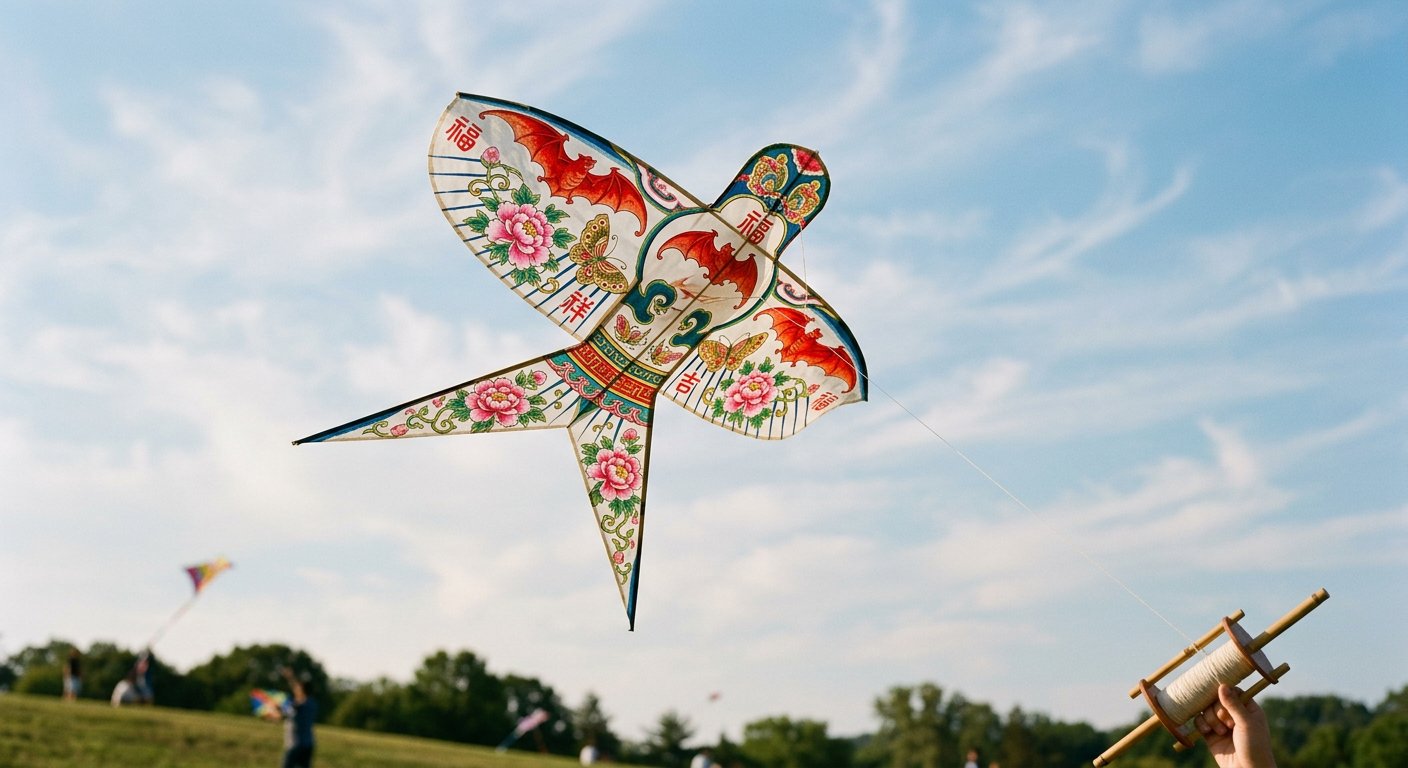
Weifang designs favor celebration: a magpie on a plum branch means joy arrives; a bat given to an elder wishes long life; a goldfish is called "a hall full of wealth." The winds too have their calendar — gentle spring winds and dry autumn air are best; summer thunderstorms and bitter winter gales ground every kite [source:4].
The old rules that cannot change
Zhang has created more than 180 kite designs, yet he insists the ancestral skeletons and patterns must never be simplified.
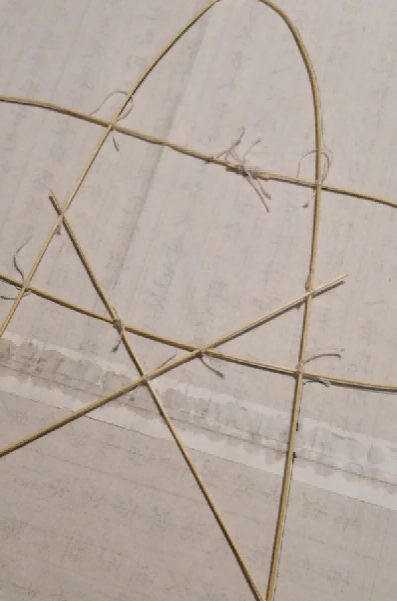
"The cross-flower lashings that bind the frame — that is the core step, and it cannot be altered." Tools may improve: bamboo was once bent over a candle flame, now over an alcohol lamp; the skin was once paper, now silk. But from every bamboo strip to every binding knot, the work still follows the old rules [source:4].
His own training went far beyond kites. He learned to make Peking-opera costumes, clay sculpture, stage art, and the folk props of dragon dances, lions, and palace lanterns. Those side crafts gave his hands extra options: "Whenever something interesting crosses my life, I ask myself whether it can become a kite. Whatever I can see, I can build." [source:4]
The kite whiz: rockets, movies, and machines in the sky
Zhang's signature move is putting machinery into kites — gears, lights, and sound built into three-dimensional frames so the kite performs in the air. His representative works include Pterosaur, Galloping Horse Treading on a Flying Swallow, and Shenzhou-5 [source:1].
When the Shenzhou-5 mission carried China's first astronaut into space, Zhang built a rocket kite sixteen meters tall and nearly two meters across, at half scale, its cabin packed with remote-control gear. At over 100 meters altitude, the kite separated on command — the upper stage flew on while the lower stage dropped away, just like the real rocket. A kite that size needs serious wind, so he added rotating aerodynamic structures that "turn small wind into big wind" [source:4].
When the producers of the film Creation of the Gods wanted their giant dark-bird prop, they mailed him a single small picture and asked for a creature fifteen meters by fifteen. "Too big, I thought — I have nowhere to put it. Then I realized I could build it in sections and assemble it for transport." He made it in his courtyard and lifted it out by crane. The bird caused a sensation at the kite festival and carried Weifang kite technique into the film industry [source:2][source:4].
Why all this tinkering? "Tradition that never changes is a pool of stagnant water. To keep the spring alive you must pour in new water. What others dare not do, you should do. Every year I innovate — with the country's big events and people's lives in mind." [source:4]
Passing the line: twelve apprentices and one wish
Zhang has traveled with official delegations to seventeen or eighteen countries and taught several thousand students across China; twelve disciples have formally apprenticed to him. Student research teams now visit his workshop regularly, and he keeps teaching in kindergartens and schools: "Let children know the nation's heritage from kindergarten — that is our greatest hope." [source:4]
Of the ten "kite stars" named at the first festival in 1984, he is the only one left. The National Library's documentary film about him, Kite Making (Weifang Kites): Zhang Xiaodong, was rated excellent on acceptance [source:1][source:2].
Mass-produced factory kites flood the market, but he is unworried: "The greatest strength of a handmade kite is the human warmth it carries — something an industrial kite can never replace." [source:4]
At the end of our interview, he returned to the sentence he says most often: "As long as the wind keeps blowing, I will keep making kites." A kite flies freely only because a line holds it, he says — and that line is like a rule, a responsibility. His own line is sixty years of unbroken devotion [source:4].
Frequently asked questions
Who is Zhang Xiaodong?
Zhang Xiaodong (born October 1949) is a national-level inheritor of Weifang kite making, a craft on China's intangible cultural heritage list. From Hanting district, Weifang, he learned the craft as a boy, has created over 180 kite designs, and is nicknamed the "kite whiz" for building mechanical kites with lights, sound, and moving parts — including a remote-controlled Shenzhou-5 rocket kite and the dark-bird prop for the film Creation of the Gods.
What makes Weifang kites special?
Weifang kites are summed up as "light, clever, fine, true": lightweight frames, precise joinery, and lifelike shapes. Hard-wing and soft-wing designs lead the six local families of kites, and every motif carries an auspicious meaning. The craft follows the four traditional steps of framing, covering, painting, and flying.
When was the Weifang International Kite Festival founded?
The first Weifang International Kite Festival was held in 1984, and it has run annually ever since — more than forty editions. Zhang Xiaodong has competed every year since the beginning. Weifang is known as the kite capital of the world.
Where can I see Weifang kites?
The Weifang World Kite Museum and the Yangjiabu folk-art village display kites year-round. Every April, the festival's flying fields in Hanting district fill with dragon-centipede kites and giant soft kites flying side by side.
Sources and further reading
- Kite Making (Weifang Kites): Zhang Xiaodong — National Library of China ICH inheritor documentation
- The "kite whiz" of Weifang, sole inheritor speaker at the national ICH documentation exhibition — Haibao News
- Kite Making (Weifang Kites) — China Intangible Cultural Heritage website
- Interview with Zhang Xiaodong, July 23, 2026 (site archive)