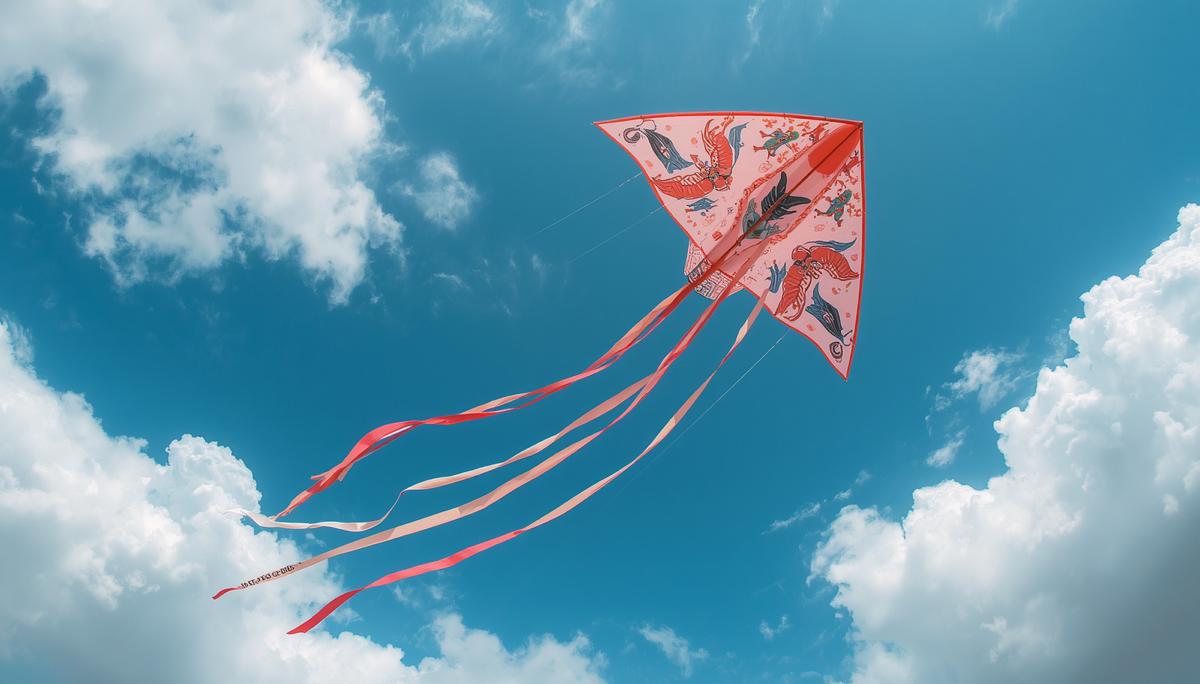
More than two thousand years ago, a carpenter in the state of Chu carved a bird from wood. According to legend, it rose into the air and circled for a full day before coming down. The carpenter was Lu Ban, and the bird was called a mu yuan — the world's earliest kite.
Today, kites are toys for Qingming outings and colorful spectacles at the Weifang festival. Yet for most of their long history they were measuring tools, messengers, reconnaissance devices, even an ancient expression of the human dream of flight. From battlefield to sky, from wood to paper, the kite records Chinese ingenuity and romance.
War signals in the sky
The earliest Chinese kites were not toys; they were military equipment.
The Han Feizi records that Mozi "spent three years making a wooden bird that could fly" in the Lu Hills, in what is now Shandong's Weifang. It stayed aloft for a day before breaking. Later texts credit Lu Ban with an even more refined "wooden magpie" that "flew for three days without descending." These accounts are surely exaggerated, but they show that as early as the Warring States period, the Chinese were already experimenting with flying machines.
By the Han dynasty, the general Han Xin was said to have used kites for surveying distance. During the Southern and Northern Dynasties, a man reportedly leaped from a height wearing a kite and survived — one of humanity's earliest gliding experiments. In the Tang dynasty, the general Zhang Pi, besieged by enemy forces, sent a kite aloft carrying a message: "If the siege is not lifted in three days, the soldiers of Linming will be eaten by the rebels." Relief arrived.
In an age without radio, a kite climbing high above the battlefield was the fastest signal tower available.
From wood to paper: two thousand years of materials
The first kites were made of wood — heavy, precious, and only master craftsmen could build them. After Cai Lun improved papermaking in the Eastern Han, paper gradually replaced wood. People shaped bamboo strips into frames and covered them with thin paper or silk, making kites light, cheap, and truly part of folk life.
The Han dynasty saw the appearance of the zhi yuan, or "paper kite." In the south it was also called a zhi yao; the old names yao in the south and yuan in the north gave rise to the phrase nan yao bei yuan — "southern yao, northern yuan." The same paper bird carried different names across the river, but the same spring memory.
As the material changed, so did the function. The kite was no longer a rare military instrument; it became a child's toy, a literati image, and a stage for folk artists to display their skill.
Why it is called fengzheng
The name fengzheng comes from sound.
In the late Tang dynasty, people attached bamboo whistles or bowed strings to paper kites. When the wind blew, the whistle sang like a zither. The paper bird became a fengzheng — "zither in the wind" — and some also called it a fengqin.
By the Five Dynasties period, kites were being covered with paper and fitted with bamboo flutes that hummed as they flew. The name fengzheng stuck, eventually becoming the general term for all wind-borne paper craft. It is a small irony: a name born from sound now covers even silent kites.
Zha, hu, hui, fang: the four crafts of kite making
Traditional kite making is built on four skills: zha (framing), hu (covering), hui (painting), and fang (flying). Each is a discipline in itself.
Zha is framing the skeleton. Bamboo must first be soaked to soften it, then split into thin strips and bent into shape. The skeleton is the kite's soul; if it is not true, the kite will not fly steady. The Beijing Ha family divided kites into seven structural types: hard-wing, soft-wing, hard paddle, soft paddle, string, umbrella-wing, and three-dimensional. Each requires a different framing method.
Hu is covering the frame. Traditional materials include cotton paper, silk, or thin gauze, chosen for strength and lightness. Tianjin's "Kite Wei" used high-grade silk fabric, both light and durable.
Hui is painting. A kite is not only a flying object but also a painting in the sky. Craftsmen mixed mineral pigments with peach gum to make colors bright and moisture-resistant. A fine kite is a picture when hung and a spectacle when flown.
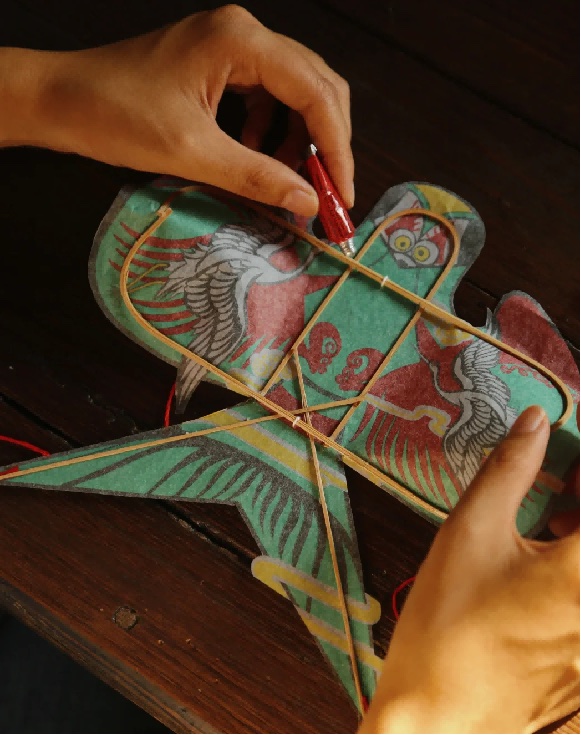
Fang is test-flying. The line must be tied at the right angle, the tail weighted for balance. A good kite "eats the strong wind, lifts quickly, and flies high and steady" — the final examination of the craft.
Soft wings, hard wings, strings, and solids: the kite family
The Chinese kite family is large. The most common types are:
- Soft-wing kites: the rear half of the wing is soft, with no rigid support, so it flutters in the wind. Swallows, butterflies, and eagles belong to this group.
- Hard-wing kites: the wing is supported by rigid bamboo strips above and below, giving a stable structure. The classic sha yan (sand swallow) kite is a hard-wing type.
- Flat-panel kites: a simple planar shape with bamboo strips around the edges — the easiest kind, and a favorite of children.
- String kites: many kites linked together. The most famous is the longtou wugong or "dragon-head centipede," dozens or even hundreds of segments long, rising like a dragon when airborne.
- Three-dimensional kites: lanterns, flower baskets, and other solid shapes, valued more for display than for altitude.
Each type answers to a different wind, demands a different skill, and reflects a different Chinese vision of the sky.
South yao and north yuan: two great traditions
Chinese kites differ sharply between north and south. Northern kites, influenced by court and scholar taste, favor symmetry, neatness, and restrained color. Southern kites are more delicate, lively, and infused with the spirit of the waterways.
Each major production center has its own character:
- Beijing kites: best known for the sha yan or sand swallow, shaped like a swallow returning in spring. The city had four great schools: Ha, Ma, Jin, and Fei; the Ha family alone has more than 160 years of history.
- Tianjin kites: the "Kite Wei" of Tianjin is the most celebrated. Founder Wei Yuantai combined carpentry mortise-and-tenon joints, tin-soldered copper rings, and folk painting to create foldable soft-wing kites.
- Weifang kites: from Shandong's Weifang, China's largest kite production center, famous for dragon-head centipedes, butterflies, phoenixes, and other large kites.
- Nantong board whistles: Nantong in Jiangsu is known for banyao kites fitted with sounding whistles that hum in the wind like an aerial orchestra.
- Lhasa kites: Tibetan kites are small and sturdy, flown in autumn with a distinctive Himalayan flavor.
- Yangjiang kites: Guangdong's Yangjiang is famous for its lingzhi or "sacred fungus" kite, a unique shape listed as Guangdong provincial intangible heritage.
These kites look different, yet all are made from the same bamboo strips and the same thin paper, lifting the wishes of the earth toward heaven.
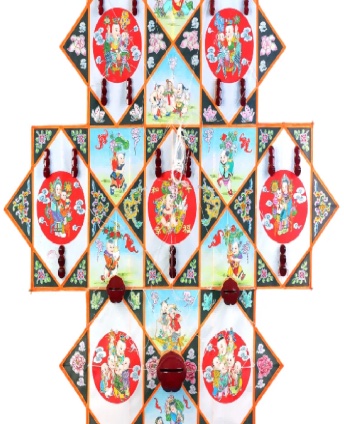
Weifang: the kite capital of the world
If one place can stand for the Chinese kite, it is Weifang in Shandong.
Weifang's kite history reaches back to the Ming and Qing dynasties. Zheng Banqiao, a Qing dynasty county magistrate of Weixian (modern Weifang), described the local kite scene in a poem: "Paper flowers fly like snow across the sky; girls on swings are surrounded on all sides."
In 1984, Weifang held its first International Kite Festival, drawing kite lovers from around the world. Every spring, the Weifang sky becomes a sea of kites: giant octopuses, whales, dinosaurs, and cartoon figures float beside traditional dragons and phoenixes. The old craft meets modern imagination, and Weifang has earned the title "Kite Capital of the World."
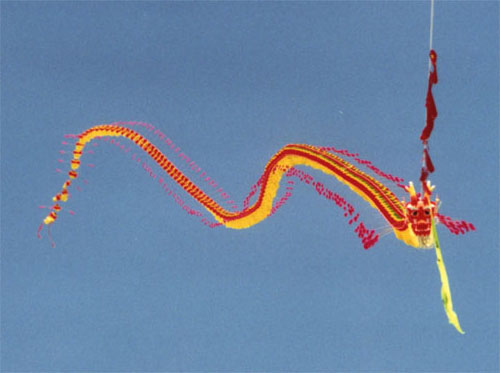
Where kites fly today
In 2006, kite-making skills were added to China's national intangible cultural heritage list. In 2008, additional regional traditions — Beijing Ha kites, Tianjin Wei kites, Weifang kites, and Lhasa kites — were included as extensions of the same project.
But kites have not been confined to museums. Today they appear as sport kites, power kites, kite surfing rigs, and kite aerial photography platforms. Designers turn them into cultural creative products. Every spring, Weifang still hosts a global festival. And children everywhere still run across fields, letting string unreel from their hands as a paper bird climbs toward the clouds.
From Lu Ban's wooden bird to today's enormous soft-body kites, the Chinese longing for the sky has never changed. The kite may fly high, but its string remains in human hands — a line connecting earth, history, and the memory of spring.
Author
This article was prepared by the team at ChineseFolkCrafts.com. We are not intangible-cultural-heritage inheritors or museum researchers. Our job is to find authoritative Chinese sources, understand them, and explain them clearly for international readers.
If you spot an error — a date, a translation, a misattributed custom — please let us know and we will correct it. Last updated 2026-08-03.