Types of Chinese Kites: Hard Wings, Soft Wings, and the Dragon-Head Centipede
To a casual eye, all kites in a spring sky look alike: a line, a sheet of paper, a dancing shadow. But an old kite maker can read one at a glance — this one will hold a hard wind, that one can only drift; this one folds into a box for travel, that one dies if you take it apart. The difference is never in the painting. It is in the bamboo.
So how many types of Chinese kites are there? By the classification handed down from Beijing's Kite Ha family, kites are grouped by frame structure and how they answer the wind into seven categories: hard-wing, soft-wing, hard paddle, soft paddle, string, umbrella-wing, and three-dimensional [source:2]. This guide starts from the skeleton, explains what each type does in the air, and then looks at the four great regional schools and their signature birds.
Reading a kite: start with the frame
Traditional kite making is summed up in four crafts — zha (framing), hu (covering), hui (painting), and fang (flying) — and framing comes first for good reason. Two kites can be painted identically, yet the frame decides everything: whether the kite lifts, how much wind it can take, how steady it rides, and whether it can be taken apart and stored in a box.
That is why craftsmen never classify kites by picture. A goldfish kite and a butterfly kite may be the same type of kite. They ask four questions instead: do the wings have rigid edges? Is the body one flat panel? Is it a single kite or a train of many? Is it flat or solid? Answer those, and the whole family tree of Chinese kites falls into place.
Hard-wing and soft-wing: the two great families
Most Chinese kites belong first to one of two great families.
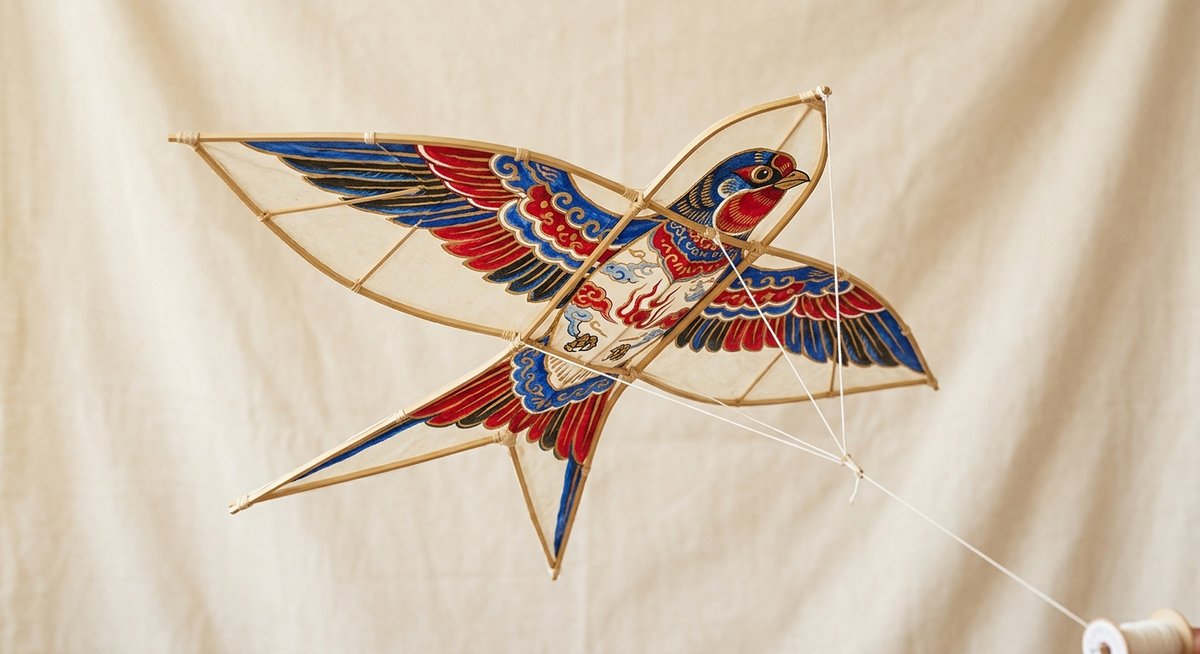
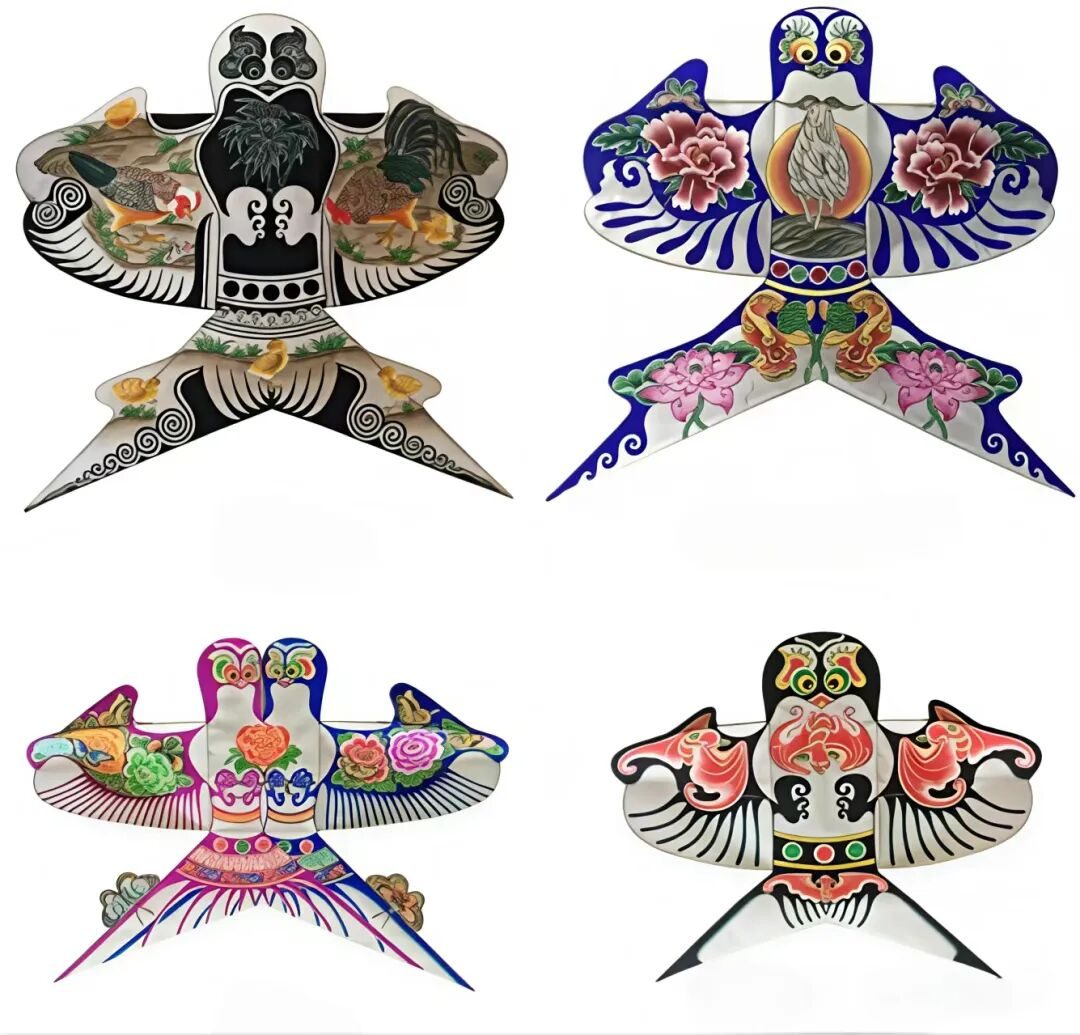
Hard-wing kites have each wing framed by two bamboo strips, top and bottom. The wing edges sit high with a slight hollow in the middle, and the wingtips tilt gently backward so the wind spills cleanly off the ends [source:4]. The rigid wing bites into strong wind and holds its line in a blow — but it cannot be disassembled, which makes storage and travel awkward. The most famous hard-wing kite is the Beijing sha-yan sand swallow, a whole household of fat swallows, slim swallows, paired swallows, and chicks, all with stiff wings [source:5].
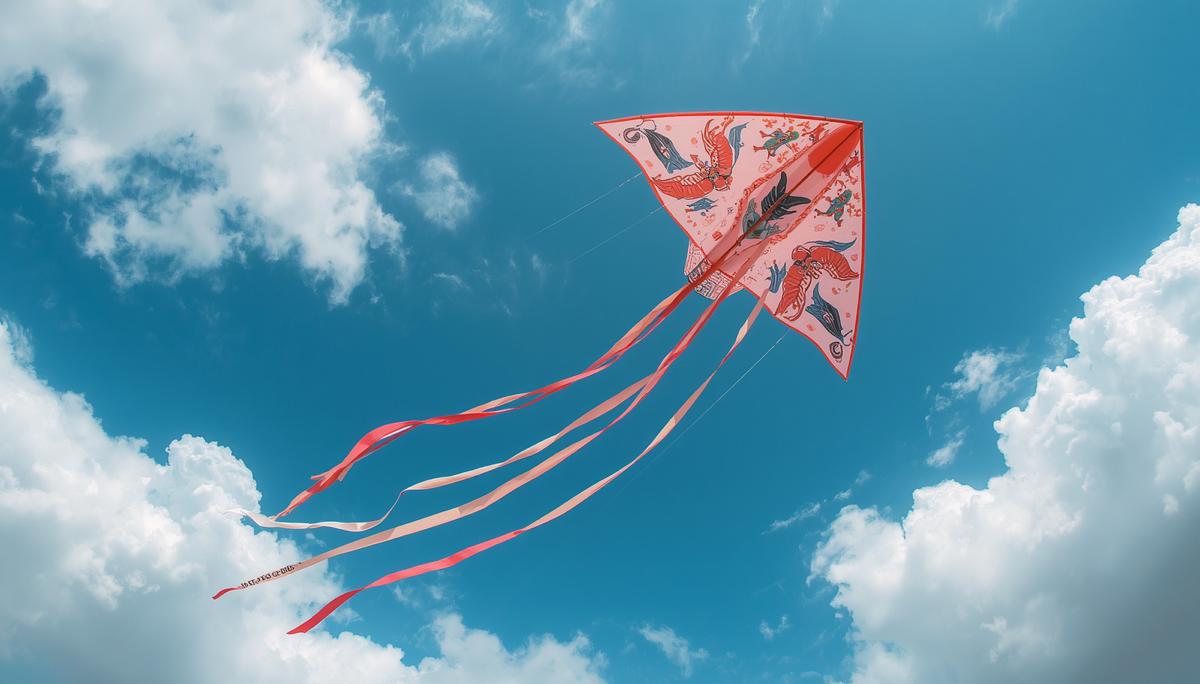
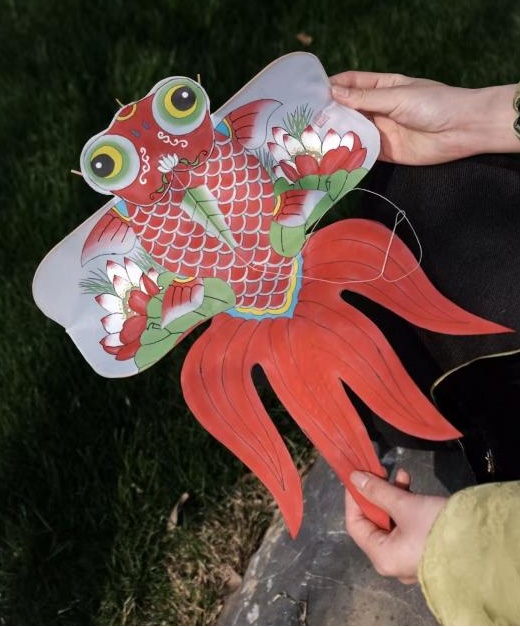
Soft-wing kites support the lifting surface with a single main spar; the rear half of the wing has no frame at all and stays soft [source:4]. When the wind blows, the soft edge trembles and the kite comes alive: a goldfish wags its head and tail as if swimming, an eagle flaps as if truly climbing. Soft-wing frames can often be taken apart and boxed, which is why portable Tianjin kites are built mostly on soft wings [source:2][source:5].
In the shortest form: hard wings win by holding firm; soft wings win by coming alive.
Panel kites: the oldest and friendliest
Panel kites — called paizi or "paddles" in the trade — are the simplest type: one flat surface, bamboo strips bracing the edges, a painted face, and up it goes. They come in hard-paddle and soft-paddle forms, and they are the easiest kites to build and fly, which makes them the classic first kite for children.
The panel kite is also the senior of the family. Weifang kites in the Ming dynasty were mostly panel kites; only later did the local craft grow into its full spectrum — "hard-wing as the mainstay, the long centipede train as the greatest, soft-wing as the cleverest, and the barrel as the curiosity" [source:1]. And the city of Nantong pushed the panel kite to its absolute limit — but that is the banyao, and it deserves its own paragraph below.
String kites and the dragon-head centipede
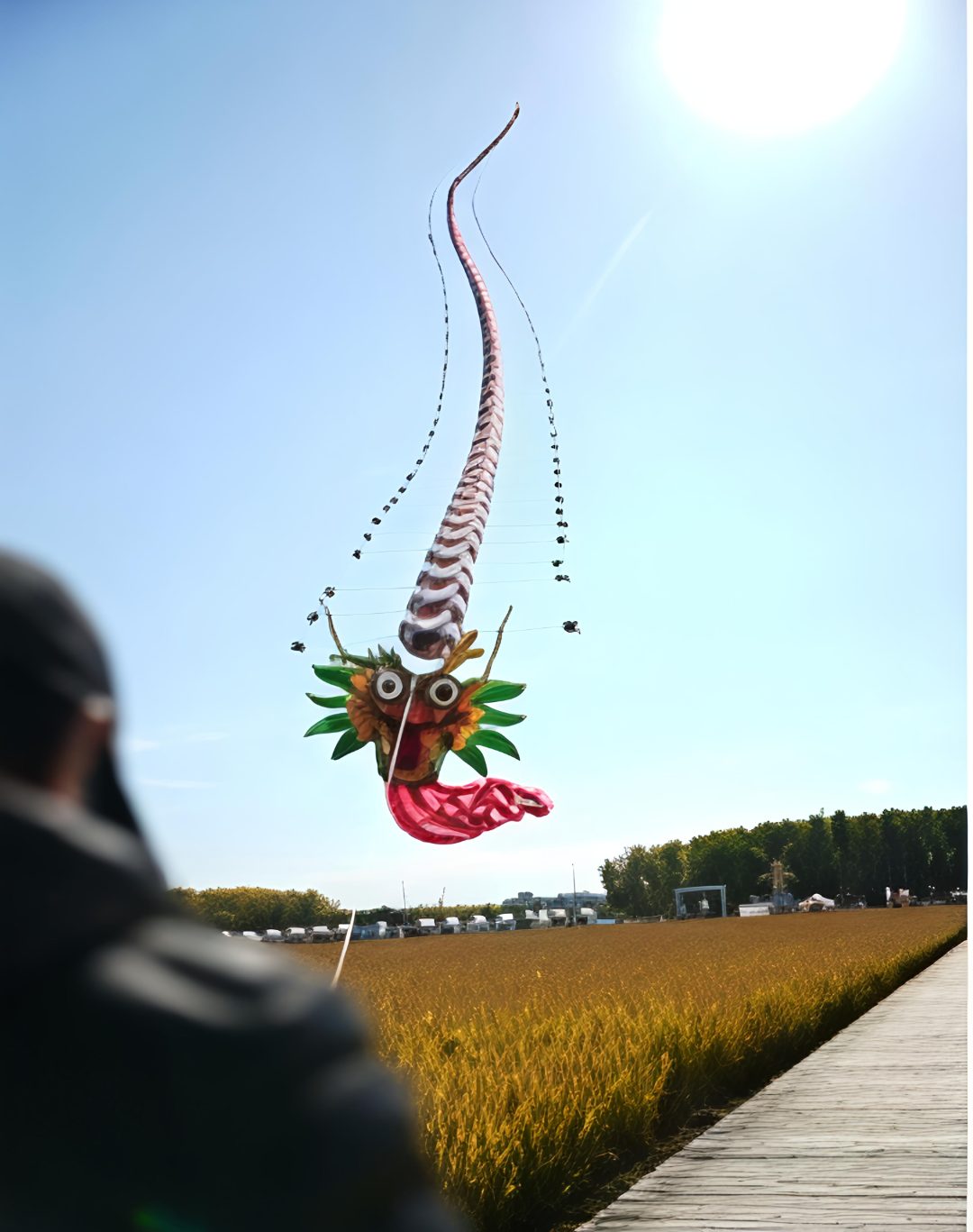
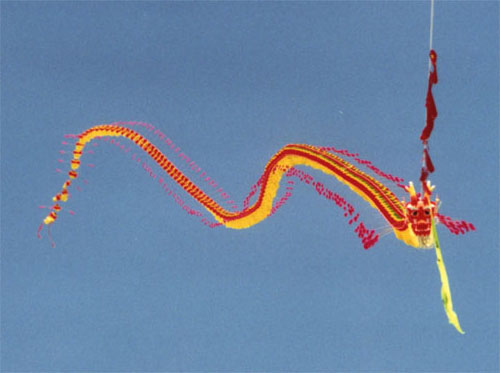
Tie dozens, even hundreds of kites onto one line and you have a string kite. Its most spectacular form is Weifang's dragon-head centipede: a dragon head leads the way, segment after segment of body strung beneath the main line like candied hawthorns on a stick, stretching tens of meters into the air. The longest Weifang centipede trains reach more than 360 meters — once aloft, truly a dragon in the sky [source:1].
The beauty of a string kite is that the whole and the details can shine at once. The centipede's head is built in the soft-wing manner, with eyes that turn and claws that flex [source:2], while every body segment is its own small disc kite. From afar it is one dragon; up close it is an orchestra of a hundred little kites.
Three-dimensional, barrel, and the rest
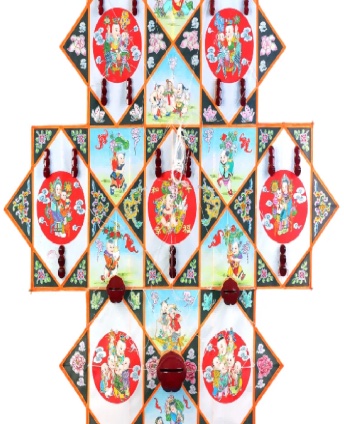
Some frames exist not for altitude but for shape. Palace lanterns, flower baskets, vases — these are three-dimensional kites, their bamboo skeletons bent into solid objects that hang in the sky like jewelry, their display value far above their climbing ability [source:2]. Barrel kites catch the wind in a cylindrical frame — the "curiosity" of the Weifang spectrum [source:1] — and Beijing's sha-yan tradition also counts paddles, long trains, and barrels among its five basic forms [source:5].
Most of these are poor choices for a beginner's first flight, but they are the stars of every temple fair and exhibition hall.
Four great schools: four temperaments under one sky
The frame decides how a kite flies; the regional school decides what it looks like. The same bamboo, paper, and silk become four different temperaments in four different places.
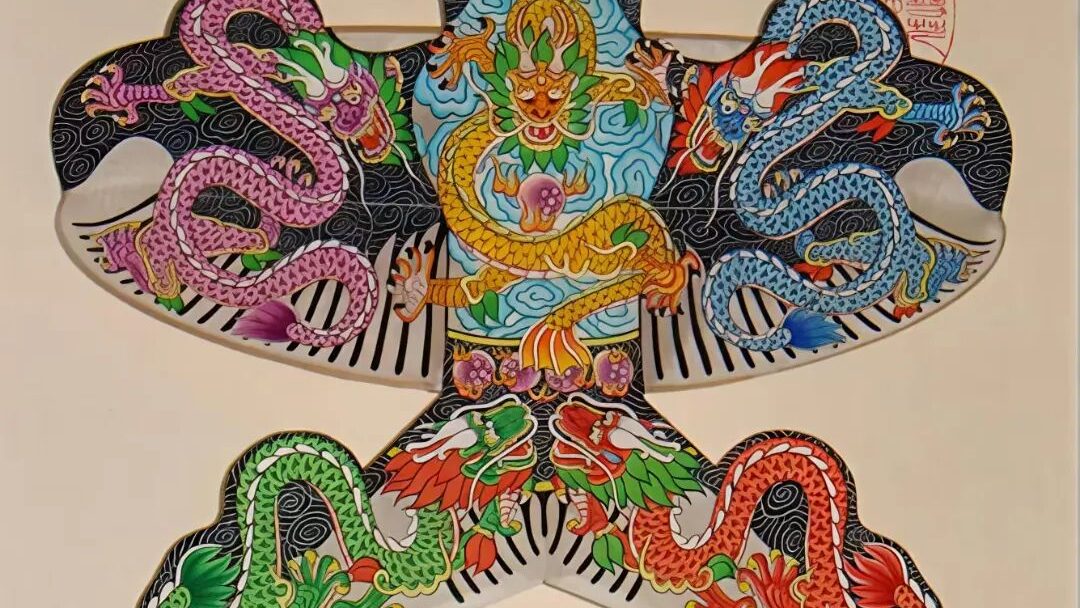
Weifang, in Shandong, is the recognized kite capital of the world. Its kite trade rose in the early Ming dynasty in Yangjiabu village, where farmers used the paper and mineral pigments of their woodblock New Year prints to make kites in the slack spring season; by the Qianlong reign (1736–1795), kites were a major local industry [source:1]. The Weifang style is rich color, strong contrast, full composition, and bold rustic line — yet its framing is radically simple: as few as three bamboo strips and never more than seven, with emphasis on even strips, a true and symmetrical skeleton, and a balanced bridle [source:1]. In 2006, Weifang kite making entered the first batch of China's national intangible cultural heritage list [source:1].
Beijing is the city of the sand swallow, its wings painted with bat, deer, and peach motifs that spell out fortune, rank, and long life. Beijing produced two separate national-level kite traditions: the Kite Ha family, whose seven-category classification is still the trade's standard taxonomy [source:2], and the Cao-style kite, said to descend from a kite manual attributed to Dream of the Red Chamber author Cao Xueqin — the manuscript's authorship is still debated, but the swallows are undeniably beautiful [source:3].
Tianjin built its name on soft wings, above all the "Kite Wei" workshop. The covering is silk, light yet strong; the frame is fine long-jointed moso bamboo, chosen with extreme care; and the whole kite folds and disassembles into a box for carrying — all the ingenuity is hidden in the joinery [source:5].
Nantong, in Jiangsu, went its own way: sound. The Nantong kite, nicknamed banyao, is a flat hexagonal panel — or its compound forms, from "seven linked stars" up to "nineteen linked stars" — studded with rows of whistles large and small. Aloft, the wind plays it like an aerial orchestra, exactly the old phrase "strings sounding in the blue sky" that gave the fengzheng its name [source:5]. Tianjin Kite Wei and Nantong banyao are both inscribed as national ICH extension projects, as is the kite tradition of Lhasa, where autumn winds over the plateau carry a very different scene [source:1].
Frequently asked questions
What are the main types of Chinese kites?
By the structural classification handed down from Beijing's Kite Ha family, Chinese kites fall into seven categories: hard-wing, soft-wing, hard paddle, soft paddle, string, umbrella-wing, and three-dimensional. In everyday use, people speak of hard-wing, soft-wing, panel, string, three-dimensional, and barrel kites.
What is the difference between hard-wing and soft-wing kites?
A hard-wing kite has each wing fixed between two bamboo strips; it cannot be disassembled, but it bites into strong wind and flies steady — the Beijing sand swallow is the classic example. A soft-wing kite leaves the rear half of the wing unsupported, so it trembles and moves in the wind; its frame can usually be taken apart and boxed, as in the Tianjin Kite Wei tradition.
What is a dragon-head centipede kite?
It is the most famous string kite: a soft-wing dragon head in front, dozens or hundreds of disc-shaped body segments strung along the main line, climbing into the sky like a flying dragon. It is the signature of Weifang, where the longest centipede trains exceed 360 meters.
What is a Nantong banyao kite?
The banyao is Nantong's flat board kite, built as a hexagonal panel or its compound forms from "seven linked stars" to "nineteen linked stars," and fitted with sounding whistles that hum in the wind like an airborne orchestra. It is a national intangible cultural heritage project of China.
Which type of kite is best for beginners?
The panel kite. One flat surface braced by bamboo strips around the edges — the simplest structure to build and the easiest to fly. For a taste of traditional framing, start with a small kite on a simple cross frame.
Author
This article was prepared by the team at ChineseFolkCrafts.com. We are not intangible-cultural-heritage inheritors or museum researchers. Our job is to find authoritative Chinese sources, understand them, and explain them clearly for international readers.
If you spot an error — a date, a translation, a misattributed custom — please let us know and we will correct it. Last updated 2026-08-04.
Sources and further reading
- Kite making (Weifang kites) — China Intangible Cultural Heritage website
- Kite making (Beijing Kite Ha) — China Intangible Cultural Heritage website
- Kite making (Beijing kite making) — China Intangible Cultural Heritage website
- Kite — Chinese Wikipedia
- Field notes on regional kite schools (site archive)