Chinese Knots in Daily Life: From Clothing to Modern Decor
Slug: chinese-knot-uses
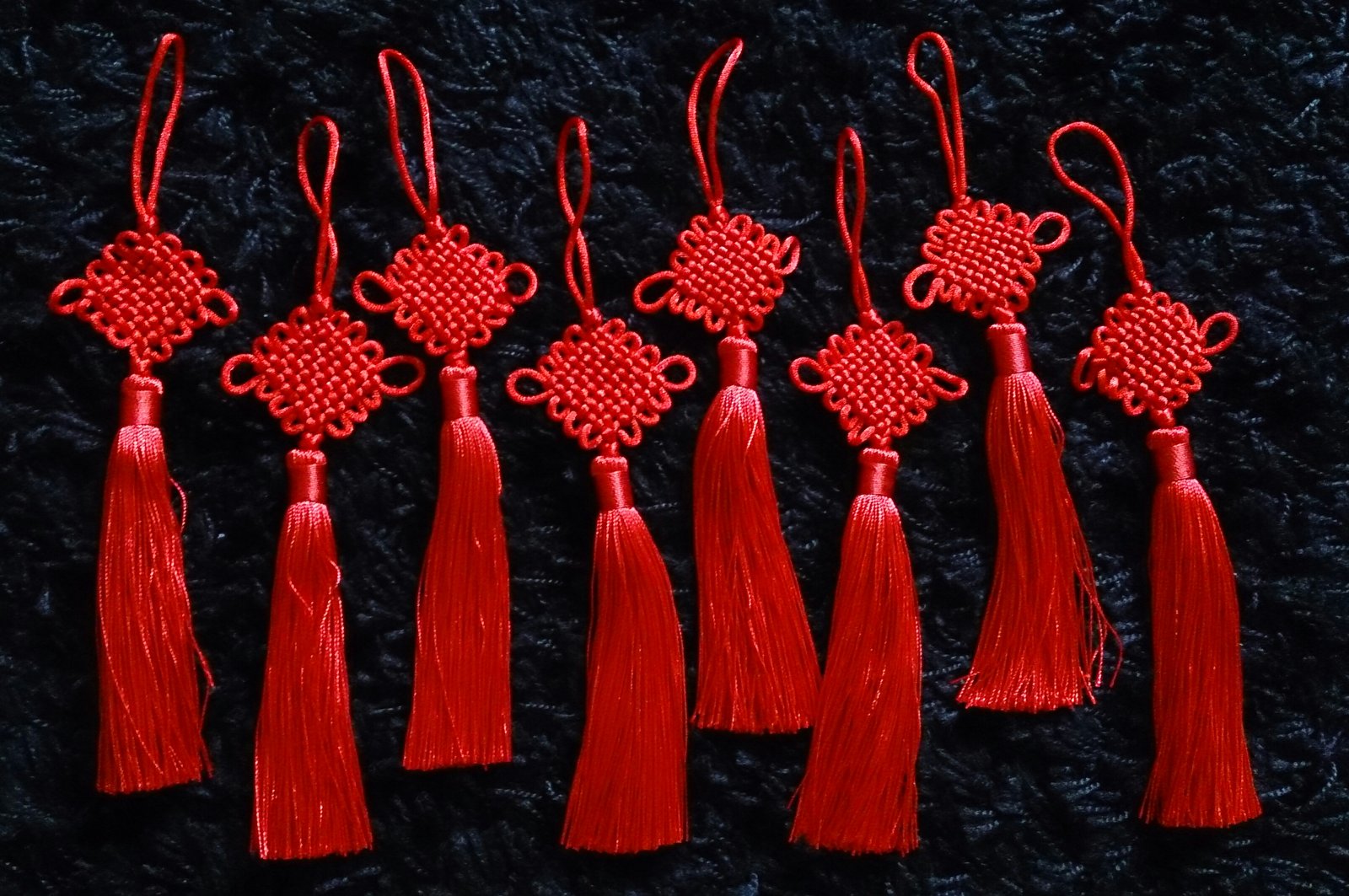
Pick up a red Chinese knot in a market, and you are holding a small piece of living history. The same looped cord that once recorded events before writing now fastens a silk robe, decorates a New Year doorway, finishes a pendant, or anchors a modern wall hanging. Zhongguo jie (中国结) has never been only a craft for display cases. It is a practical decorative language that has moved with Chinese daily life for thousands of years.
In this article we follow the knot through its everyday roles: on clothing and accessories, in festival gifts and home decor, and even on the global stage. For the shapes and names behind the uses, see our guides to Chinese knot types and categories and common Chinese knots and their meanings.
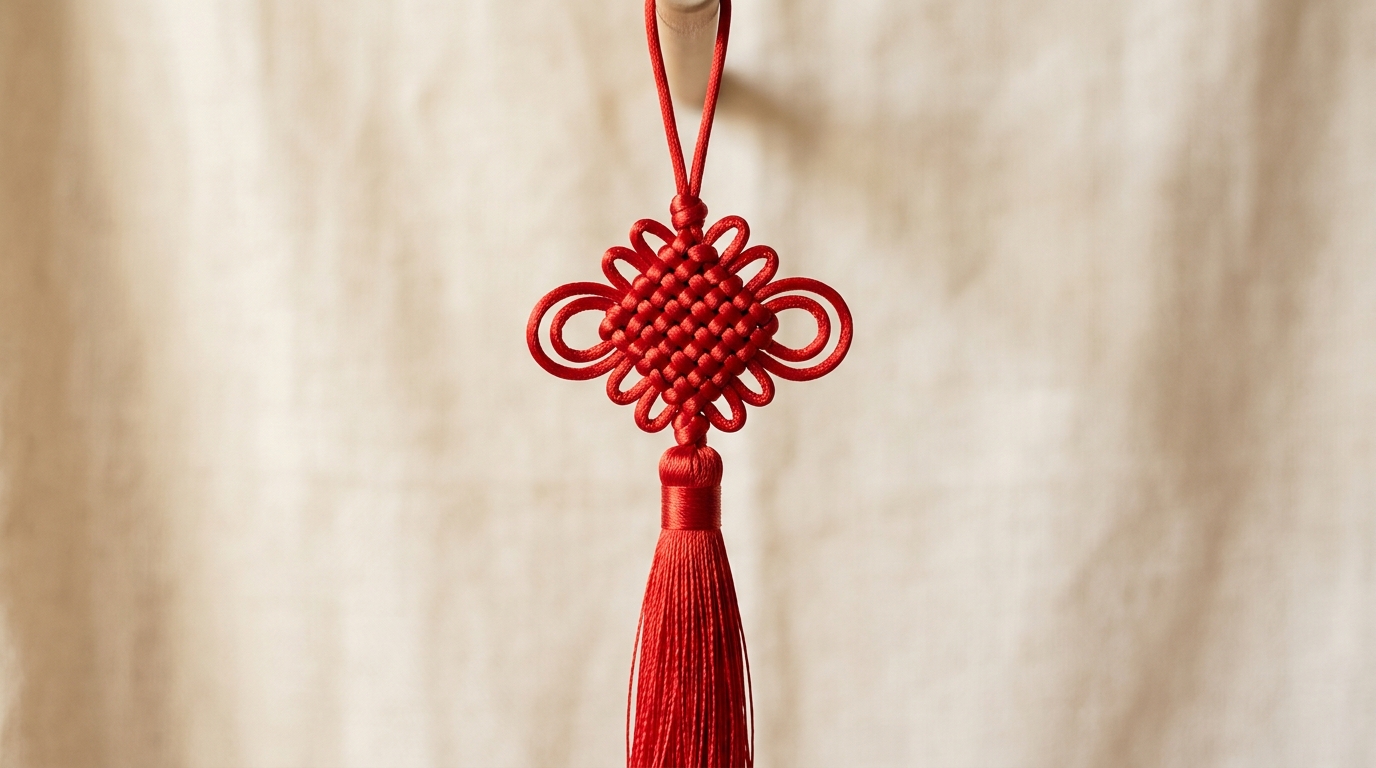
A red pan chang knot hanging on a carved wooden screen — Chinese knots remain a classic accent in home decor.
From Cord Memory to Everyday Ornament
Chinese knotting began, quite literally, as a way to remember. Before writing spread, people tied large and small knots in cords to keep records of important and minor matters [source:1]. By the Zhou dynasty, knotted silk cords were already suspending jade pendants from the waist, and by the Han dynasty ribbons knotted at the belt signaled rank. Knots were not yet decorative art; they were tools of memory, status, and dress.
Over time, function turned into ornament. A knot that held a robe closed became a frog button; a cord that tied a fan became a tassel with a pan chang knot. This slow transformation from utility to symbol is why Chinese knots still feel at home in ordinary life.
On Clothing and Personal Accessories
For centuries, Chinese knots lived on the body. Silk ribbons were knotted at the waist to close robes, suspend pendants, and hold sachets. In Tang and Song paintings, court women wear butterfly knots at the chest and shoulders, while scholars carry fans finished with knotted tassels [source:1]. The Qing dynasty pushed this further: knots decorated hat finials, spectacle cases, purses, fan tassels, and rosaries [source:1]. A well-dressed household might own dozens of knotted objects.
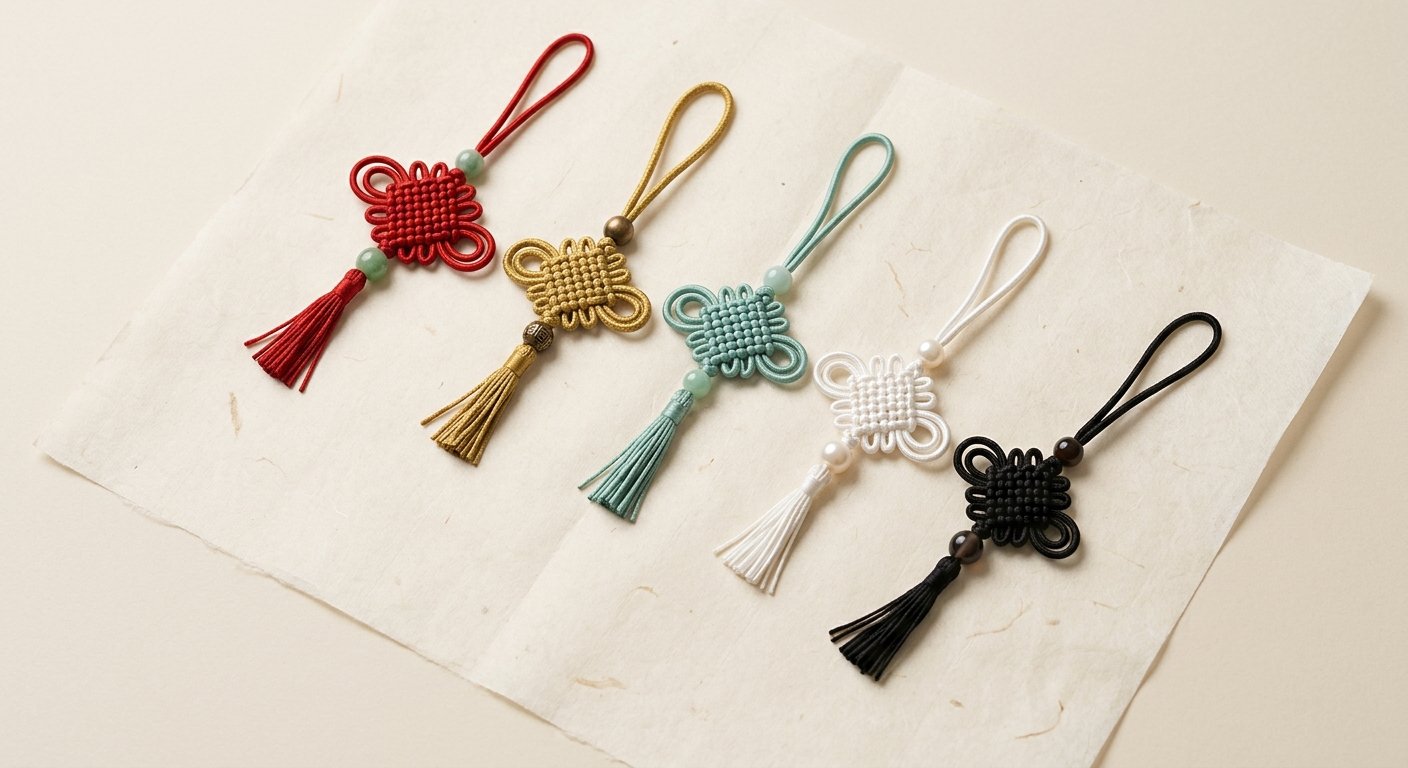
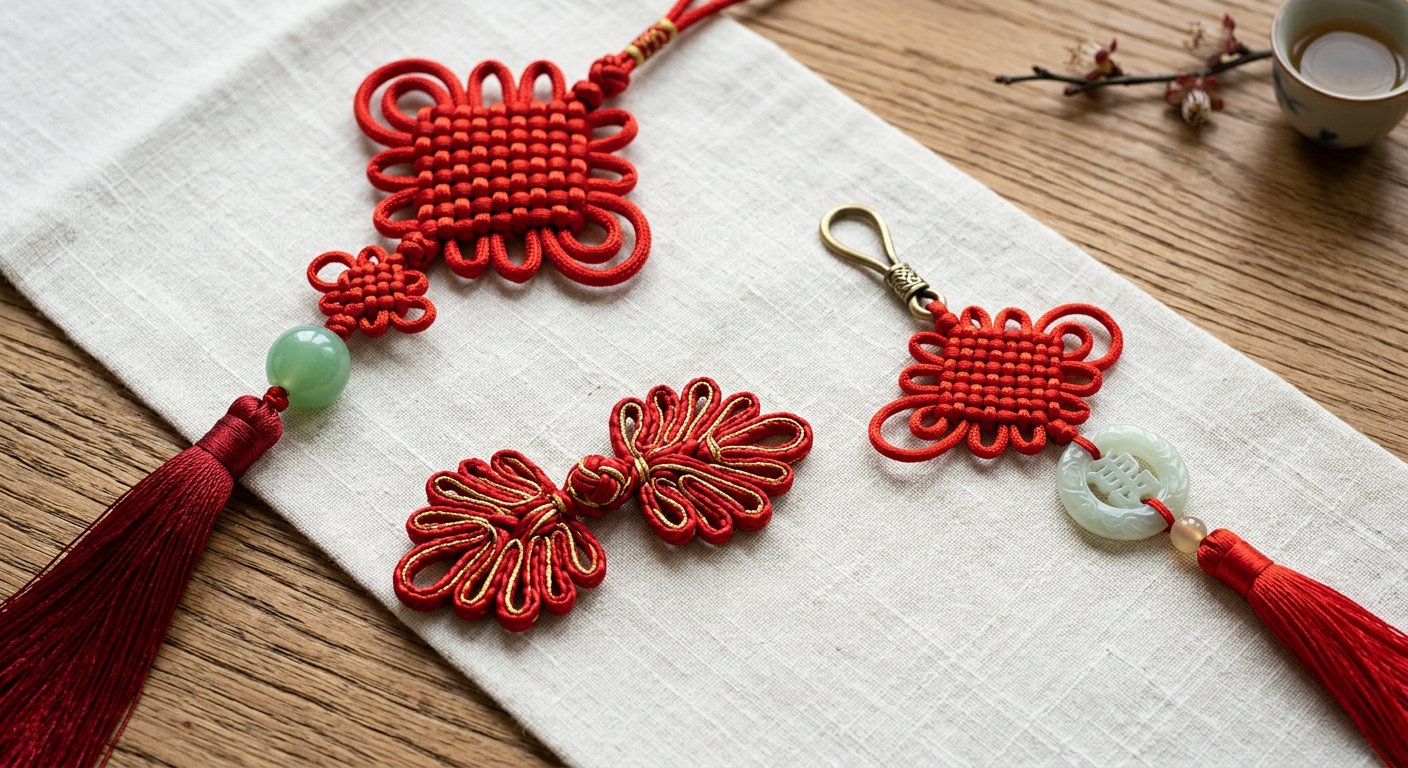
The most recognizable clothing use survives in the qipao (cheongsam). The rounded pipa knot and other button knots form the classic frog buttons that fasten the collar and front [source:1]. As craft researcher Pan Lusheng notes, traditional frog buttons and garment ribbons gave rise to the modern Chinese knot pendants and ornaments now sold as jewelry and personal accessories [source:2]. A single pan chang or double coin knot on a cord becomes a necklace, bracelet, phone charm, or car-mirror pendant; beads of jade, ceramic, or cloisonné add color. Because each shape carries a wish, the wearer can choose a design like a birthstone: double coin for wealth, endless knot for continuity, butterfly for love [source:1].
Festival Decorations and Lucky Gifts
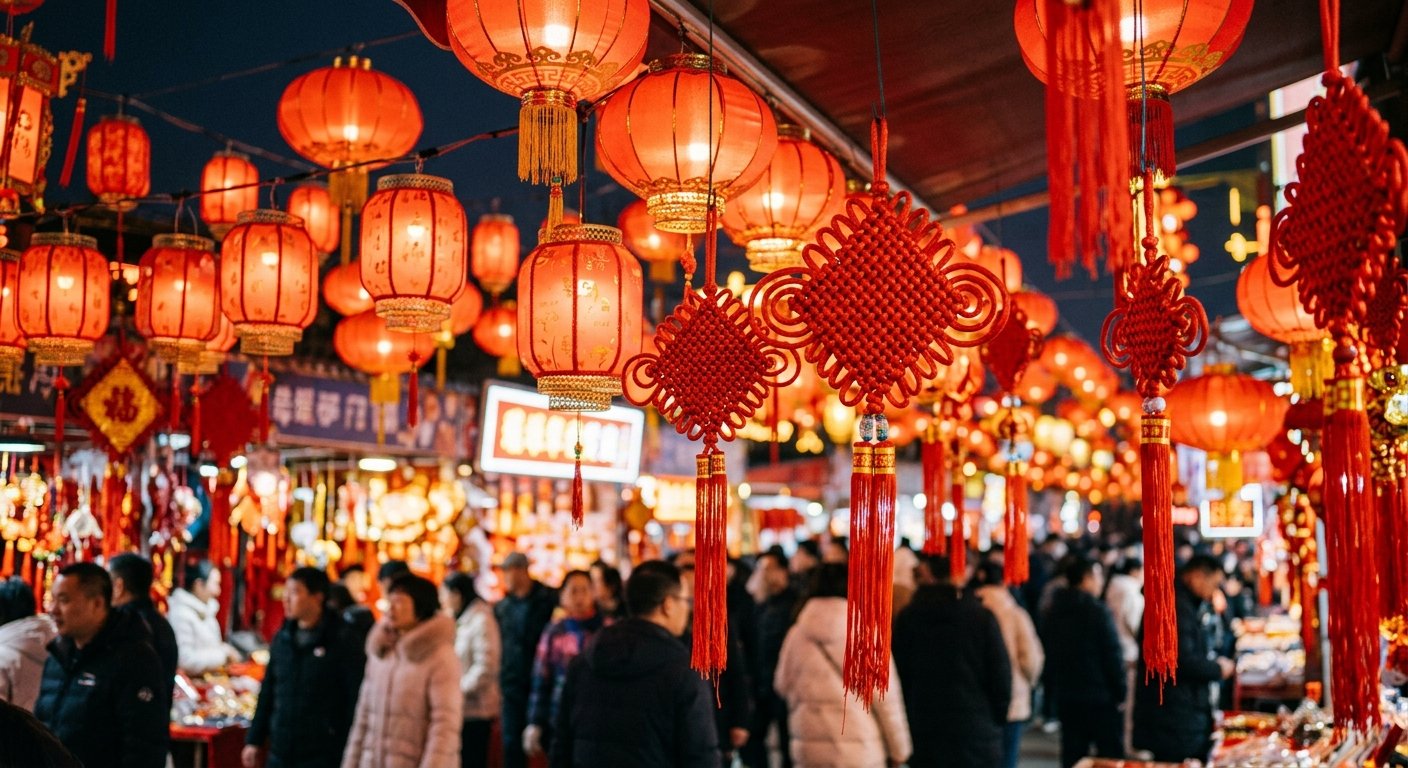
No Chinese New Year market is complete without red knots. They hang beside door gods, fu character posters, red lanterns, and paper cuttings to create a mood of reunion, luck, and protection [source:3]. Red is the default festival color because it is believed to ward off misfortune and invite joy. A red pan chang knot on a door says, in effect, "may good fortune arrive and stay."
The Ministry of Culture has encouraged the use of Chinese knots, spring couplets, lanterns, fu characters, paper cuttings, and window flowers in public spaces during Spring Festival, turning the knot from a private decoration into a shared holiday symbol [source:3].
Knots also travel as gifts. A wedding present may carry a red and gold knot for joy and prosperity; a graduation gift might use a ruyi knot to say "may everything go as you wish"; for an elder's birthday, a tasseled knot expresses longevity. For color choices, see our guide to Chinese knot color meanings.
Knots are classic festival gifts — here a handmade knot set is paired with a zodiac tiger plush for the New Year.
In the Home and Modern Decor
Walk into a Chinese home during a celebration and you will likely see a Chinese knot somewhere: on a door handle, above a window, on a cabinet, or as part of a wall hanging. The same knot that once ornamented palace sedan chairs now fits comfortably in apartments and modern interiors.
Contemporary knot makers have adapted the tradition to new materials and settings. Nylon, parachute cord, hemp, and metallic thread sit alongside silk and cotton [source:1]. Designers use knot motifs in cushions, lampshades, curtain tiebacks, and table runners. A single large pan chang knot with a long tassel can anchor a minimalist wall; smaller knots become drawer pulls, key chains, or bookmarks.
Pan Lusheng observes that traditional crafts such as frog buttons and garment ribbons have generated new pendant and display ornaments, while other folk arts like New Year pictures and kites have become gifts and tourism souvenirs [source:2]. Chinese knots follow the same path: from functional dress parts to decorative objects that carry cultural identity into modern living spaces.
On the World Stage: Public Celebrations and Design
Chinese knots are no longer confined to homes and clothing. They now appear in public art, stage design, and international events. The most striking recent example was the Beijing 2022 Winter Olympics opening ceremony. When the final torch was lit, the giant snowflake cauldron contained a woven Chinese knot hidden inside its design. The ceremony's visual director explained that the knot carries a wish for unity, and its tight weave echoes the idea of countries and regions gathered closely together [source:4].
This public use reflects a broader idea in Chinese intangible cultural heritage work: traditional crafts survive best when they find a connection point with modern life [source:4]. The same principle appears in metro-station public art, hotel lobbies, and museum shops that weave knot patterns into walls, textiles, and signage.
Choosing a Knot for the Moment
If you would like to use Chinese knots in your own life, a few simple rules make the choice easier:
- For happy occasions, red is the safest color. A red pan chang or double coin knot works for New Year, weddings, housewarmings, and birthdays.
- For study or work, a blue-green or black endless knot suggests steady growth and quiet wisdom.
- For romance, a butterfly knot or a pink-toned cloverleaf knot expresses love and sweetness.
- For gifts, combine a knot with a bead or small charm that matches the wish — jade for health, a coin motif for wealth, a ruyi for success.
- For modern decor, let the knot speak for itself. A single large knot on a plain wall or a small knot on a bag can be more elegant than many colors crowded together.
The meaning is not fixed by tradition alone. A Chinese knot is a small sentence written in cord: choose the shape, choose the color, and the finished piece says what you want it to say.
Sources and Further Reading
- Chinese knotting — Wikipedia
- 潘鲁生:工艺美术和生活价值的回归 — 中国非物质文化遗产网
- 文化部举行新闻发布会介绍春节、元宵节期间文化活动安排 — 中国非物质文化遗产网
- 《焦点访谈》——非遗:薪火相传 与时俱进 — 中国非物质文化遗产网
Author
This article was prepared by the team at ChineseFolkCrafts.com. We are not intangible-cultural-heritage inheritors or museum researchers. Our job is to find authoritative Chinese sources, understand them, and explain them clearly for international readers.
If you spot an error — a date, a translation, a misattributed custom — please let us know and we will correct it. Last updated 2026-07-28.