Chinese Tie-Dye and Batik: Two Thousand Years of Blue and White
In the mountain villages of southwest China, two crafts answer the same question: how do you leave white flowers on a length of blue cloth?
The Bai people answer with a thread. They stitch and bind plain white cloth, dip it into an indigo vat, and wherever the thread bites tight, the dye cannot reach. When the threads are unpicked, white blossoms open across the blue. The Miao people answer with a copper knife. Dipped in melted beeswax, the knife draws pictures on handwoven cloth; wherever the wax seals the fibers, the indigo cannot enter. Boil the wax away, and white flowers appear on deep blue — traced with fine "ice cracks" that no hand could plan.
The first craft is zhanran (扎染), tie-dye, known in ancient times as jiaoxie (绞缬). The second is lran (蜡染), batik, once called waxie (蜡缬). Together with clamp-resist dyeing (jiaxie), they are the three basic types of traditional Chinese resist dyeing [source:6]. In 2006, Bai tie-dye and Miao batik were both inscribed on China's first national list of intangible cultural heritage [source:1][source:3]. Two thousand years on, these blue-and-white cloths are still quietly being made in the courtyards of Dali and the stilted houses of Qiandongnan.
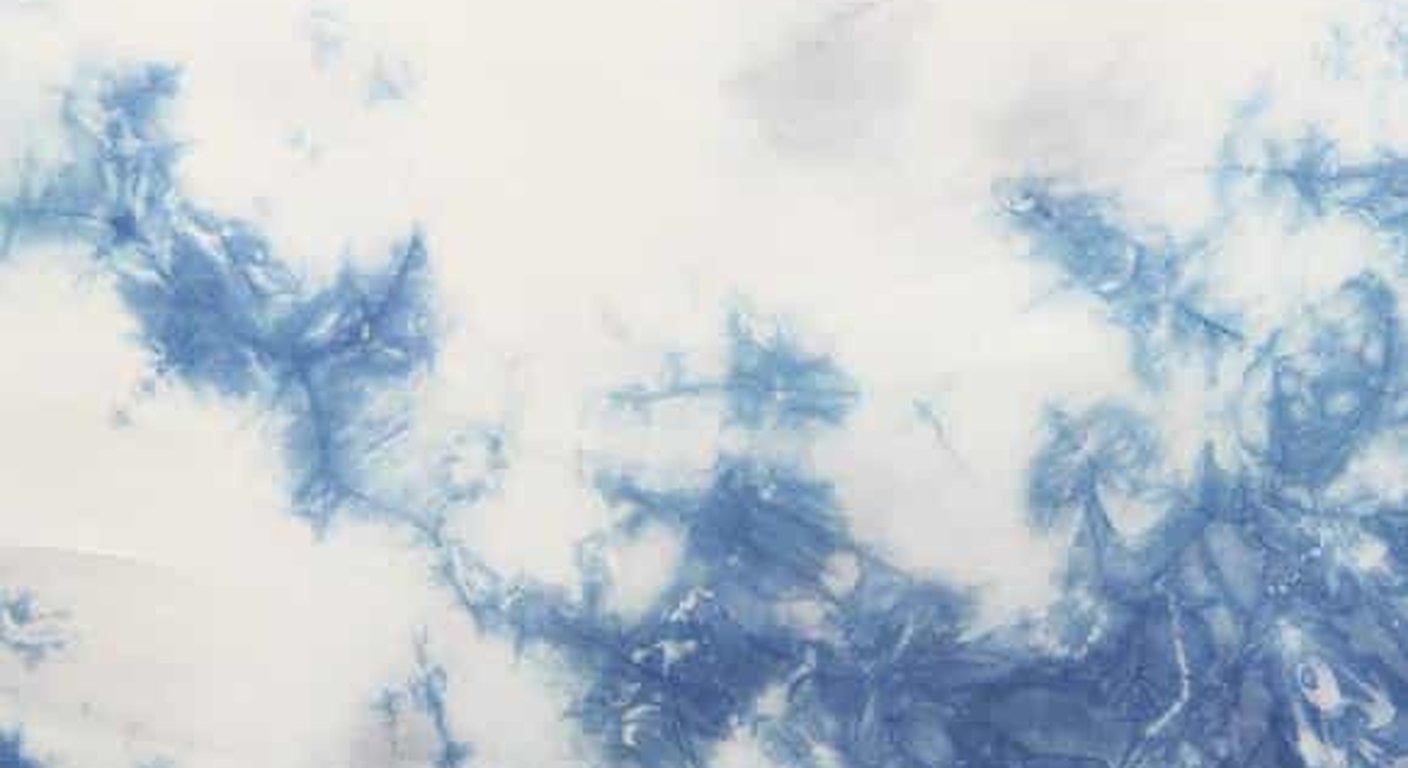
Tie-dye's signature look: indigo blooms and soft halos where the dye bled gently past the bound threads.
Tie-dye: a thousand patterns tied with one thread
The origins of tie-dye are too old to pin down. What records do tell us is that by the Eastern Jin dynasty, resist-dyed jiaoxie silk was already being produced in quantity — around the year 408, the craft was fully mature [source:5]. Jin-dynasty tie-dye came in small clustered motifs like butterflies, wintersweet, and crabapple blossoms, as well as all-over patterns with poetic names: tiny white dots were called "fish-roe xie," larger dots "agate xie," and a purple ground flecked with white spots like a spotted deer was known as "deer-fawn xie" [source:5]. Sixteen centuries ago, Chinese dyers were already using a single thread to plant whole fields of flowers on cloth.
Tie-dye has many old names — zhaxie, jiaoxie, jiaoran — all built around the character xie (缬), which specifically means a patterned cloth made by resist dyeing. Its principle is disarmingly simple: the tighter the binding, the less dye seeps in, and the crisper the white; bind loosely, and the blue bleeds into soft halos. A hundred ways of tying produce a hundred kinds of flowers — in Dali's Bai tie-dye tradition alone, more than a thousand patterns have been handed down [source:1].
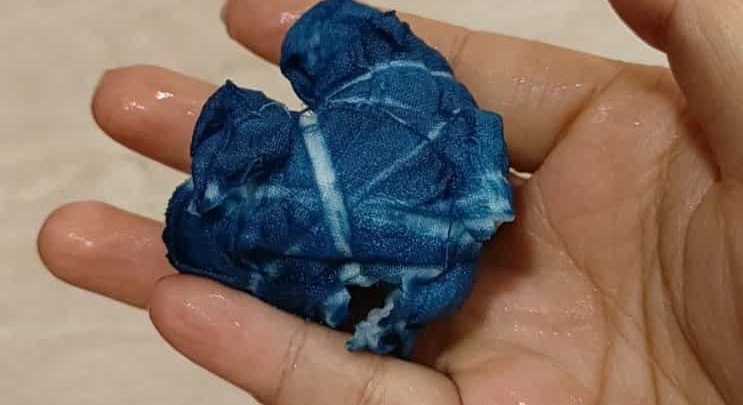
A bound bundle fresh from the dye vat: where the thread held tight, the white is waiting underneath.
How tie-dye is made: tying, dyeing, and the moment of unveiling
In Zhoucheng, near Dali, a length of Bai tie-dye goes through a clear sequence of steps [source:1]. First the pattern is brushed onto the white cloth. Then comes the crucial step: stitching and binding along the pattern — the tightness and spacing of each stitch decides what the finished flower will look like. The bound cloth is soaked, then lowered into the dye vat. The traditional dye is indigo, extracted and fermented from banlangen (woad, a blue-grass plant). The cloth is dipped and oxidized again and again, turning from green to blue in the air. After steaming to fix the color and drying in the sun, comes the most thrilling step of all: unpicking the threads.
Unpicking is a revelation. The cloth, bound through the whole process, relaxes open in your hands, and the blue-and-white pattern leaps out — no two lengths of tie-dye are ever identical, because every stitch's tension stays written in the pattern. A final pressing, and the cloth is done.
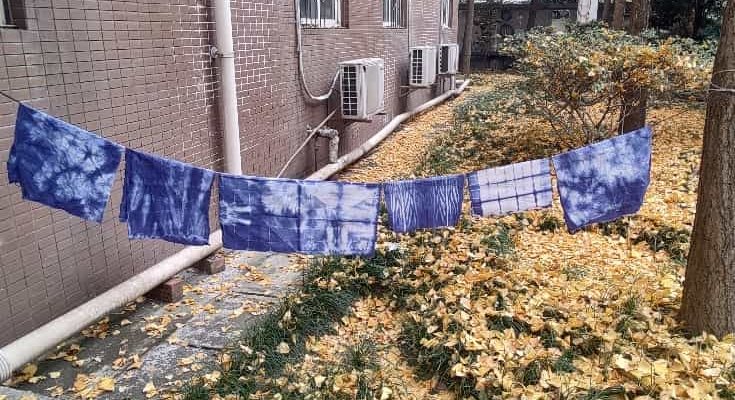
Fresh from the vat, tie-dye cloths dry on the line — each one a slightly different blue.
Dali and Zigong: two faces of Chinese tie-dye
Ask most people about Chinese tie-dye and they will picture Dali in Yunnan. Zhoucheng village, on the shore of Erhai Lake, is the heart of Bai tie-dye, where Bai and Yi women have practiced the craft for generations. The local style favors the classic blue-and-white palette, with patterns drawn from flowers, fish, insects, and the surrounding mountains and waters. In 2006 it entered the first national list of intangible cultural heritage (item VIII-26) [source:1].
The other face of Chinese tie-dye is Zigong in Sichuan. Zigong tie-dye, added to the national list as an extension in 2008, is famous for its multi-color work: dozens of techniques — twisting, stitching, binding, bundling, gathering, folding, tying, clamping — are combined with repeated immersions to layer several colors of gradient onto a single cloth [source:2]. If Dali tie-dye is a dialogue between blue and white, Zigong tie-dye is a full chorus. Precisely because the craft is so laborious, Zigong tie-dye was once close to disappearing, and its transmission remains fragile today [source:2].
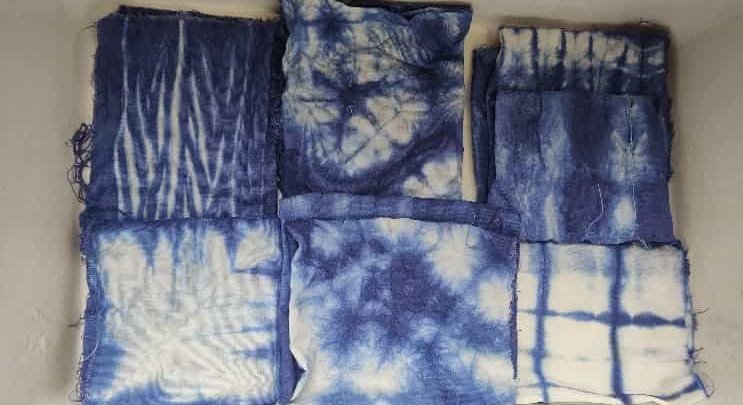
Same blue, same white — six different bindings, six entirely different patterns.
Batik: ice cracks drawn with a copper knife
If tie-dye's beauty lies in the binding, batik's beauty lies in the drawing.
In the Miao villages of Guizhou, batik is called wutu (务图) in the Miao language — "wax-dyed clothing." It is a craft passed from mother to daughter: a girl grows up watching her mother draw wax on cloth, then takes up the knife herself [source:3]. The tools could hardly be simpler — a copper knife and a small bowl for melted wax. The knife is dipped in molten beeswax and moved across handwoven white cotton, drawing flowers, birds, fish, and butterflies freehand, without any draft.
The painted cloth goes into the indigo vat. Where the wax has sealed the fibers, the dye cannot enter. And as the wax cools, it cracks into a web of fine fissures; indigo slips into the cracks and leaves hair-thin blue lines inside the white pattern. This is batik's famous "ice crackle" (bingwen), also called "tortoise-shell veining" [source:6]. Every crackle is accidental, so no two batik cloths are ever the same. After dyeing, the cloth is boiled to remove the wax, rinsed, and dried — and the blue-and-white batik is complete.
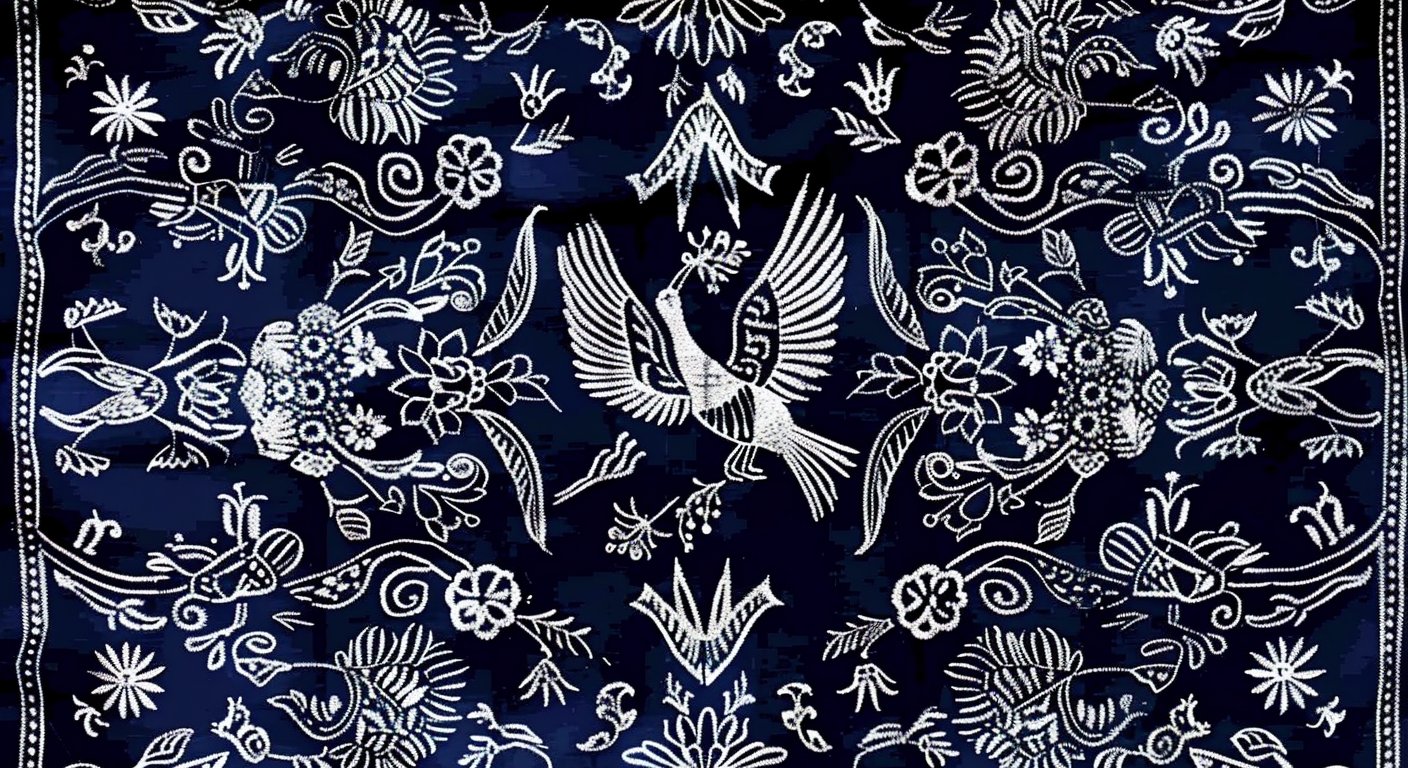
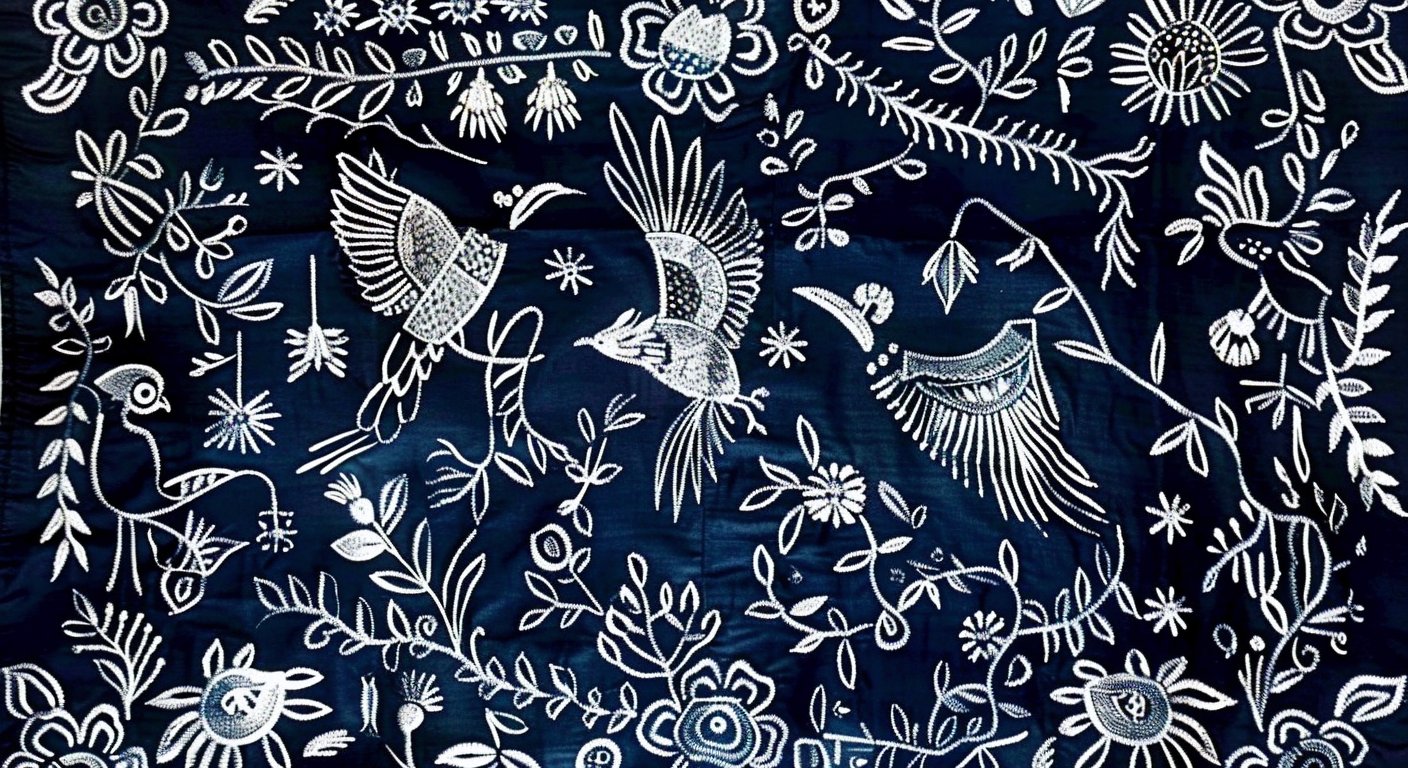
Phoenix, butterflies, and flowers — classic Miao batik subjects, drawn freehand with a copper knife.
Danzhai, Anshun, Zhijin: three schools of Miao batik
In 2006, Miao batik entered the first national list of intangible cultural heritage (item VIII-25), with its heartland in Danzhai, Anshun, and Zhijin in Guizhou [source:3]. All three are Miao batik, yet each has its own temperament [source:3]:
Danzhai batik celebrates nature, with large, generous motifs — birds, fish, flowers, and butterflies drawn with free, sweeping energy. Danzhai dyers also add color over the finished blue: red from madder root, yellow from gardenia fruit, lending warmth to the blue-and-white ground.
Anshun batik favors geometry: disciplined lines, precise symmetry, an ordered beauty.
Zhijin batik is famous for fineness — dense, delicate work with spiral patterns coiled like fingerprints. In 2021, Zhijin Miao batik was inscribed separately on the fifth national list of intangible cultural heritage [source:4].
Miao batik is usually blue and white, dyed with indigo fermented from blue-grass plants [source:6]. In southeastern Guizhou, the indigo vat lives in the stilted house itself, tended like a vat of living water.
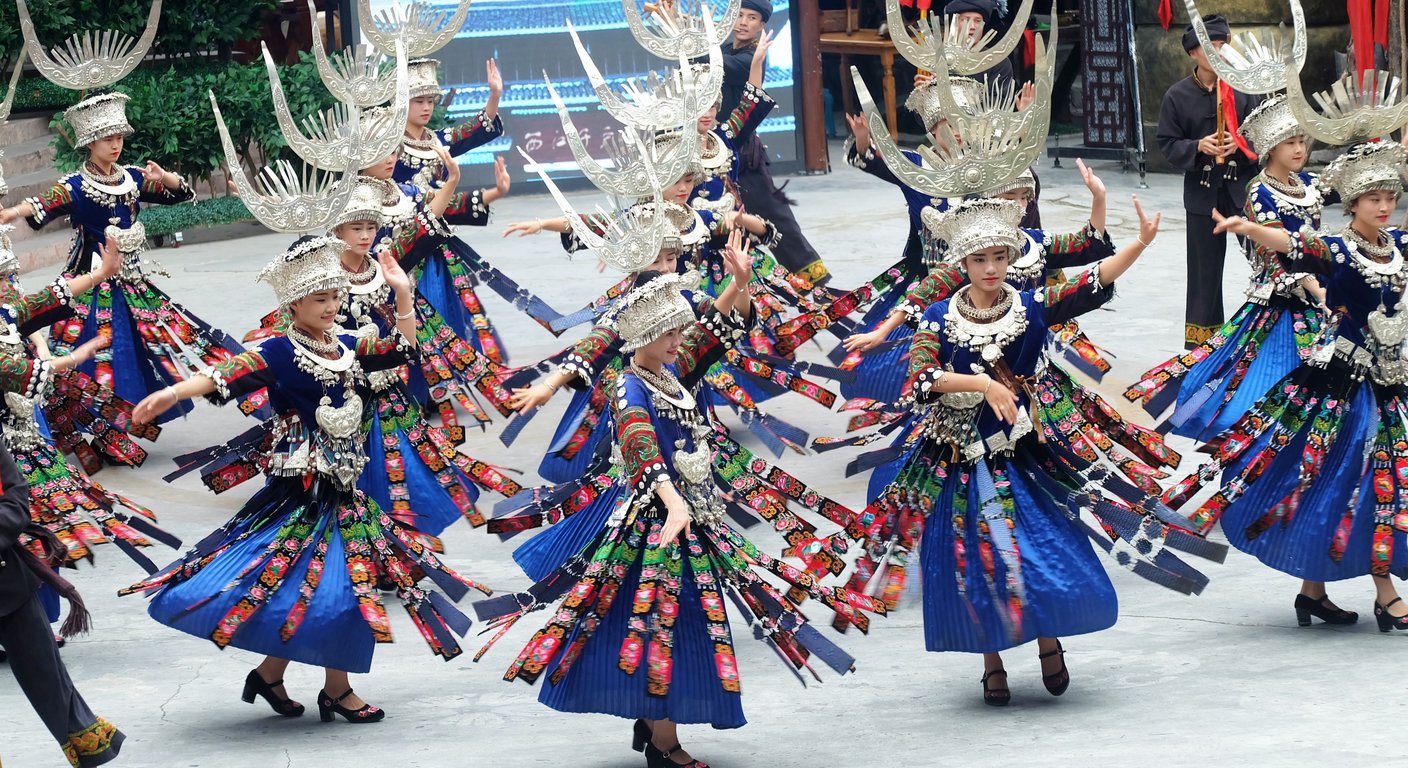
Festival dress is the Miao woman's finest wardrobe — silver horns, embroidered ribbons, and indigo skirts worn as living culture.
Reading the wax: butterflies, fish, and the Miao epic in cloth
For much of their history, the Miao had no unified written language — so their patterns became a history book worn on the body. Zhijin Miao batik alone counts thousands of documented motifs [source:4], and each recurring figure has a story.
The most important is the Butterfly Mother. In the Miao epic songs, a butterfly was born from a maple tree and laid twelve eggs, one of which hatched into the ancestor of humankind. The butterfly is thus the symbol of life's origin — almost an emblem of Miao identity. Other recurring figures include the dragon-headed fish, paired yin-yang fish, and "snake-skin" flowers: the dragon-fish carries old tribal memories, while spirals and geometry may record the mountains and rivers crossed on ancient migrations [source:4]. It is the same instinct that shapes Miao embroidery, where every stitch is a word.
Zhijin batik is made in five steps: the maker first scores the composition into the cloth with a fingernail, then draws the wax, dyes, removes the wax, and rinses [source:4]. In their hands the copper knife works like a calligrapher's brush — no draft, no corrections, the whole picture already complete in the mind before the first stroke.
A third answer: blue printed calico
Beyond tie-dye and batik, China has a third, more homely blue-and-white cloth: blue printed calico (lan yinhuabu), a descendant of the ancient clamp-resist tradition. It uses neither thread nor wax. A perforated oil-paper stencil is laid over the cloth, and a resist paste of soybean flour and lime is scraped through the openings; after dyeing, the paste is scraped away to reveal the white pattern.
Blue printed calico was once everywhere in the Jiangnan water towns: quilt covers, wrapping cloths, door curtains, aprons. Its motifs are more regular and more folksy — lions rolling embroidered balls, phoenixes threading through peonies, the qilin bringing a son — all auspicious wishes in cloth. If tie-dye and batik carry a whiff of the mountains, blue printed calico is the blue of the waterside kitchen.
Where to see and try tie-dye and batik today
Both of these ancient crafts can still be touched with your own hands.
In Zhoucheng, Dali, nearly every household keeps a dye vat, and visitors can step into a workshop to bind their own square of cloth and experience the whole journey from tying to unveiling. In Danzhai, Guizhou, batik cooperatives organize Miao women to draw, dye, and sell together, turning a cloth once made for family use into a living craft economy. In workshops in both places, the most common scene is the same: a child from the city dips cloth into the vat for the first time and gasps as it turns from green to blue in the open air.
The blue-and-white aesthetic is also returning to modern life. Tie-dyed scarves, batik bags, and blue-calico table runners appear on designers' runways and in young people's homes. The millennia-old jiaoxie and waxie have not become museum specimens — they have simply found new ways to keep leaving white flowers on blue cloth.
Frequently asked questions
What is the difference between tie-dye and batik? The core difference is the method of "resist." Tie-dye binds the cloth with thread so the bound areas stay undyed; batik covers the pattern with melted beeswax so the waxed areas stay undyed. Tie-dye patterns are soft and haloed; batik lines are crisp and freehand, often traced with natural ice-crack veining.
Why are Chinese tie-dye and batik always blue? The traditional dye is indigo, extracted from blue-grass plants (such as banlangen, or woad) and fermented into a vat dye. Indigo is colorfast, moth-resistant, and gentle on the skin, which made blue-and-white the classic palette of both crafts.
Is tie-dye only found in Dali? No. Zhoucheng in Dali is the most famous center, but Zigong tie-dye in Sichuan is also national-level intangible cultural heritage, known for multi-color layered dyeing. Tie-dye also has a long tradition among Yi communities in Weishan, Yunnan [source:5].
Is batik only found in China? No. Batik traditions exist in Indonesia, Malaysia, India, Nigeria, and elsewhere — Indonesian Javanese batik was inscribed on UNESCO's Representative List of the Intangible Cultural Heritage of Humanity in 2009 [source:6]. Chinese Miao batik stands apart for its copper-knife freehand drawing, its ice-crack effect, and its epic, story-bearing motifs.
Can children try tie-dye? Absolutely. Tie-dye is gentle, safe, and perfect for family activities: bind with rubber bands, dip, and unpick — within half an hour a child can hold their own finished piece. Heritage workshops in Dali and Guizhou widely offer hands-on classes, as do many city museums and craft studios.