In the villages of northern China, cloth was never thrown away. A worn shirt became a patch. A faded bedsheet became part of a quilt. Leftover fabric from a wedding dress became a blessing sewn into a child's hat.
This tradition of patchwork was born from poverty, but it became an art form full of meaning — and in the tiger hats, cloth tigers, and hundred-family quilts of the north, it produced some of the most beloved objects in Chinese folk art.
Nothing wasted
Northern winters were long and cold. Families needed thick bedding and padded clothing but could not always afford new cloth. Cotton fabric was precious: until well into the twentieth century, many rural families wove and dyed their own, and every meter represented days of labor. So they saved every scrap. Small pieces were joined into larger squares, then layered with cotton batting and quilted together into bedding, door curtains, and padded jackets.
The result was practical and beautiful. Bright colors and geometric patterns turned necessity into decoration. A well-planned patchwork quilt could use dozens of fabric memories — a sister's wedding dress, a father's old shirt, a length of festival red — arranged in diamonds, squares, and strips. Quilters developed an eye for contrast and rhythm, placing dark against light, plain against printed, so that the finished quilt read as a deliberate composition rather than a compromise.
This aesthetic of making-do has a name in folk art scholarship: the art of pin (拼), joining. It appears across northern folk crafts, from appliqué clothing to pieced door hangings, and it taught generations of village women the fundamentals of color and design that also fed into embroidery, paper cutting, and toy making.
The hundred families quilt
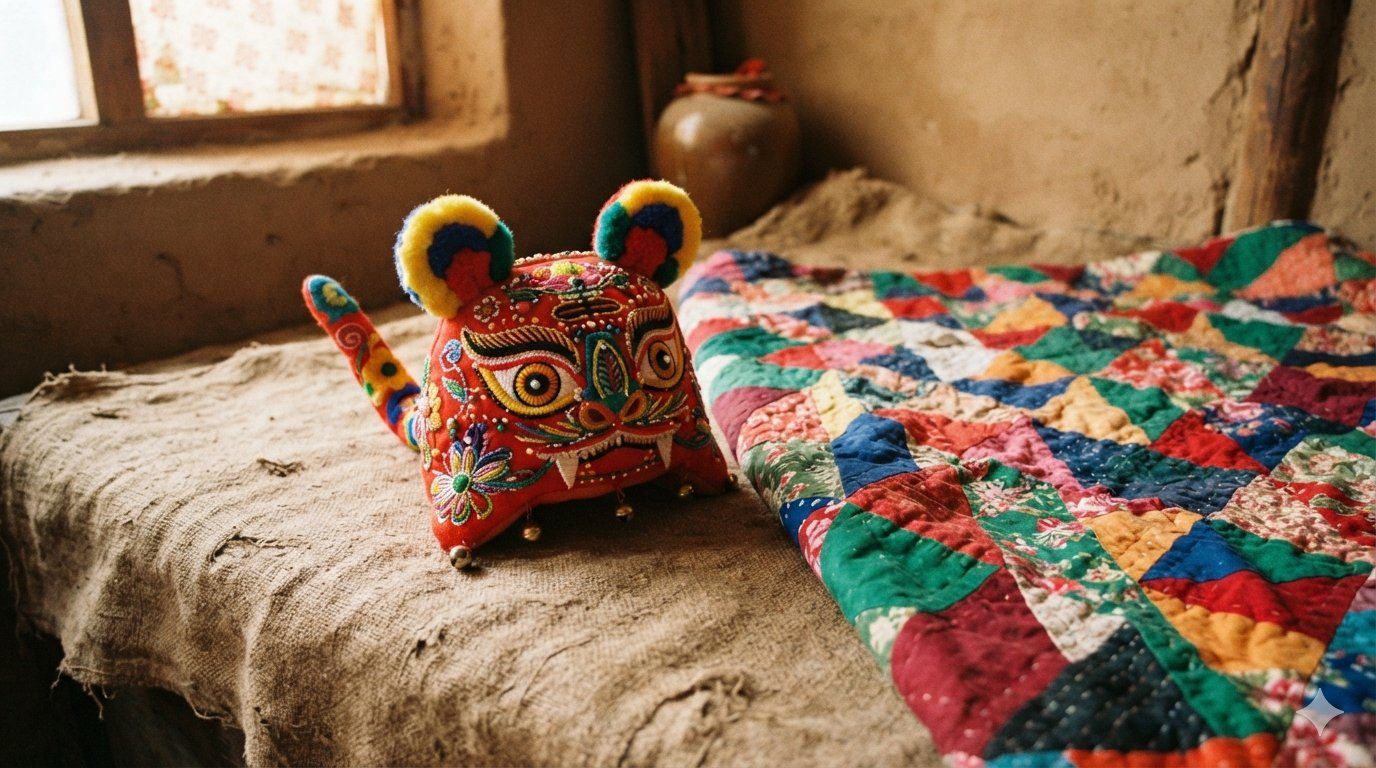
One of the most meaningful patchwork traditions was the hundred families quilt (baijia bei, 百家被). When a baby was born, the family asked neighbors and relatives for small pieces of cloth. These were sewn together into a single quilt.
The idea was that the child would be protected by the collective goodwill of the community. Each patch carried a piece of a neighbor's blessing. A related custom produced the hundred families coat (baijia yi, 百家衣), a child's garment pieced from contributed scraps, sometimes deliberately collected from many households — the more families represented, the stronger the protection. The logic echoes an older practice: collecting a hundred families' rice or coins to buy a child a "longevity lock." In each case, the community itself becomes the charm, woven around the child to confuse misfortune and share the responsibility of keeping a small life safe.
The custom also had a practical social function. Asking for a patch was an easy, graceful way to announce a birth and invite the village into the family's joy; giving one was an obligation everyone could afford. The quilt that resulted was a map of the family's relationships, legible to anyone who knew whose cloth was whose.
Why the tiger?
Among all the animals in Chinese folk art, the tiger holds a special place as protector of children. The tiger is the king of beasts — the three horizontal lines and one vertical stroke on its forehead even read as the character wang (王), "king," which embroiderers often stitch explicitly onto tiger hats and cloth tigers. Folk belief held that a creature so fierce would frighten away the evil spirits and illnesses that threatened small children, and that a child dressed as a tiger would grow up as strong and bold as one.
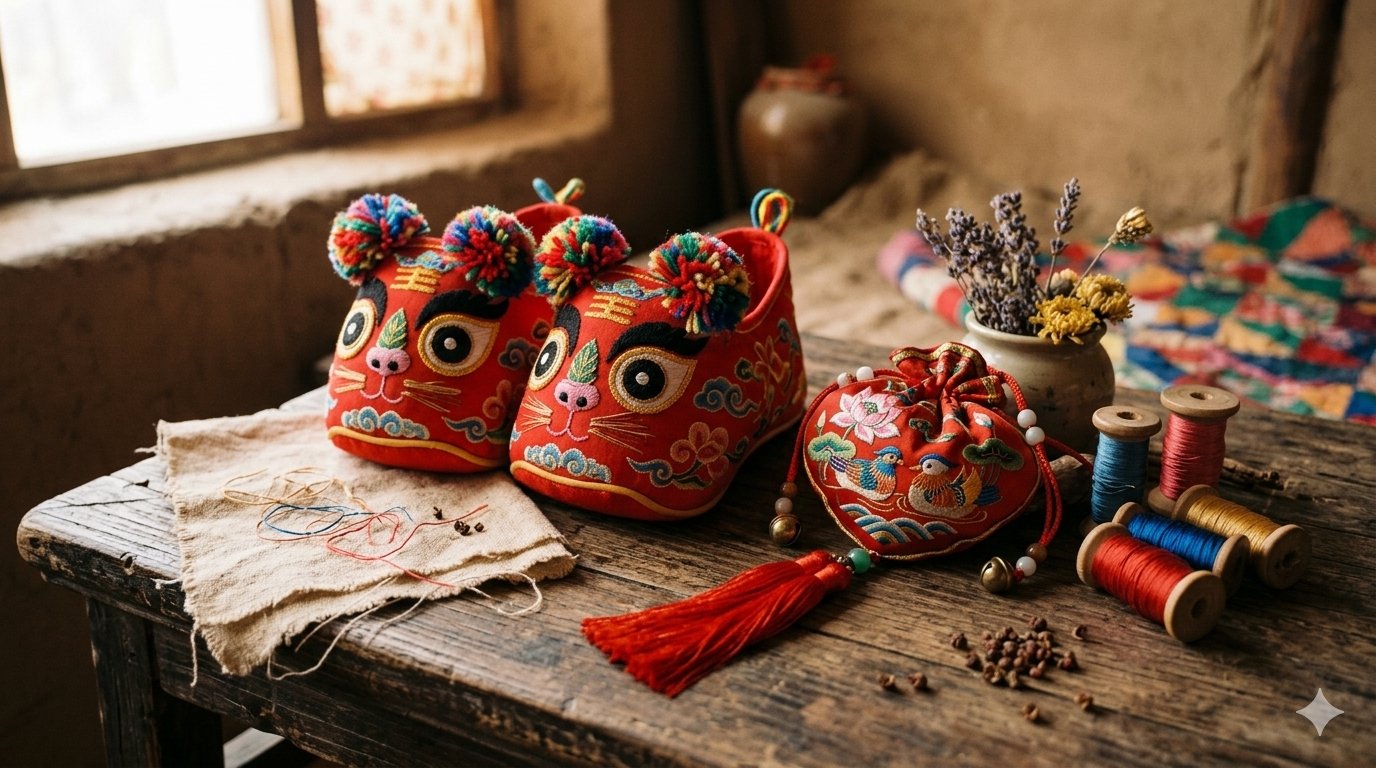
So the tiger became the patron animal of early childhood. Across the north, babies wore tiger hats and tiger shoes, slept on tiger pillows, and played with cloth tigers. The full kit could include a tiger-head hat, tiger-head shoes, a tiger cape, a tiger bib, and a tiger bellyband — a head-to-toe armor of embroidered protection, usually made by the women of the family or given by the maternal grandmother. Parents still call a sturdy child hu wa (虎娃), "tiger cub," and the compliment hu tou hu nao (虎头虎脑, "tiger head, tiger brain") describes a healthy, sturdy-looking toddler.
Tiger hats
Along with tiger shoes, northern families made tiger hats for babies and young children. The hat was shaped like a tiger's head, with embroidered eyes, ears, and whiskers. Sometimes a small bell was sewn inside, so the hat made a gentle sound when the child moved.
A good tiger hat is a small sculpture. The maker builds the face in layers: a base of padded cloth, appliqué patches for the white of the eyes and the muzzle, embroidered pupils, nose, and the all-important wang character on the forehead, and two upright ears — often stiffened so they stand alert. Whiskers may be stitched in white thread or made from knotted cord. The back of the hat extends into a flap that covers the child's neck, sometimes finished with a row of tiny cloth tigers or tassels. Colors are bold: yellow and orange for the tiger, red for luck, green and pink accents for festive brightness.
Like the shoes, the hat was meant to frighten away evil spirits and keep the child safe. But it was also a public display of love — a way for a mother or grandmother to show her needlework and her devotion at every village gathering. A particularly fine tiger hat was admired, studied, and copied, pattern traveling from village to village the way folk patterns always have.
The Lihou tiger: a cloth tiger with ancient roots
The most famous cloth tiger in China comes from Licheng County in Shanxi, and it shows how deep this tradition runs. The Lihou tiger (黎侯虎) takes its name from the ancient state of Lihou that once stood there. Artifacts excavated from Western Zhou dynasty tombs at Xiguan village show that tiger worship in the area reaches back to the Shang and Zhou periods — three thousand years of tiger imagery in wood, stone, straw, paper, and cloth, of which the sewn cloth tiger is the richest surviving form.
A Lihou tiger is made by sewing dyed cotton cloth into a stylized tiger body, then decorating it with appliqué patches, painted details, and hanging tassels. The result stands head-high and chest-out in a highly condensed, almost geometric pose — more emblem than animal, radiating vigor. The tigers come in large, medium, and small sizes, and local custom assigns them roles: a pair of cloth tigers guards a household; a small one accompanies a child. In 2008, Lihou tiger making was inscribed on China's national list of intangible cultural heritage, and the county still supports farmer needleworkers who produce them.
Shanxi's tiger culture goes well beyond Licheng. At a 2022 Spring Festival heritage fair in Taiyuan, collectors displayed tiger-head shoes, tiger hats, tiger capes, tiger bibs, tiger bellybands, and cloth tigers of every size gathered from villages across the province — objects the exhibitors described as "treasures that accompanied growing up, condensed with blessing." Similar tiger-cloth traditions thrive in neighboring Shaanxi, where the embroidery cooperatives of Qianyang County have carried local tiger hats as far as the Beijing Winter Olympics.
How the pieces are made
Northern cloth folk art shares a compact toolkit of techniques:
- Piecing (拼缝): joining saved scraps into quilt tops, coat backs, and curtain panels — the foundation of the hundred families quilt.
- Appliqué (贴布): cutting cloth shapes and stitching them onto a base, used for tiger faces, muzzles, and decorative borders.
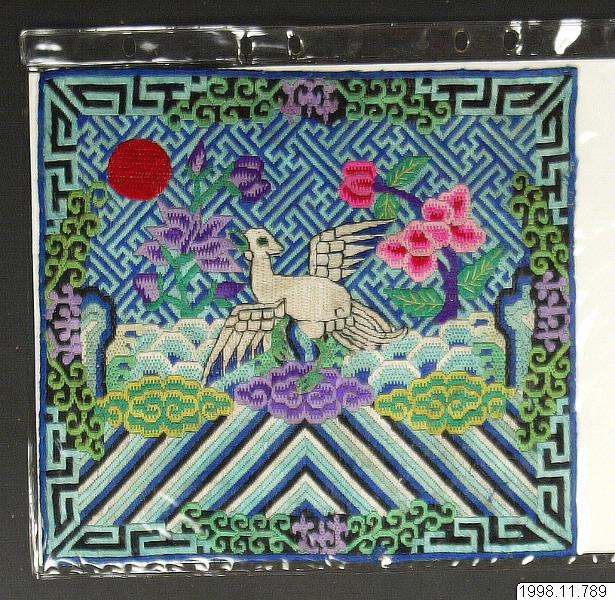
- Embroidery (刺绣): satin stitch and outline stitch for eyes, whiskers, the wang character, and floral fills.
- Padding and quilting: layering cotton batting for warmth and sculpting — what gives a tiger hat its rounded cheeks and a quilt its weight.
- Tassels and bells (挂穗): finishing details that add movement and sound, pleasing to babies and festive to the eye.
Every one of these techniques could be learned at home, from mother to daughter, which is precisely why the tradition was so resilient: it required no workshop, no master, and no money — only saved cloth, patience, and love.
Living tradition
Today, machine-made clothing has reduced the need for patchwork, but the tradition survives in craft markets and museums. Some families still make tiger shoes and hats for new babies, and heritage workshops in Shanxi, Shaanxi, and Gansu have turned village needlework into a source of income for rural women. Tiger hats appear on postage stamps and at international exhibitions; cloth tigers stand guard in folk-art museums from Taiyuan to Stockholm, where the Museum of Far Eastern Antiquities holds Qing dynasty tiger-head shoes.
The old cloth may be gone, but the wishes stitched into it remain. And when a grandmother today pieces a small quilt or sews a tiger hat for a new baby, she is doing exactly what the women of the northern villages did: turning leftovers into armor, and fabric into a blessing. If you would like to meet the companion pieces — the tiger shoes and scented sachets that completed a baby's traditional kit — see our article on tiger shoes and baby sachets.
Frequently asked questions
What is a hundred families quilt?
A hundred families quilt (baijia bei) is a patchwork quilt sewn for a newborn from small pieces of cloth contributed by neighbors and relatives. Each patch was believed to carry a household's goodwill, so the quilt wrapped the baby in the collective protection of the community. A matching custom-made hundred families coats from contributed scraps.
Why do Chinese babies wear tiger hats?
Folk belief casts the tiger, king of beasts, as a fierce protector that frightens away evil spirits and illness. Dressing a baby in a tiger hat — often stitched with the character 王 ("king") on the forehead — was a way to borrow the tiger's strength and wish the child a bold, healthy life. The hats were also displays of family needlework and affection.
What is a Lihou tiger?
The Lihou tiger is a cloth tiger from Licheng County, Shanxi, named for the ancient state of Lihou. Sewn from dyed cotton and finished with appliqué, painting, and tassels, it descends from a local tiger-worship tradition documented as far back as Western Zhou tombs. In 2008, it was listed as national intangible cultural heritage.
Is Chinese patchwork related to quilting in other countries?
The construction logic — piecing scraps, layering with batting, quilting through — is shared wherever cloth was precious, from American scrap quilts to Japanese boro. The Chinese northern tradition is distinguished by its protective purpose: patchwork was often assembled deliberately from many households to gather blessings for a child.
Where can I see tiger hats and cloth tigers today?
Folk-art museums across northern China display them, and heritage fairs in Shanxi regularly exhibit historic tiger-head shoes, hats, capes, and bibs. Craft markets in Xi'an, Taiyuan, and Beijing sell newly made examples, and artisans in Licheng and Qianyang counties still produce them by hand.
Author
This article was prepared by the team at ChineseFolkCrafts.com. We are not intangible-cultural-heritage inheritors or museum researchers. Our job is to find authoritative Chinese sources, understand them, and explain them clearly for international readers.
If you spot an error — a date, a translation, a misattributed custom — please let us know and we will correct it. Last updated 2026-07-08.