In Chinese villages, a newborn's first shoes were rarely bought from a shop. They were sewn by grandmothers and aunts: tiny cloth shoes with round tiger faces, bright embroidery, and hidden wishes for health and courage.
This is cloth folk art — not the silk robes of emperors, but the patchwork, embroidery, and stitching that ordinary families used to turn everyday objects into blessings.
Cloth as protection
For centuries, Chinese families believed that infants and children were vulnerable to evil spirits and illness. The solution was not just medicine but symbolism. A tiger, the king of beasts, could frighten away harm. A sachet filled with fragrant herbs could purify the air around a child. An embroidered pouch could carry a prayer.
So cloth became armor. Babies wore tiger hats and tiger shoes. Pregnant women carried embroidered sachets. Brides received quilts covered with symbols of fertility and long life.
"A needle and thread can speak louder than words when the words are wishes for a child."
This protective logic reached its fullest expression at two moments of vulnerability: birth, when tiger gear wrapped the newborn, and early summer, when sachets went up against the "five poisons" of the season. Both customs survive today, and both are now recognized as carriers of genuine craft heritage.
The tiger shoe
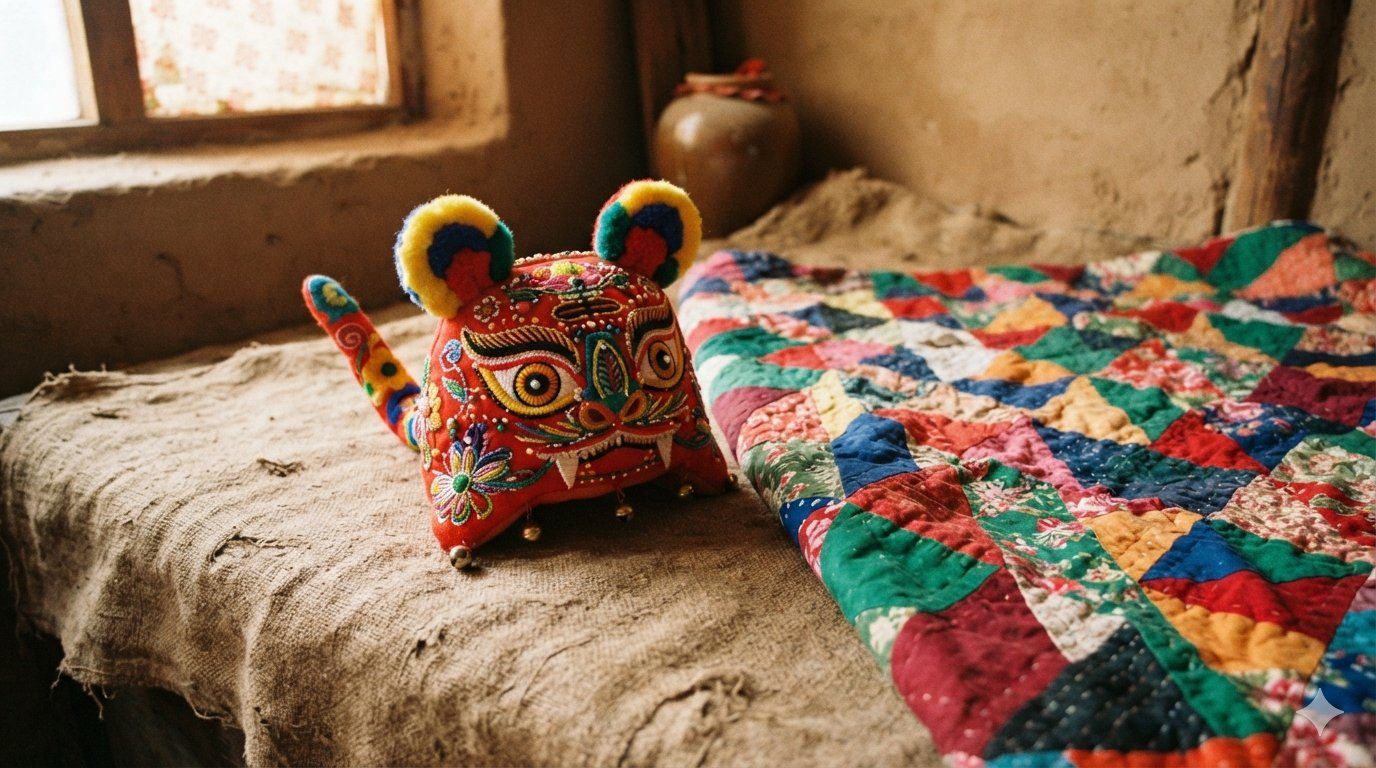
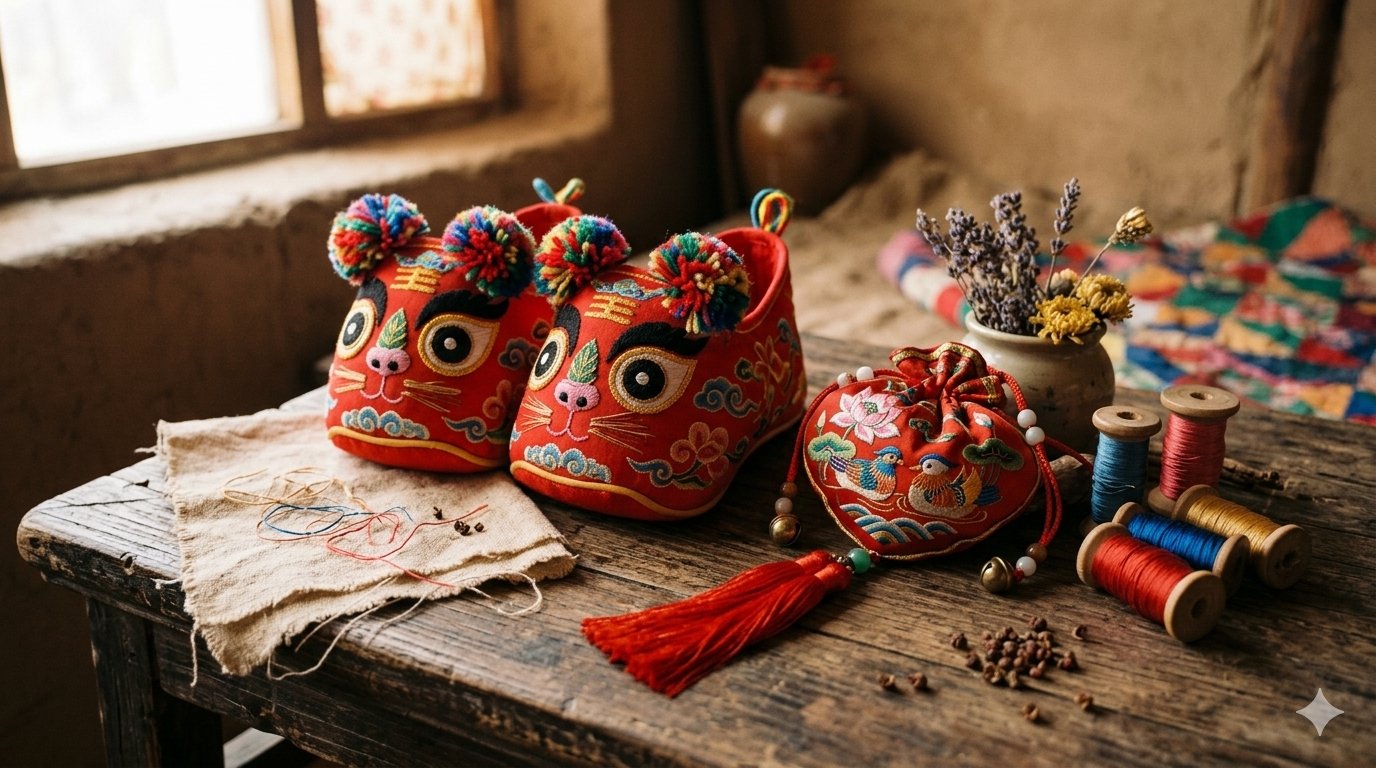
Tiger shoes, or laohu xie (老虎鞋), are the best known example. The front of each shoe is shaped and embroidered to look like a tiger's face: round eyes, a broad nose, whiskers, and sometimes small ears sticking up. The tradition is especially strong in southern Hebei and across the north, where matching tiger-head hats complete the outfit.
A traditional pair starts with the sole — many layers of cotton cloth pasted together, dried, and stitched through with dense rows of hemp or cotton thread, the famous "thousand-layer sole" technique of Chinese cloth shoemaking. The upper is cut from bright cloth, usually yellow or red, and the tiger face is built up in appliqué and embroidery: white-edged eyes with dark pupils, a stitched nose, radiating whiskers, and often the character wang (王, "king") on the forehead, because the markings on a real tiger's brow were said to spell exactly that. The shoe is soft-soled for a pre-walking baby; it was never meant for mileage.
The tiger was chosen because it was fierce enough to protect the child and noble enough to bring dignity. In some regions, the first pair was made before the baby was born, as a gift from the maternal grandmother. The shoes were too small to walk in for long, but that was not the point. They were a portable blessing — one half of the head-to-toe tiger armor that also included hats, capes, bibs, and bellybands. Qing dynasty tiger-head shoes survive in museum collections as far away as the Museum of Far Eastern Antiquities in Stockholm, evidence of how widespread the custom once was.
Sachets and scent
Embroidered sachets, or xiangnang (香囊) — also called xiangbao (香包), "fragrant bag" — were another common cloth art. They were small pouches, often shaped like animals, flowers, or gourds, filled with dried herbs such as mugwort, cinnamon, and cloves.
During the Dragon Boat Festival, families hung sachets on children's clothing to protect them during the summer months. The festival falls as the weather turns hot and insects multiply, and folk tradition marked it as a dangerous season of "five poisons." The aromatic herbs — mugwort, calamus, angelica, clove, and others — were believed to repel pests and ward off disease, and the pouch that held them worked as both medicine and charm. Lovers also exchanged sachets as tokens. A well-made sachet showed patience, skill, and affection.
Two thousand years of the sachet
The sachet is one of the oldest continuously used accessories in China. The Book of Rites (礼记) records that boys and girls not yet of age wore rongchou (容臭) — "odor holders" — small pouches of fragrant herbs at the waist, and the poet Qu Yuan's Li Sao made wearing fragrant plants the classic image of personal virtue. By the Han dynasty, sachets hung from the four corners of bed curtains — the ancient ballad Peacock Flying Southeast describes a bed-curtain "with sachets dangling at its corners" — and lovers tied them at the elbow as gifts of devotion. A Ming dynasty perfume manual, the Xiang Sheng (香乘), gives a precise recipe: cloves, gansong, patchouli, angelica, tree peony bark, and star anise, crushed and sealed in a silk pouch.
By the Qing dynasty at the latest, the sachet had merged with Dragon Boat Festival custom. Beijing's festival records describe households hanging mugwort "tigers" and dressing little girls with small silk pouches sewn into shapes — figures, dumplings, garlic heads, and "five-poison tigers." The sachet you see at a Dragon Boat Festival market today is the direct heir of that custom.
Heritage sachets: Qingyang and Xuzhou
Two regional sachet traditions are listed as national intangible cultural heritage, and they show the range of the craft.
Qingyang sachets, from the loess plateau of eastern Gansu, are locally called chuchu (绌绌), after an old word for a stitched pouch. Local legend traces the custom back more than four thousand years to Qibo, the legendary physician of the Yellow Emperor's Inner Classic and a native of Qingyang, who was said to carry a herb bag against epidemics. Whatever its true age, the craft flourished through the Ming and Qing, and until the mid-twentieth century Qingyang girls "learned the needle at seven or eight." Qingyang sachets come in four technical families: chuchu "hidden-stitch" pouches, where the seam vanishes inside the form; cord-wound "thread-coiled" sachets shaped like five-pointed dumplings; three-dimensional embroidered hangings and pendants in nearly four hundred styles; and flat embroidery worked in a dozen stitches from braid-stitch to gold-couching. In 2002 Qingyang was named China's "home of sachet embroidery," and inheritors like Liu Lanfang have since built cooperatives that employ thousands of rural women, opened a private sachet museum, and carried the little pouches to exhibitions in America and beyond.
Xuzhou sachets, from Jiangsu, unite utility and ornament: honest and simple in shape, precise in stitch, and filled with medicinal herbs that repel mosquitoes, resist damp, and freshen the air. Their forms are exuberant — hearts, rounds, diamonds, ingots, butterflies, vases, teardrops, and little dolls — and their surfaces carry the classic auspicious repertory: dragon and phoenix, mandarin ducks among lotuses, pine and crane for long life, magpies on blossoming plum. Modern Xuzhou makers have added opera masks and cartoon figures to the traditional stock, keeping the craft legible to new generations.
Regional styles
Different regions developed their own cloth traditions:
- Northern China: bold tiger shoes and patchwork quilts using strong primary colors — including the Lihou cloth tigers of Shanxi and the hundred families quilts of the villages
- Jiangnan: delicate silk embroidery on sachets and handkerchiefs, with Xuzhou's sachet-making listed as national heritage
- Shaanxi: bright, geometric applique work influenced by paper cutting, and tiger hats carried by the embroidery cooperatives of Qianyang County
- Gansu: the Qingyang sachet, from hidden-stitch chuchu pouches to three-dimensional embroidered hangings
- Guizhou: indigo-dyed cloth with wax-resist patterns made by Miao communities
Each style used local materials and local beliefs, but the purpose was the same: to wrap the people you loved in beauty and protection.
Make a simple sachet yourself
A basic sachet needs no pattern beyond a heart, a fish, or a gourd. Cut two identical shapes from bright cotton or silk, embroider or appliqué a simple motif on the front piece — a flower, a character, a tiny tiger face — then stitch the two pieces right sides together, leaving a gap. Turn the pouch right side out, fill it with dried lavender, mugwort, or a clove-and-cinnamon mix, add a loop of cord, and slip-stitch the gap closed. Finish with a tassel. You have just repeated, in miniature, a custom recorded in the Book of Rites. For the patchwork side of this tradition, see our article on northern patchwork quilts and tiger hats, and for the stitches that decorate these pieces, our guide to China's four great embroidery styles.
Frequently asked questions
What are Chinese tiger shoes for?
Tiger shoes are soft cloth shoes for babies and toddlers, embroidered with a tiger's face. Folk belief held that the tiger, king of beasts, would frighten away evil spirits and illness, so dressing a child in tiger shoes — often with a matching tiger hat — borrowed the animal's protection. They were usually sewn by mothers and grandmothers and given as gifts.
What is inside a Chinese sachet (xiangbao)?
Traditional sachets hold dried aromatic herbs: mugwort, calamus, angelica, cloves, cinnamon, patchouli, and star anise are all recorded in historical recipes. The scent was believed to repel insects, purify the air, and ward off disease — one reason sachets were worn through the summer months and especially at the Dragon Boat Festival.
Why are sachets associated with the Dragon Boat Festival?
The festival arrives as summer heat and insects surge, and folk tradition treated it as a season of "five poisons." Wearing herb-filled sachets, hanging mugwort, and tying five-color cords were all protective customs for the dangerous season, recorded in Qing dynasty festival accounts and continued in markets today.
What is a Qingyang sachet?
The Qingyang sachet, from eastern Gansu, is a national intangible cultural heritage known locally as chuchu. It comes in four technical families — hidden-stitch pouches, cord-coiled dumpling shapes, three-dimensional embroidered hangings, and flat embroidery — and local legend links it to the ancient physician Qibo. Qingyang was named China's "home of sachet embroidery" in 2002.
Can I still buy handmade tiger shoes and sachets?
Yes. Heritage workshops in Gansu, Jiangsu, Shanxi, and Shaanxi produce them by hand, and they appear widely at craft markets and around the Dragon Boat Festival. Museum shops in China also sell versions made by inheritor-led cooperatives, which support rural needleworkers.
Author
This article was prepared by the team at ChineseFolkCrafts.com. We are not intangible-cultural-heritage inheritors or museum researchers. Our job is to find authoritative Chinese sources, understand them, and explain them clearly for international readers.
If you spot an error — a date, a translation, a misattributed custom — please let us know and we will correct it. Last updated 2026-07-11.