Miao Embroidery: Patterns That Record a History Without Words
In the mountain villages of Guizhou, Hunan, and Yunnan, a Miao woman may spend three to five years stitching her wedding costume. She does not write a diary. She does not keep a family tree on paper. Instead, she records the journey of her ancestors, the myths of her people, and her own hopes for the future in colored silk thread on indigo cloth. To the Miao people, embroidery is a history book worn on the body — a wordless archive that can be read by anyone who knows the language of its patterns [source:1][source:2].
A history without words: why Miao embroidery matters
The Miao are one of China’s largest ethnic minorities, with a population spread across steep valleys and high plateaus. For much of their history, the Miao did not use a single unified writing system. Important knowledge — genealogies, migration routes, creation stories, and religious beliefs — had to be preserved in other ways. Oral song was one path; cloth was another.
Embroidery became the Miao people’s visual text. A skirt panel might trace a river crossing made during an ancient migration. A baby carrier might show the Butterfly Mother, the ancestor from whom all life sprang. A collar might carry the image of a dragon not as a royal symbol, but as a water spirit who protects the crops. Because every stitch carries meaning, Miao embroidery is often called the "history book worn on the body" [source:3].
In 2006, Miao embroidery was added to China’s first list of national intangible cultural heritage. Today seven regional sub-styles hold national recognition: Taijiang, Leishan, Jianhe, Huaxi, Kaili, Songtao, and Xiangxi [source:1][source:3].
From tattooed skin to embroidered cloth: origins of Miao embroidery
Scholars trace the roots of Miao embroidery to the tattooing practices of the ancient Pu people. Long before cloth was decorated, skin was marked with protective symbols. As silk farming and weaving developed, those same symbols moved from body to fabric. The tattoos became tiaohua (counted-thread work), woven flowers, and finally the rich embroidery seen today [source:2].
Historical records support this long lineage. The Book of the Later Han describes Miao ancestors weaving tree bark, dyeing with plant fruits, and loving "five-colored clothing." In the Tang dynasty, a Miao envoy named Xie Yuanshen appeared at the Tang court wearing brilliantly decorated robes; the emperor ordered painters to record the scene in the Wanghui Tu (Picture of the Royal Audience) [source:2]. By the Ming and Qing dynasties, local gazetteers across Guizhou, Yunnan, Hunan, and Guangxi were praising Miao women for their ability to weave and embroider "Miao brocade."
This deep history means that Miao embroidery is not a single style. Because the Miao migrated in many directions and lived in isolated mountain communities, different branches developed their own stitches, color palettes, and symbolic vocabularies.
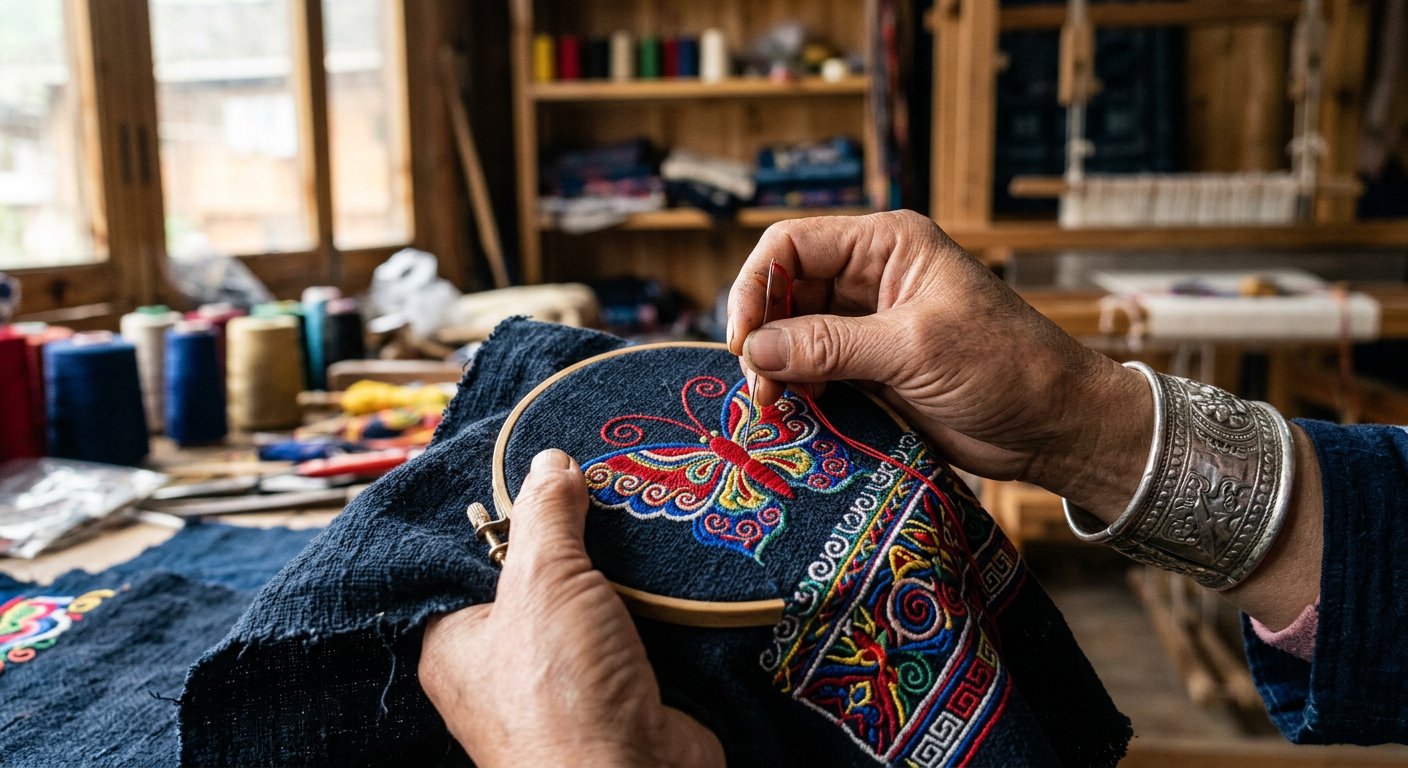
A Miao embroiderer stitches a butterfly motif onto dark indigo cloth. Each pattern functions like a word in a visual language passed down through generations.
If you are new to Chinese textile arts, you may also want to read our overview of the four famous schools of Chinese embroidery before exploring Miao embroidery's unique visual vocabulary.
Reading the patterns: animals, plants, and sacred symbols
To an outsider, a Miao jacket may look like a riot of color. To an insider, every shape is a word in a sentence. Miao embroidery motifs fall into several categories [source:2]:
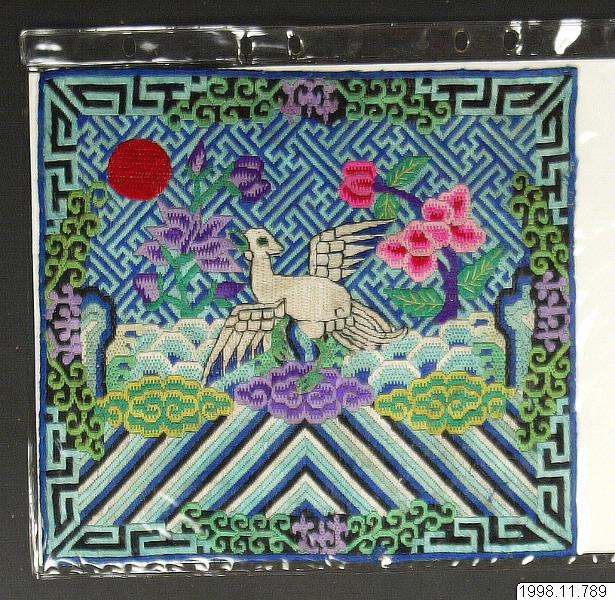
Animal motifs. The butterfly is among the most important. In Miao mythology, the Butterfly Mother (Mai Bang) was born from a maple tree and laid twelve eggs, one of which became the ancestor of the Miao people. Birds, fish, dragons, and bats also appear frequently. A bat is not frightening; its name (fu) sounds like the word for good fortune.
Plant motifs. The maple tree represents the origin of life. Pomegranates and grapes express wishes for many children. Flowers and vines suggest growth, beauty, and continuity.
Figure motifs. Heroes and ancestors such as Jiang Yang, Chiyou, Lanjuan, and Wumoxi appear in narrative embroideries. These figures preserve historical memory and ethnic identity.
Symbol and geometric motifs. Waves, sun disks, bronze-drum patterns, and wanzi (swastika-like) patterns reference natural forces, ancient rituals, and protective magic. Some geometric marks resemble fragments of an old Miao script and are still studied by scholars today.
Miao embroidery does not usually copy real scenes. Instead, it borrows shapes to express ideas — what the writer Shen Congwen praised as "creative boldness and innocence" [source:2]. A single garment can therefore be read as a poem about creation, migration, and hope.
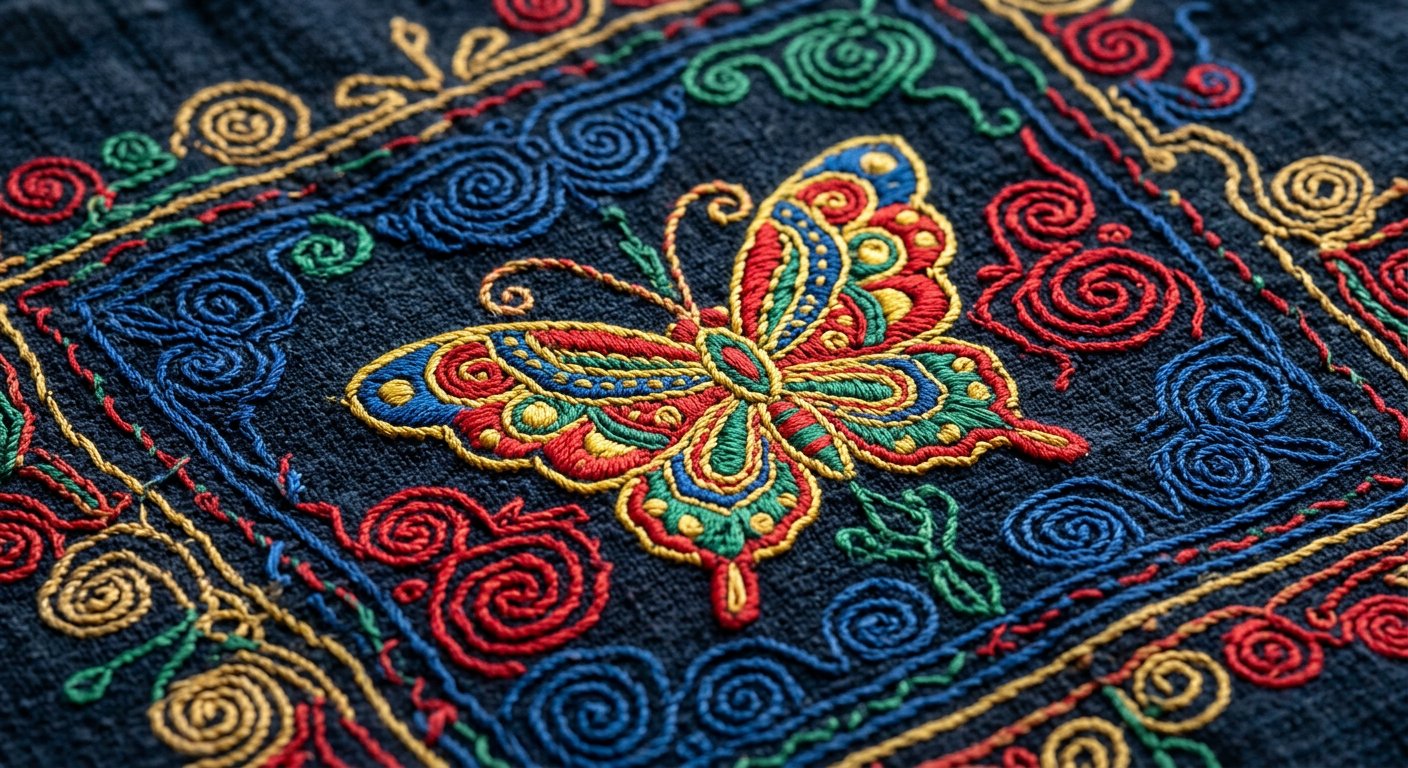
The butterfly is one of the most important motifs in Miao embroidery, representing the Butterfly Mother from whom Miao mythology traces the origin of life.
Seven faces of Miao embroidery: regional styles across China
Miao embroidery varies sharply from valley to valley. A few representative styles include [source:1][source:3]:
- Taijiang Miao embroidery, centered in Shidong Township, is famous for its dense, realistic imagery and split-thread stitching. Taijiang costumes are divided into nine types based on pattern and cut, each marking a different branch of the Miao people.
- Leishan Miao embroidery favors zhouxiu, or crepe stitch, which creates a raised, textured surface that catches the light.
- Jianhe Miao embroidery is instantly recognizable by its tin embroidery: small strips of silvery tin are stitched onto dark blue cloth, giving the fabric the appearance of metal armor.
- Huaxi Miao embroidery uses counted-thread cross-stitch without a drawn pattern. The embroiderer counts warp and weft threads, creating perfectly symmetrical designs from memory.
- Songtao Miao embroidery is known for bold color contrasts and more than a hundred stitch variations. Songtao pieces often look three-dimensional because the artist layers threads to build depth.
- Xiangxi Miao embroidery, from western Hunan, has been recorded in Tang-dynasty sources and is especially valued for its fine, expressive flower-and-bird work.
These differences are not accidental. They are identity badges. When two Miao women meet at a festival, they can often tell each other’s home village by the style of their collar, sleeve, or skirt panel [source:2].
The needle vocabulary: stitches and techniques
Miao embroidery is technically demanding. Common stitches include flat stitch, crepe stitch, braid stitch, counted-thread work, split-thread embroidery, seed stitch, pile stitch, appliqué, and tin embroidery [source:1][source:3]. Some pieces combine several techniques in a single panel.
What is remarkable is how often the work is done without a drawn pattern. Many Miao embroiderers learn by watching mothers and grandmothers, internalizing hundreds of motifs until the needle moves almost from memory. This "heart-method" inheritance means that the craft is passed down as a living practice, not as a set of fixed blueprints.
A girl's three-year dowry: embroidery and Miao women's lives
For generations, Miao girls began learning to embroider as children. Before marriage, a young woman was expected to make her own wedding costume — a project that could take three to five years [source:1]. The finished garment was more than clothing. It was proof of patience, skill, and cultural knowledge. It was also a personal statement: the motifs she chose told her family and community who she was and where she came from.
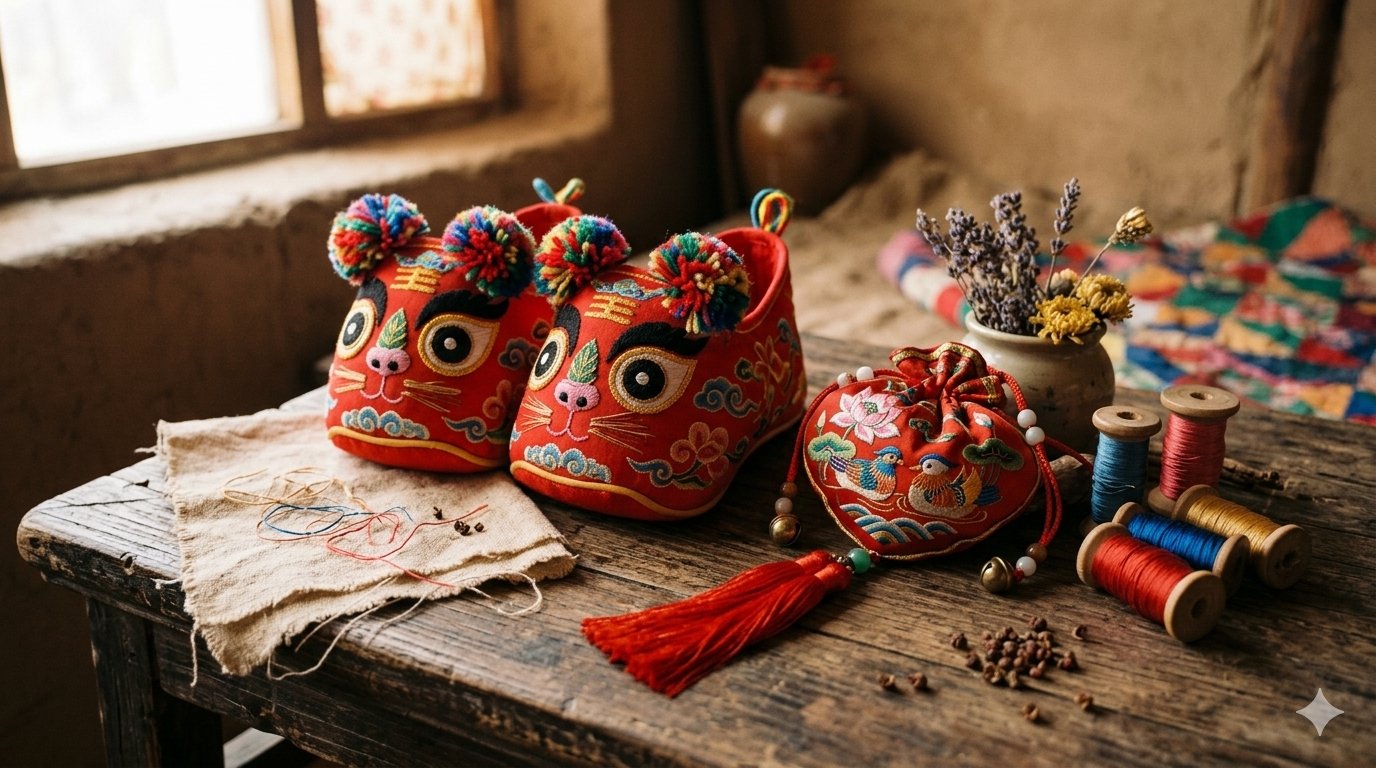
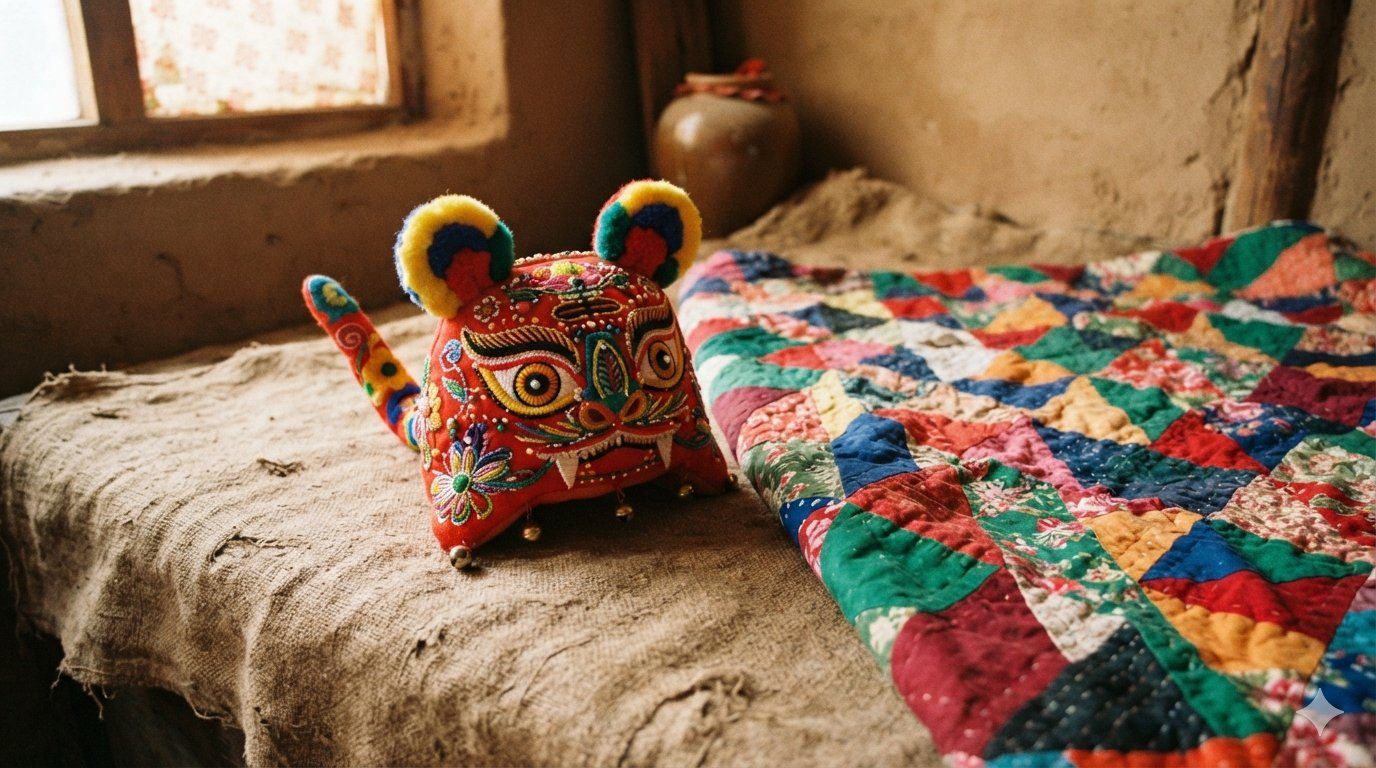
Embroidery accompanied every stage of life. Baby carriers, shoulder bags, headscarves, apron belts, and festival jackets were all decorated. Women embroidered while chatting, watching children, or resting between farm tasks. In this way, Miao embroidery became the background texture of daily life as well as the high art of ceremonial dress.
From village lane to fashion runway: Miao embroidery today
Miao embroidery is no longer confined to mountain villages. In 2021, during a visit to a Miao embroidery workshop in Huawu Village, Guizhou, Chinese leader Xi Jinping praised the craft as "stitched out one needle and thread at a time — how wonderful" and encouraged its development as both cultural heritage and rural industry [source:2].
Today, Miao embroidery appears in fashion shows, museum exhibitions, and cultural-creative products. Initiatives such as Guizhou’s "Splendid Plan" for women’s handicrafts and Hunan’s "Let Mothers Come Home" projects train rural women in traditional skills and help them earn income. Designers have adapted Miao patterns for handbags, scarves, jewelry, and home décor [source:3].
These modern uses bring both opportunities and risks. On one hand, they create new markets and keep skills alive. On the other hand, mass production can flatten the meaning of ancient symbols. The challenge for the next generation is to balance innovation with respect for the stories encoded in every stitch.
How to look at a piece of Miao embroidery
When you see a Miao embroidered garment in a museum, market, or photograph, try reading it on four levels:
- The stitch. Is the surface flat, raised, braided, or metallic? The technique tells you which regional school the piece likely belongs to.
- The color. Bright red, green, and yellow often dominate, but each region has its own palette. Songtao pieces may be especially vivid; Jianhe tin embroidery is silvery and dark.
- The motif. Look for butterflies, dragons, fish, birds, maple trees, and geometric migration symbols. Each carries a specific meaning.
- The composition. Miao embroidery often fills the cloth edge-to-edge, creating a sense of abundance and energy. The balance comes from repetition and symmetry, not empty space.
Once you begin to read these layers, a piece of Miao embroidery becomes far more than decoration. It becomes a conversation across time — a woman speaking to her ancestors, her community, and the future.
Sources and Further Reading
- 苗绣 - 中国非物质文化遗产网(台江苗绣项目详情)
- 守望、传承与创新:跨越时空的苗绣艺术 - 中国非物质文化遗产网
- 苗绣(松桃苗绣) - 中国非物质文化遗产网
- Miao Embroidery: A History Book Worn by People - State Council Information Office of China
This article was researched and written by the ChineseFolkCrafts.com editorial team. Claims are cross-checked against authoritative Chinese-language sources; see About Us for our editorial approach.