Chinese Fish Lanterns: The New Year Wish That Swims
At the Lantern Festival, some lanterns don't hang — they swim.
They are not the round red lanterns above doorways, but great fish held aloft on short poles, weaving through streets and village lanes to the sound of gongs and drums. Bamboo bones, paper skin, painted scales, a candle glowing in the belly: from a distance, it looks as if a school of fish has slipped out of the river and into the river of lights.
This is the Chinese fish lantern. For centuries, in the fishing villages and water towns of southeastern China, fish lanterns have swum through New Year nights. Fishermen raise them to pray for safe seas and full nets; children carry them in giggling chases. And inside every fish lantern sits a blessing every Chinese speaker understands: yu (鱼), the fish, puns with yu (余), the surplus. To raise a fish lantern is to raise the wish nian nian you yu — may you have more than enough, year after year.
Why a fish? The blessing inside the lantern
Chinese affection for the fish begins with a homophone. The word for fish sounds exactly like the word for "surplus" — and surplus is the plainest Chinese hope for a good life: grain left in the bin, money left in the pocket, next year a little roomier than this one. So the fish became a symbol of happiness, plenty, and good fortune, swimming into New Year pictures, paper cuttings, embroidery — and into lanterns [source:5].
A fish lantern makes that blessing move and glow. A painted fish stays on the paper; a fish lantern is a fish you can carry. At Lantern Festival parades, ancestor rites, and harvest celebrations, it plays the leading role [source:5]. In fishing communities it carries an even more specific wish: calm seas and overflowing nets. For people who live from the ocean, a good year means one thing — the fish came home.
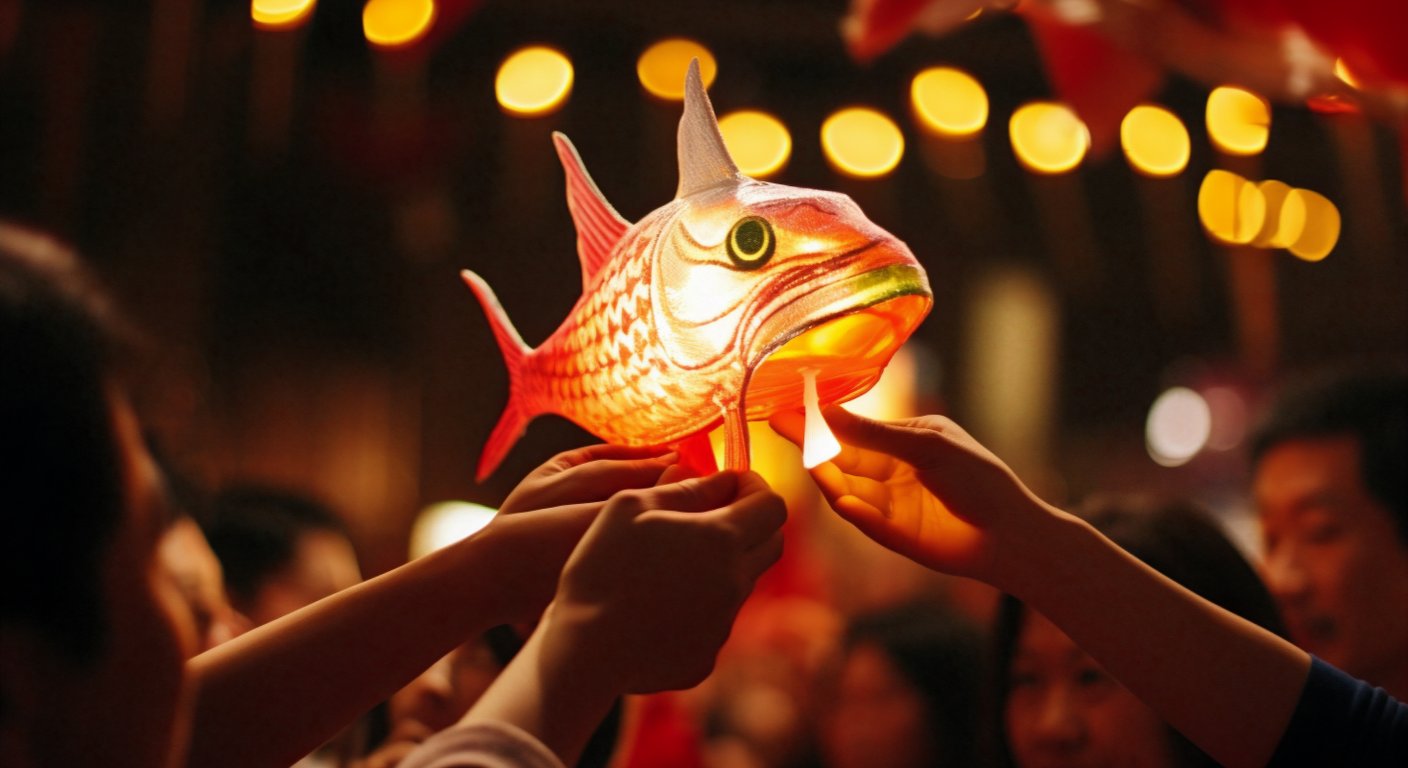
A fish lantern raised into the night: bamboo bones, painted scales, and a light in its belly — the wish for a surplus year you can carry.
From fish totems to a dragon-headed fish: two thousand years
Dancing with fish lanterns goes back to the fish-totem dances of ancient China. The Xijing Fu (Rhapsody on the Western Capital) by the Eastern Han scholar Zhang Heng already records vivid performances of "fish turning into dragon, dragon turning into fish" — seventeen centuries ago, fish-dragon pageants were the height of fashion in the capital [source:5].
In the south, the lineage is traceable. Fish lanterns in Huizhou, Anhui, date back to the Southern Song; today's Zhanqi and Wangmantian fish lanterns are branches of that stream, and Wangmantian's tradition — begun in the Ming dynasty — was inscribed on Anhui's provincial intangible cultural heritage list in 2021 [source:5]. On New Year nights in these mountain villages, the whole village carries fish lanterns of every size along the creek, a scene that has recently gone viral online.
The fish lanterns of Shipu, in Xiangshan, Zhejiang, come with a sea-battle legend. In the early Ming, the general Hu Dahai was campaigning against pirates along the eastern Zhejiang coast. At the battle of Damuyang, his men — unused to naval fighting and caught against a rising tide — were on the brink of destruction. Suddenly a storm rose, the tide reversed, and giant waves capsized the pirate ships; sharks, mackerel, and eels tore at the men overboard, and the Ming forces won. When Hu asked an old fisherman why the tide had turned, the answer was: the ao-fish commands the tides — it rolled over to help the Ming. Hu reported this to the Hongwu Emperor, who was delighted and granted the ao-fish a dragon's head on a fish's body, naming it the God of Sea Peace [source:5].
From 1370 on, at every festival and grand rite in Shipu, the order has been "dragon lanterns first, fish lanterns second" — the dragon-headed ao-fish ranking just below the dragon itself. An old ballad still sings: "In the first month we sport the fish lanterns; Hongwu's troops came to eastern Zhejiang — Hu Dahai in the vanguard, Chang Yuchun guarding the rear" [source:5].
How a fish lantern is made: bamboo bones, paper skin, painted scales
A fish lantern is beautiful to watch, but building one is a complete craft in itself.
Traditionally, the maker works over a T-shaped wooden jig, bending thin bamboo strips into the outline of a round-bodied sea fish. The frame is then skinned with white cloth or cotton paper, and the scales, fins, and coloring of each species are painted on by hand — ao-fish, yellow croaker, mackerel, rabbitfish, cuttlefish, dolphin, each with its own look [source:5]. Careful workshops brush the finished painting with tung oil, which both waterproofs the skin and lets the light glow through [source:1]. The fish is built in three articulated sections — head, body, tail — so that in motion it can flick and twist through moves like "the carp wags its tail" and "the fish leaps the dragon gate." A candle or small bulb burns inside; a short handle beneath gives the dancer a grip [source:1][source:5].
Old masters say a fish lantern must be right "not only in form, but in spirit" [source:5]. The spacing of the scales, the light in the eye, the curve of a fin — get any of them wrong, and the fish doesn't come alive. Xu Yunyu, a veteran maker in Kanmen, Zhejiang, was the acknowledged master of his village; his fish lanterns lit the township year after year. After he passed, his children and grandchildren inherited the craft — yet the villagers still say no one makes them quite like the old gentleman did [source:5]. The weight of a craft is often only felt when it is gone.
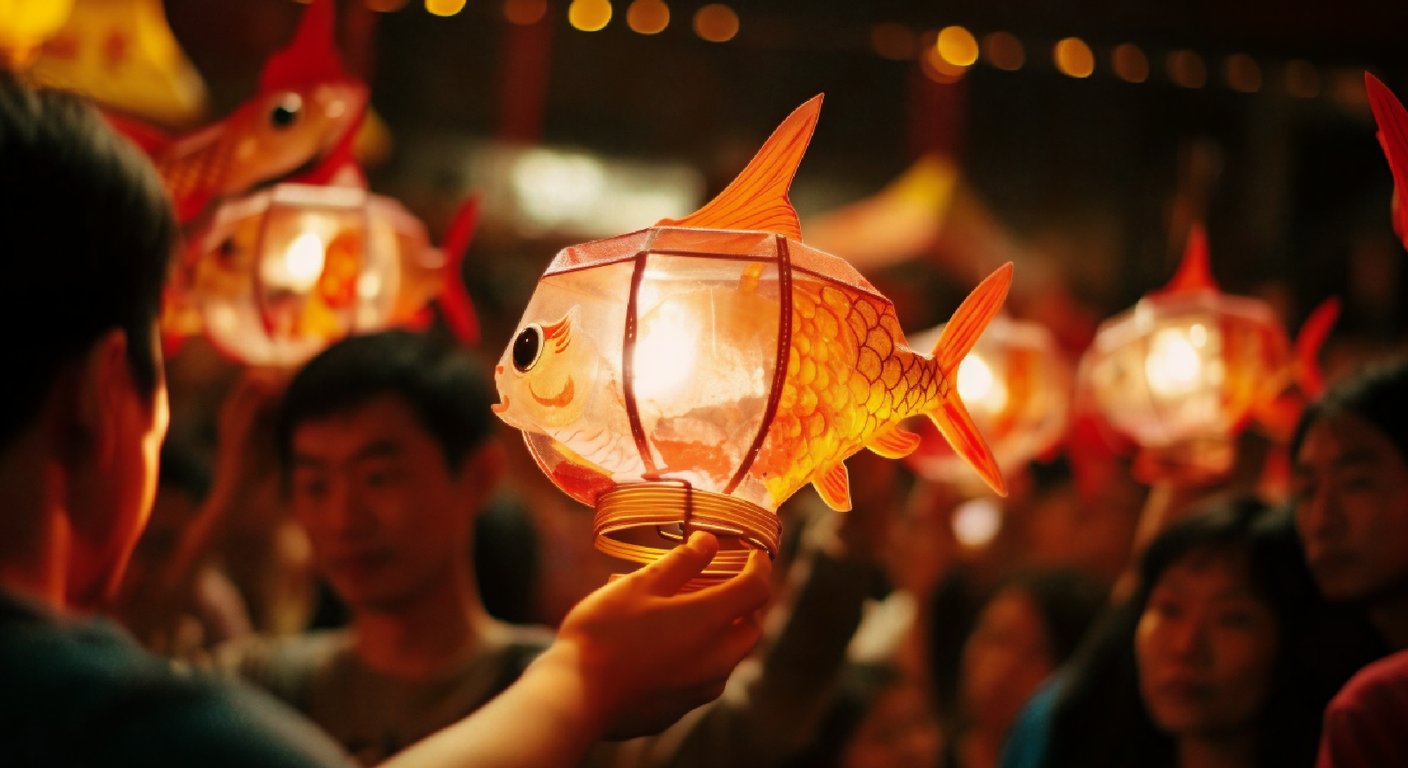
In the parade dark, you can see how a fish lantern works: bamboo ribs under a painted skin, and the lamp burning in its belly.
Four dances on the national heritage list
China's national intangible cultural heritage list keeps a special category called "lamp dance" (dengwu, item III-45): night dances performed in formation with lanterns as props, grand in scale and rich in changing patterns. By the shape of the lamps, the family includes dragon-lamp dances, lion-lamp dances, clam-lamp dances, butterfly-lamp dances — and the fish lantern dance is one of its most important branches [source:1].
Several fish traditions hold national status:
- Shatoujiao fish lantern dance (Shenzhen, Guangdong — second batch, 2008)
- Qingtian fish lantern dance (Qingtian, Zhejiang — second batch, 2008)
- Putian nine-carp lantern dance (Putian, Fujian — second batch, 2008)
- Wuwei fish lantern (Wuwei, Anhui — third batch extension, 2011)
Kindred entries on the same list include the Jishui ao-fish lantern and the carp lantern dance of Ji'an [source:1]. Four "national teams," four temperaments: one tells of pirates and resistance, one of military drill, one of peace and answered vows, one of carp and home.
Shatoujiao: twenty-five fish and a pirate story
The fish lantern dance of Shatoujiao, Shenzhen, began in the Kangxi reign of the Qing dynasty, over three hundred years ago. In the early Qing, the Wu clan of Shalanxia village moved from Boluo to the coast and created this all-male square dance by combining Lantern Festival customs with their experience of fishing at sea. It is still performed on both sides of the border — in Shenzhen's Shatoujiao and in Hong Kong's New Territories — a shared memory of the two cities [source:1].
The performance happens at night, with no stage lighting at all. The dancers hold low horse stances and hide their bodies behind the lanterns, gripping the short poles and weaving hunched through the dark — the audience sees no people, only a school of glowing fish that swims, chases, startles, and wheels [source:1].
The dance unfolds in three acts, like a silent play. First, the fish live freely on the seabed. Then a great fish called the huanglijiao appears — dragon-headed, fish-bodied, ferocious. It does not exist in any real sea; the villagers imagined it from dragon legends, and it stands for the pirates who preyed on fishermen. The huanglijiao hunts the school; the small fish halt, reverse, and swerve in fright, outthinking it again and again, yet one by one they are "eaten." In the final act, the small fish unite and attack in waves until the great fish flees, and the sea returns to peace [source:1].
Every fish carries a meaning: the huanglijiao is the pirate; the school is the fishing people — unbowed, united, fighting for a happy life [source:1]. A fish lantern dance stages three centuries of the sea's sorrows. A traditional performance fields twenty-five fish, and before it begins, the clan elders carry the huanglijiao to the Wu ancestral hall and the Tin Hau temple for a consecration rite. Today the dance faces a shortage of successors and urgently needs safeguarding [source:1].
Qingtian: a fish lantern dance drilled like an army
Qingtian's fish lantern dance, in Zhejiang, has a different temperament — it is martial.
Legend says that at the end of the Yuan dynasty, as warlords rose, Liu Ji of Qingtian — later the Ming founding strategist Liu Bowen — secretly recruited rebels and drilled their battle formations under the cover of fish lantern dancing, before leading them to join Zhu Yuanzhang [source:3][source:5]. That origin left its mark: the dancers wear headscarves, sashes, wrist guards, and leg wrappings, dressed like ancient warriors [source:3].
In performance, a leader raises a large red pearl on a long pole and directs the troupe with a whistle. Two red carp follow as "head fish" and "second fish," then come bream, silver carp, grass carp, crucian carp, field fish, grouper, tiger fish, goldfish — plus shrimp, pufferfish, golden toad, and crab, a whole procession of aquatic life [source:5]. The dance is built on marching formations with names like martial-arts moves: the woven-fence array, the two-dragons-spout-water array, the four-corner circuit, the plum-flower array, the scissors array, the carp-grabs-the-pearl. Four acts build the year — spring fish playing in the water, summer fish leaping the rapids, autumn fish lingering by the banks, winter fish binding into a dragon — and the finale is always "the carp leaps the dragon gate" [source:3].
Within the formations, every fish has its own character: the shrimp dancer crouches into a full horse stance and bounces sideways, lantern near the ground — "the river shrimp flees the tightening water"; the pufferfish dancer goes head-down, tail-up, spinning the fish head and hopping in place [source:5]. For its exquisite props and bold, sweeping movement, the Qingtian fish lantern dance has been called "the number one fish under heaven" [source:3].
Wuwei and Putian: lanterns of peace, nine red carp
In Wuwei, Anhui, the fish lantern is known as the lamp of good fortune, peace, and happiness. Legend holds that in the Northern Song, after the judge Bao Zheng distributed famine relief in Chenzhou, lanterns were summoned as tribute from across the land — the people of Wuwei presented eight fish lanterns, won the court's praise, and kept the dance alive for a thousand years [source:2].
Wuwei's ritual frame is unusually complete. The fish lanterns are played from the fifteenth to the thirtieth of the first lunar month: the first day is "lighting the lamps," the last "putting out the lamps." From the opening day, the whole village sets offering tables and hires Taoist priests to hold services until the dance ends. If disease spreads in the village or pests strike the crops, the fish lanterns are danced to make and repay vows, serving as guardian spirits against evil. A local proverb says: "Burning incense and holding a mass can't beat one round of the red lantern" [source:2]. In 1956, the Wuwei fish lantern even danced in Beijing's Huairentang hall at a national folk music and dance festival [source:2].
Putian's nine-carp lantern dance, in Fujian, wins on red. Its lanterns are bamboo-framed, pasted with red paper, and painted with scales and fins: red carp 1.5 meters long and 40 centimeters wide, a dozen or more to a troupe, the lead fish slightly larger. To the night-time music of gongs, drums, and cymbals, the great red carp dart and play through the dark. Most charming is the "fish-dragon duet": if the performers meet a neighboring village's dragon dancers, the two troupes have a special routine in which fish and dragon dance together, as a token of friendship [source:4]. The dance flourished in the Ming and Qing, but today it survives in a single lineage village north of Goubian — props and choreography handed down inside one family, in urgent need of rescue [source:4].
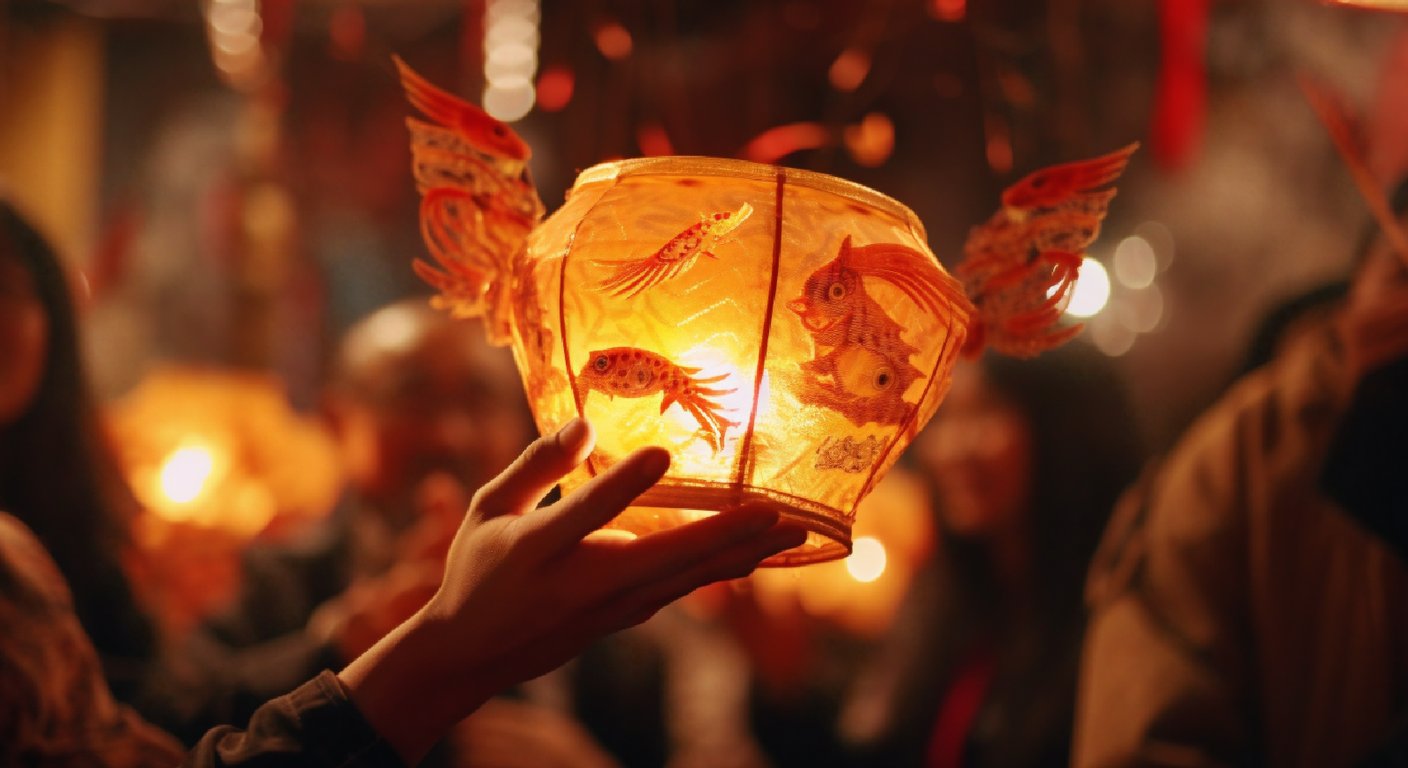
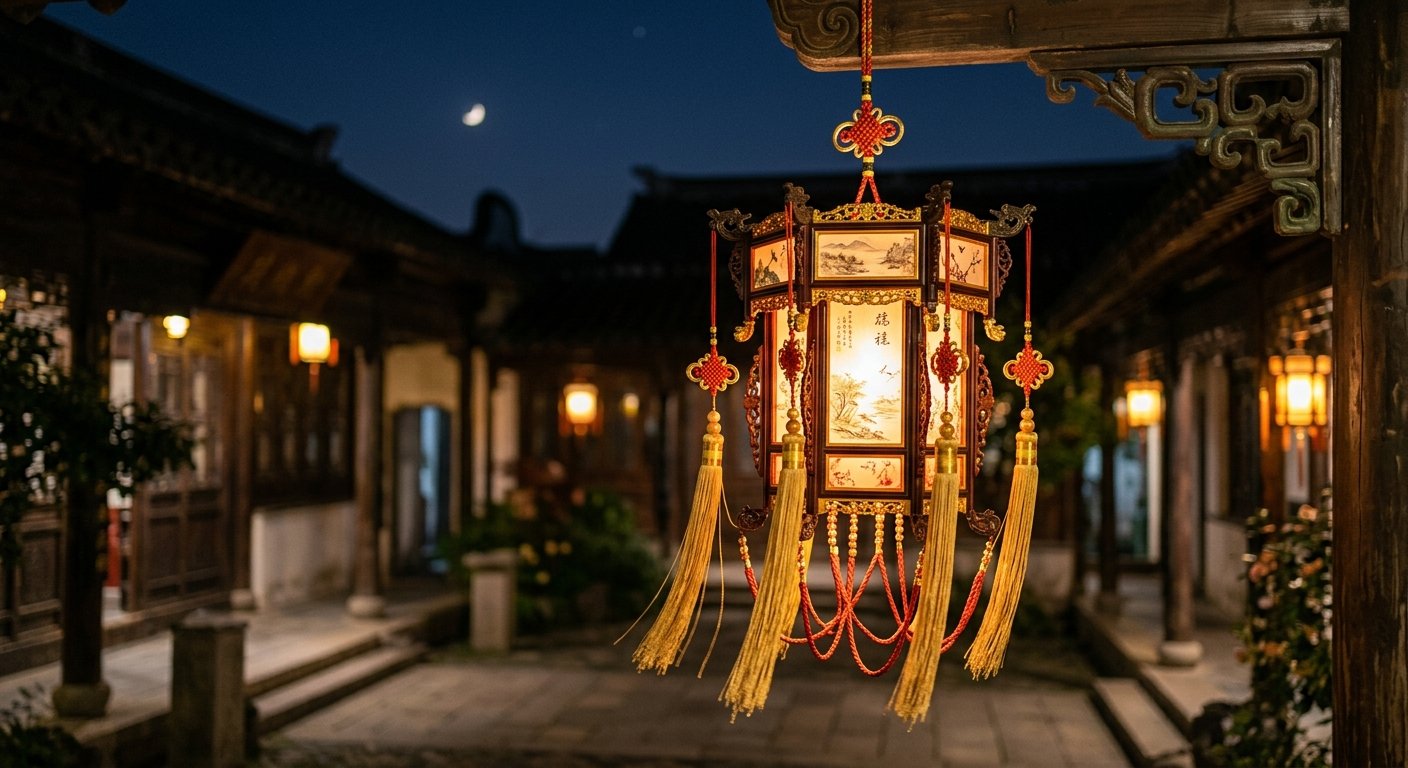
Even on ordinary lanterns, the goldfish is a favorite painter's subject — the same wish for surplus, glowing in the lamplight.
Suixi and beyond: new fish in an old stream
The fish lantern has not stayed in the past. The "swimming fish" of Beipo town in Suixi, Guangdong, shows how alive the tradition is.
In the Kangxi era, Beipo suffered frequent droughts. One spring, after days of torrential rain, schools of carp swam to the flooded slopes to feed. The villagers reached out to catch them — until an elder shouted: "Do not touch them! They are water gods; they brought this rain!" The people held back. Strangely, the fish showed no fear: they fed and played at ease, children cradled them, adults stroked their scales, and for a moment people and fish danced together on the flooded fields [source:5]. Ever since, on the fifteenth of the first month, villagers bind carp shapes from bamboo strips and sandpaper, set candles in their bellies, and "swim the fish" to pray for rain — carrying the wish "swimming fish bring water, year after year, surplus." It has swum for over three hundred years [source:5]. In 2018, the Suixi Beipo swimming-fish custom was inscribed on Guangdong's provincial intangible cultural heritage list.
Today's parade has been reinvented: dragon and lion dances lead the fish; the lanterns have grown from a single carp to include crocodile-fish, snakehead, shrimp, crab, frogs, and the zodiac animal of the year; the candles have become electric bulbs [source:5]. And the fish are swimming onto ever larger stages: Huizhou's fish lantern parades have become a cultural-tourism phenomenon, and in February 2026, nearly 3,000 fish lanterns appeared in the Hefei sub-venue of the CCTV Spring Festival Gala — the smallest just 10 centimeters long, the largest 8 meters [source:5].
From fishing hamlets to the national gala, the school is still swimming.
Frequently asked questions
What is the difference between a fish lantern and a fish lantern dance? The fish lantern is the prop — a fish-shaped lantern with a bamboo frame, paper or cloth skin, and a light inside. The fish lantern dance is the folk dance performed while carrying it. A single fish lantern can be a child's toy; a troupe of fish lanterns in motion is the full heritage performance.
When can I see fish lanterns? The peak season is Chinese New Year through the Lantern Festival (the fifteenth of the first lunar month). The Shatoujiao dance is traditionally performed on the nights of the Lantern Festival and Mid-Autumn Festival; Wuwei plays its fish lanterns from the fifteenth to the thirtieth; Suixi's swimming-fish parade takes place on Lantern Festival day; and in Huizhou, the Wangmantian and Zhanqi parades run for several nights in the first month.
What are fish lanterns made of? Traditionally: a bamboo-strip frame, a skin of white cloth or cotton paper, hand-painted scales and fins, and sometimes a coat of tung oil; a candle or bulb inside, a short handle below. Modern fish lanterns increasingly use LED lights, and large parade versions may include electric mechanisms [source:1][source:5].
Why do fish lanterns so often appear with dragon lanterns? In Chinese folklore, fish and dragon are two faces of one being: "fish become dragons, dragons become fish" was recorded as early as the Eastern Han, and "the carp leaps the dragon gate" is a household saying. In the Shipu legend, the ao-fish was granted a dragon's head; the Qingtian dance ends with the carp leaping the dragon gate; and Putian's nine-carp dancers have a special duet for when they meet a dragon troupe. Fish and dragon together mean transformation — rising higher through every trial.
Can children make a fish lantern? Yes — a simplified fish lantern is a lovely family craft. Bend bamboo strips or wire into a fish outline, cover it with rice paper or white cloth, paint the scales, and add an LED tea light. During the Spring Festival season, many heritage workshops and museums in Anhui, Zhejiang, and Guangdong offer hands-on fish lantern sessions.