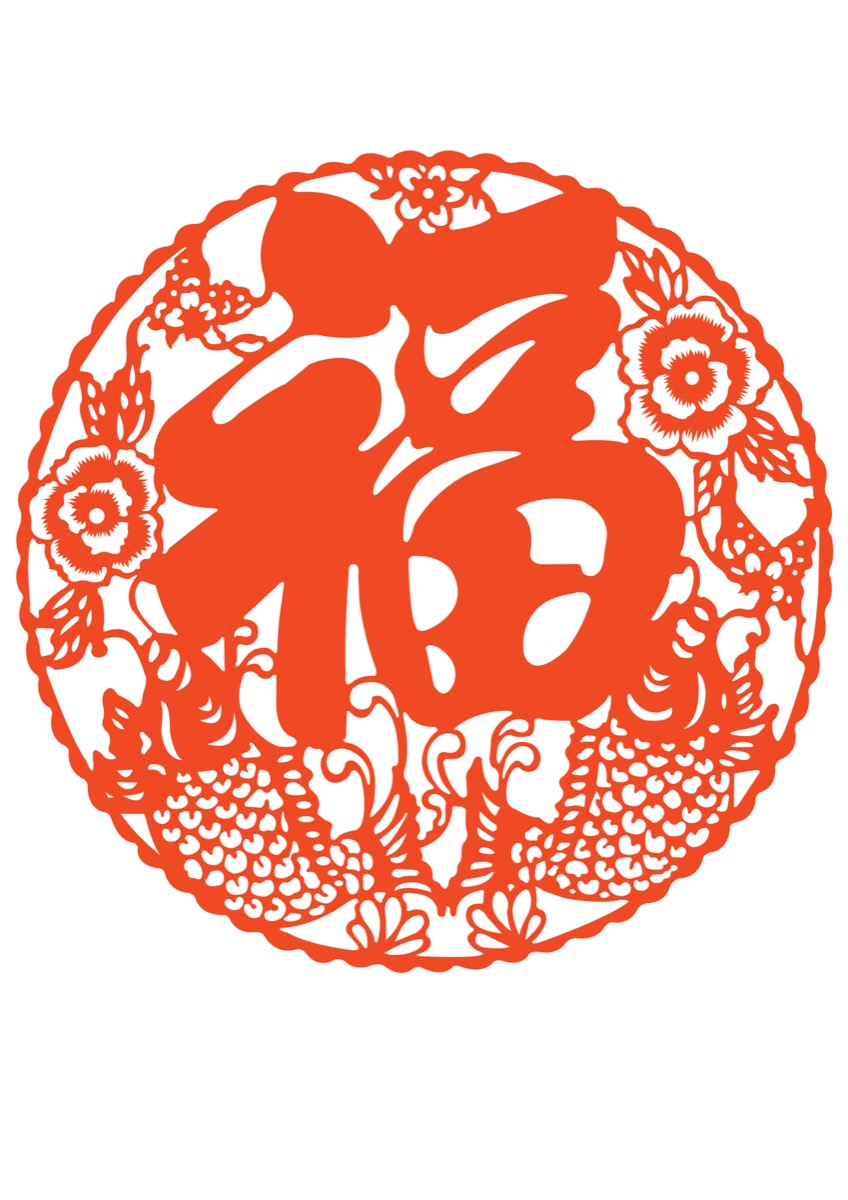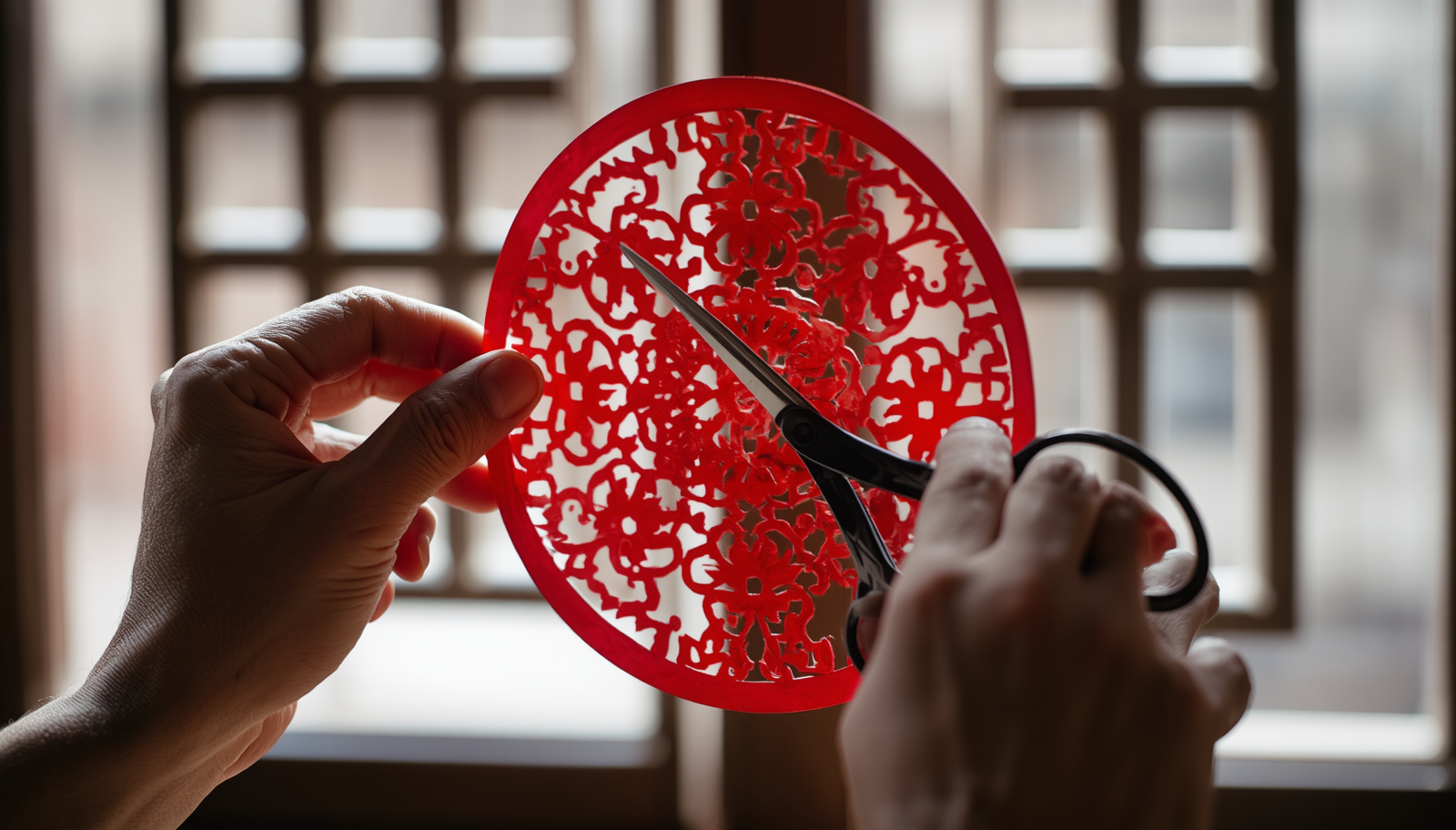
On the morning before Chinese New Year, a grandmother in Shaanxi takes a folded square of red paper, snips the center, and turns the wrist. Red flecks fall into a basket. When she unfolds the sheet and pastes it onto the paper window, the room changes. The dull winter light comes through the cut holes and draws flowers, fish, and the character for blessing onto the kang.
That cut paper is called chuanghua (窗花), the window flower. It is the most common face of Chinese paper cutting, and for many families it is the real beginning of the new year.
Why the window
Windows were the right place for paper cuts because windows were already the boundary between the house and the world. A window flower turned that boundary into a message: we are clean, we are ready, and we are asking for luck.
Red was the obvious color. In Chinese folk belief, red drives away the evil spirit called nian and brings joy. A window without red paper cuts did not feel like New Year. Even poor households found a few cents for red paper; the cut itself cost nothing but time and skill.
The pasted flowers also made the house beautiful at the darkest time of year. In northern villages, where paper windows replaced glass, the cuts turned a cold room into a lantern.
How they are made
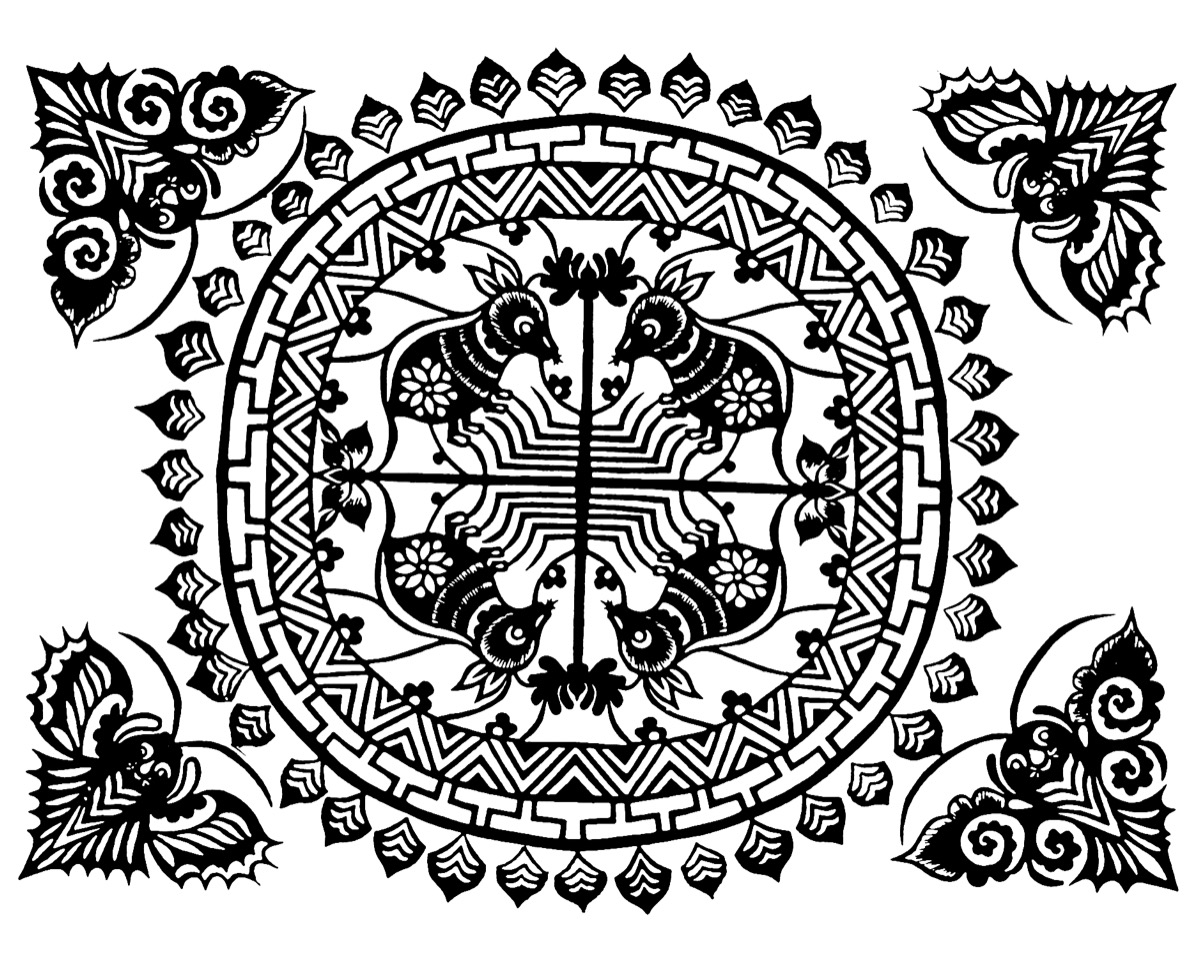
Most window flowers are cut from a single square of red paper. The cutter folds the paper once, twice, or four times, depending on how much symmetry the design needs. A four-fold square produces a design that repeats around a center; a two-fold square produces a left-right mirror.
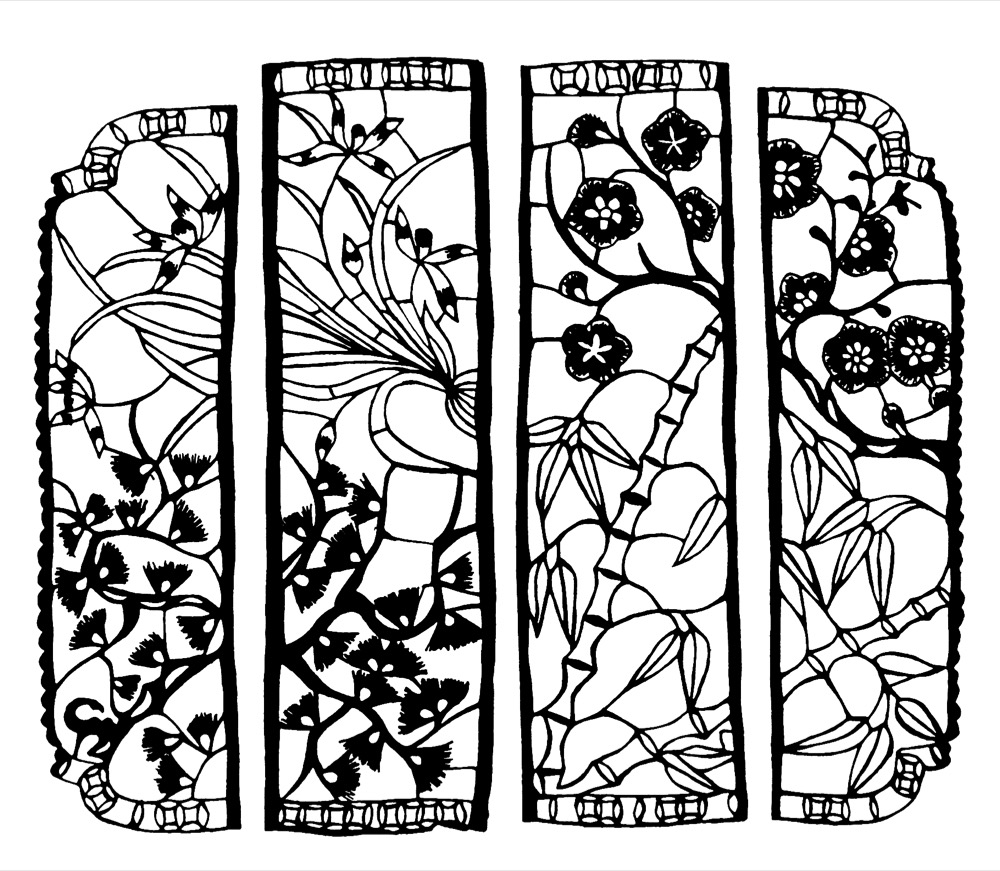
A four-panel window flower design. Each panel frames its own small scene.
The cutting itself can be done with scissors or a small knife. Scissors are faster and leave the lively, slightly uneven lines that northern cutters prize. Knives allow finer work and are common in the south. Either way, the trick is to keep the paper connected: every line that remains must hold the others together, or the flower falls apart.
Classic designs and what they mean
Window flowers are not random decoration. Each design asks for something specific. If you want a fuller guide to the symbols, see our article on the eight auspicious symbols in Chinese paper cutting.
The character fu (福, blessing) is the most common image. It is often cut so that the strokes themselves become peonies, fish, or bats. Many families paste it upside down, because the word for "upside down" (dao) sounds like the word for "arrive." An upside-down blessing means "blessing arrives."
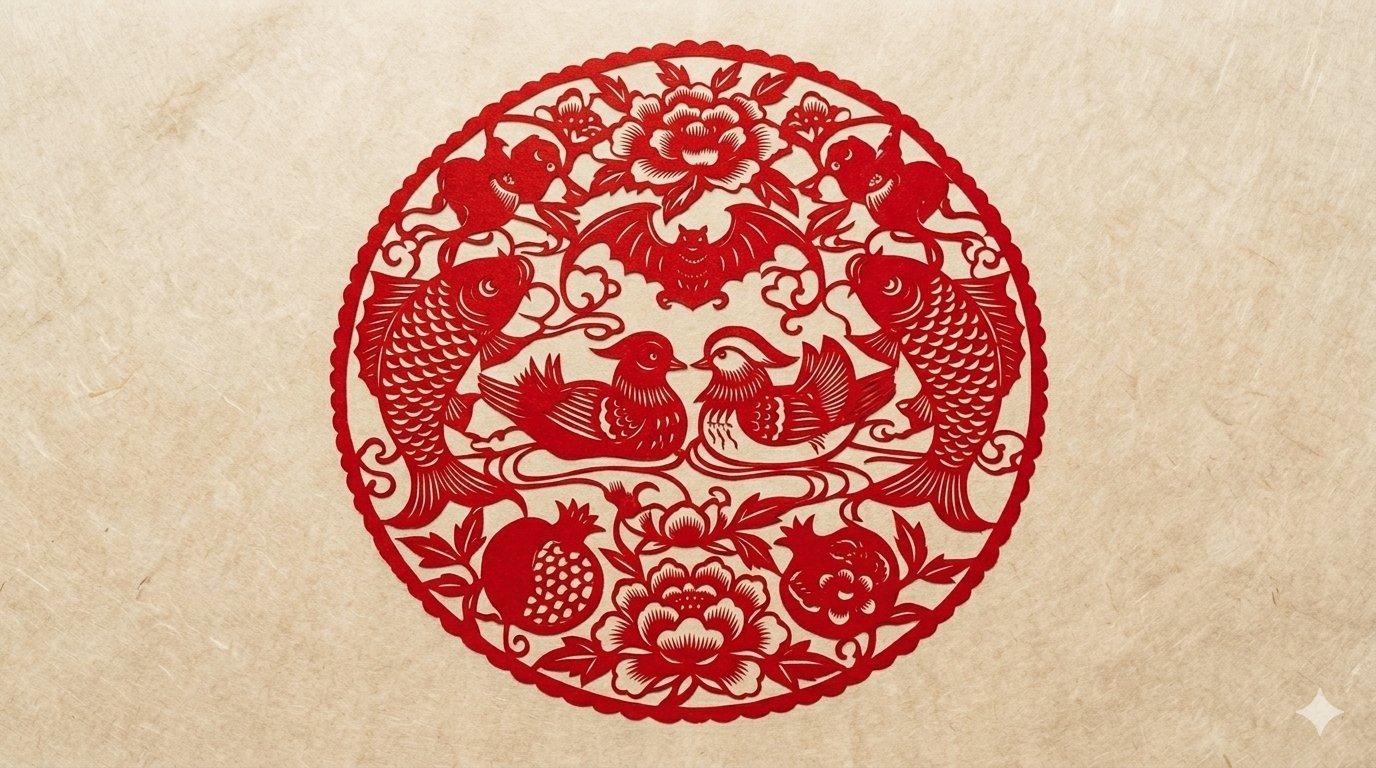
Fish (yu) sound like "abundance" or "surplus." A pair of fish means "abundance year after year." Cutters often place fish around the character for fortune so that wealth seems to swim toward the house.
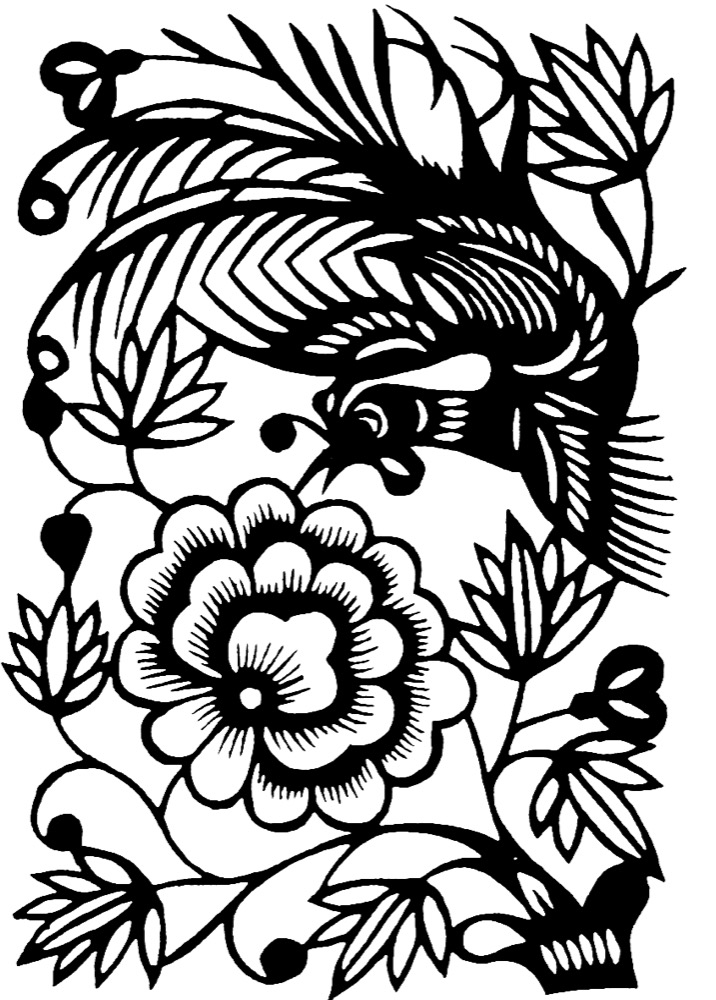
A symmetrical window flower. Paired figures and paired plants reinforce the idea of doubling good fortune.
Pomegranates pray for children. A pomegranate full of seeds says "may there be many sons." In modern cuts, the wish is broader: may the family grow.
Peonies mean wealth and high rank. They are the "king of flowers" in Chinese symbolism, and they pair well with almost any other lucky image.
Zodiac animals mark the coming year. A window flower for the Year of the Dragon will show a dragon coiled among clouds; for the Year of the Rabbit, a rabbit among cabbages.
Children and dolls are another favorite. A chubby child holding a fish or a lotus means "may the family prosper." These figures carry the same wish as the fertility statues of older times, but in a gentler form.
Symmetry and light
Window flowers love symmetry. A symmetrical cut looks balanced on the window and reads clearly from the street. Many designs are radial, spreading from a center like a mandala. Others are mirrored left-to-right so the cut looks the same from inside the house and outside.
The real magic happens when the sun is low. Light passes through the cut holes and throws red patterns onto the floor and walls. The paper window becomes a lantern, and the room itself seems to wear the cut.
History of window flowers
The habit of putting cut paper on windows is old, but it grew up alongside the paper window itself. For much of Chinese history, ordinary families could not afford glass. Instead, wooden lattice windows were covered with oiled paper made from mulberry bark, bamboo fiber, or rice straw. The paper let in light, kept out wind, and provided a soft, pale surface that red paper cuts could dominate.
The earliest ancestor of window flowers may be the Han-dynasty practice of cutting gold foil and colored silk into human shapes for seasonal rituals. By the Tang and Song dynasties, paper had become cheap enough for everyday decoration, and by the Ming and Qing, rural households were pasting New Year cuts on doors, windows, and stoves as a matter of course.
Glass arrived slowly. Imported glass was a luxury of coastal cities and imperial buildings in the late Qing; most villages did not see glass windows until the mid-twentieth century. When glass finally replaced paper, people simply pasted the cut onto the glass instead. The light changed—sharper, colder—but the red silhouette still worked. Today, some families even use transparent static-cling versions that leave no paste on the pane.
For a deeper timeline of the craft, read our overview of Chinese paper cutting history.
How to fold and cut a basic window flower
You do not need special training to cut a simple window flower. A square of paper, sharp scissors, and a little patience are enough.
1. Choose your paper. Start with a 15 cm (6 inch) square of red paper. Lightweight paper folds cleanly; tissue paper or kite paper works well. Avoid cardstock, which is hard to cut in tight curves.
2. Fold for symmetry. Fold the square in half from left to right, then fold it again from top to bottom. You now have a smaller square that is four layers thick. Every cut you make will repeat four times around a center.
3. Draw a simple design. On the top layer, lightly sketch half of a petal or leaf shape along the folded edges. Keep at least a fingernail-width of paper uncut along the outer edge; this border holds the flower together.
4. Cut the outline. Cut along your drawn line, then add small notches or holes inside the shape. A hole punch can make quick dots. Remember that the folded corner of the paper will become the center of the finished flower, so any shape cut there will appear four times around the middle.
5. Keep bridges. Never cut all the way across the folded square. Leave strips of paper connecting the petals to the center and to one another. If every line is cut through, the flower will fall apart when you unfold it.
6. Unfold and flatten. Open the paper gently, press it flat under a book for a few minutes, and trim any ragged edges. If you like, mount it on a slightly larger square of white or gold paper so the red cutwork stands out.
A first attempt will be wobbly. That is part of the charm. Northern cutters often say that the slight unevenness of scissors gives the cut life.
Regional accents
Different villages cut different window flowers.
In Shaanxi, the cuts are bold and almost childlike. Lines are thick, animals are fierce, and the overall effect is strong enough to be read from a muddy courtyard.
In Hebei's Yuxian county, cutters make white paper cuts and then dye them in bright mineral colors. The window flowers glow like stained glass.
In Yangzhou and the southern delta, the work is fine and lace-like. A single peony may have dozens of tiny holes, and the whole cut feels closer to embroidery than to folk art.
In the northeast, window flowers often show farming life: cabbages, pigs, roosters, and children with fish. The designs keep the household close to the land.
Regional window flower styles
Step back from individual villages and two broad styles emerge.
The northern style is shaped by cold, dry winters and paper windows. Cuts tend to be large, bold, and graphic so they can be seen from a distance through frosted panes or oiled paper. Colors are usually the raw red of the paper, sometimes with black or yellow accents. Themes are folk and practical: grain, livestock, children, gods of fortune, and the zodiac. Scissor cutting dominates, and cutters pride themselves on speed and rhythm.
The southern style is shaped by a milder, more humid climate and a longer literati tradition. Cuts are smaller, more delicate, and densely detailed, often featuring flowers, birds, insects, and scenes from opera or daily life. Knives are common because they allow the tight interior cuts. In places like Yangzhou and Zhejiang, window flowers were sometimes framed as gifts rather than pasted directly on windows.
Neither style is "correct." The same New Year wish can be shouted in thick red lines or whispered in fine lace.
Modern window flowers and craft revival
Chinese paper cutting was added to the UNESCO Representative List of the Intangible Cultural Heritage of Humanity in 2009, and window flowers have benefited from the renewed attention. Museums now collect historic cuts, county governments sponsor "paper cutting villages," and young designers reimagine traditional motifs for notebooks, wedding invitations, and packaging.
Online video has changed how the skill travels. Grandmothers who once taught only their granddaughters now post folding tutorials to short-video platforms, and city dwellers buy DIY kits with pre-printed patterns. At the same time, some workshops worry that laser-cut factory versions are replacing hand-cut originals. The best revival projects treat the old designs as a living language rather than a fixed souvenir: they keep the red paper, the symmetry, and the wish, but let the motifs speak to modern life.
Window flowers today
Glass windows and electric lights have changed the practical role of window flowers, but they have not killed the habit. In rural China, families still paste fresh cuts every New Year. In cities, people buy printed versions or frame antique cuts as wall art.
The design language has also moved. Modern cutters make window flowers for weddings, birthdays, and even graduation parties. But the old rules remain: red paper, symmetrical design, and a wish that light can pass through.
A window flower is still one of the cheapest ways to make a room feel like a celebration. All it takes is a square of paper, a sharp edge, and the patience to cut carefully enough that the blessing does not fall apart.
FAQ
What is the difference between a window flower and other Chinese paper cuts?
Window flowers are a subtype of Chinese paper cutting designed specifically for display on windows. They are usually symmetrical, small enough to fit a lattice pane, and made to look good with light shining through. Other forms include door cuts, stove god decorations, and ceremonial figures used at funerals or weddings. Our guide to the types of Chinese paper cutting explains the full family.
Can I paste window flowers on glass instead of paper windows?
Yes. Today most people paste them on glass. Use a thin rice-paste or wheat-starch glue that peels off easily, or choose static-cling versions made for modern windows. The cut will cast sharper shadows on glass than it did on paper, which can be beautiful in the morning sun.
Is it appropriate for non-Chinese people to display window flowers?
Window flowers are widely shared as folk art, and displaying them respectfully during Lunar New Year or as part of a craft appreciation is welcome. Avoid treating sacred or funeral motifs as party decoration, and buy from artisans or credit the tradition when sharing images.
How long do paper window flowers last?
A paper cut pasted indoors can last for months, but tradition expects a fresh set each New Year. Replacing the old cut with a new one is part of the ritual: it says the household is starting clean and asking for new blessings.
Author
This article was prepared by the team at ChineseFolkCrafts.com. We are not intangible-cultural-heritage inheritors or museum researchers. Our job is to find authoritative Chinese sources, understand them, and explain them clearly for international readers.
If you spot an error — a date, a translation, a misattributed custom — please let us know and we will correct it. Last updated 2026-07-25.