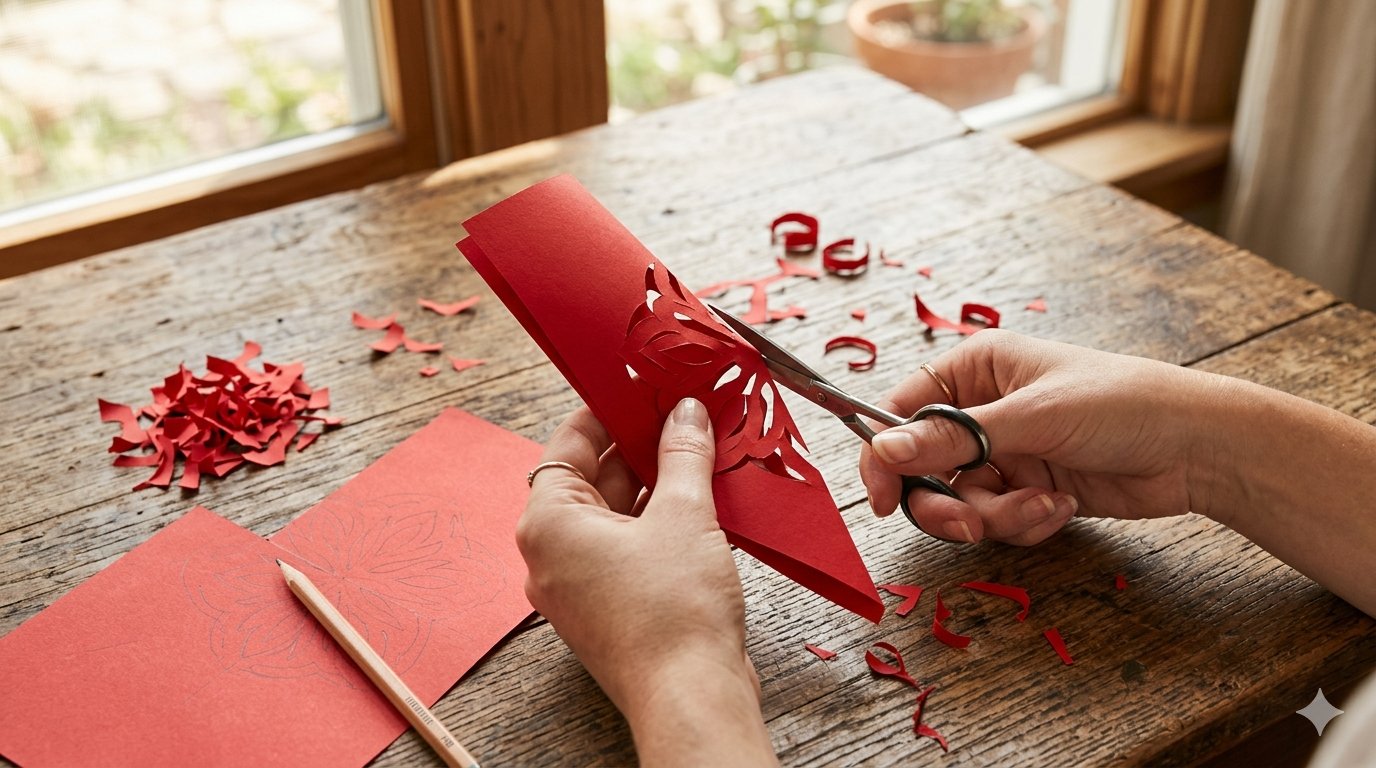
You do not need years of training to try Chinese paper cutting. The simplest designs use the same technique as a paper snowflake: fold, cut, unfold, and discover a pattern you could not see while cutting.
That said, you are not just making a snowflake. Folding and cutting red paper is the exact foundation of jianzhi (剪纸), the Chinese art of paper cutting — a craft at least fifteen hundred years old, practiced by hundreds of millions of people, and inscribed by UNESCO on the Representative List of the Intangible Cultural Heritage of Humanity. Every master started where you are about to start: one sheet, one fold, one cut.
What you need
- A sheet of red paper, about the size of a postcard
- A small pair of sharp scissors
- A pencil for drawing your pattern first (optional)
- A flat surface and good light
Red is traditional because it symbolizes joy and luck, but you can use any color for practice.
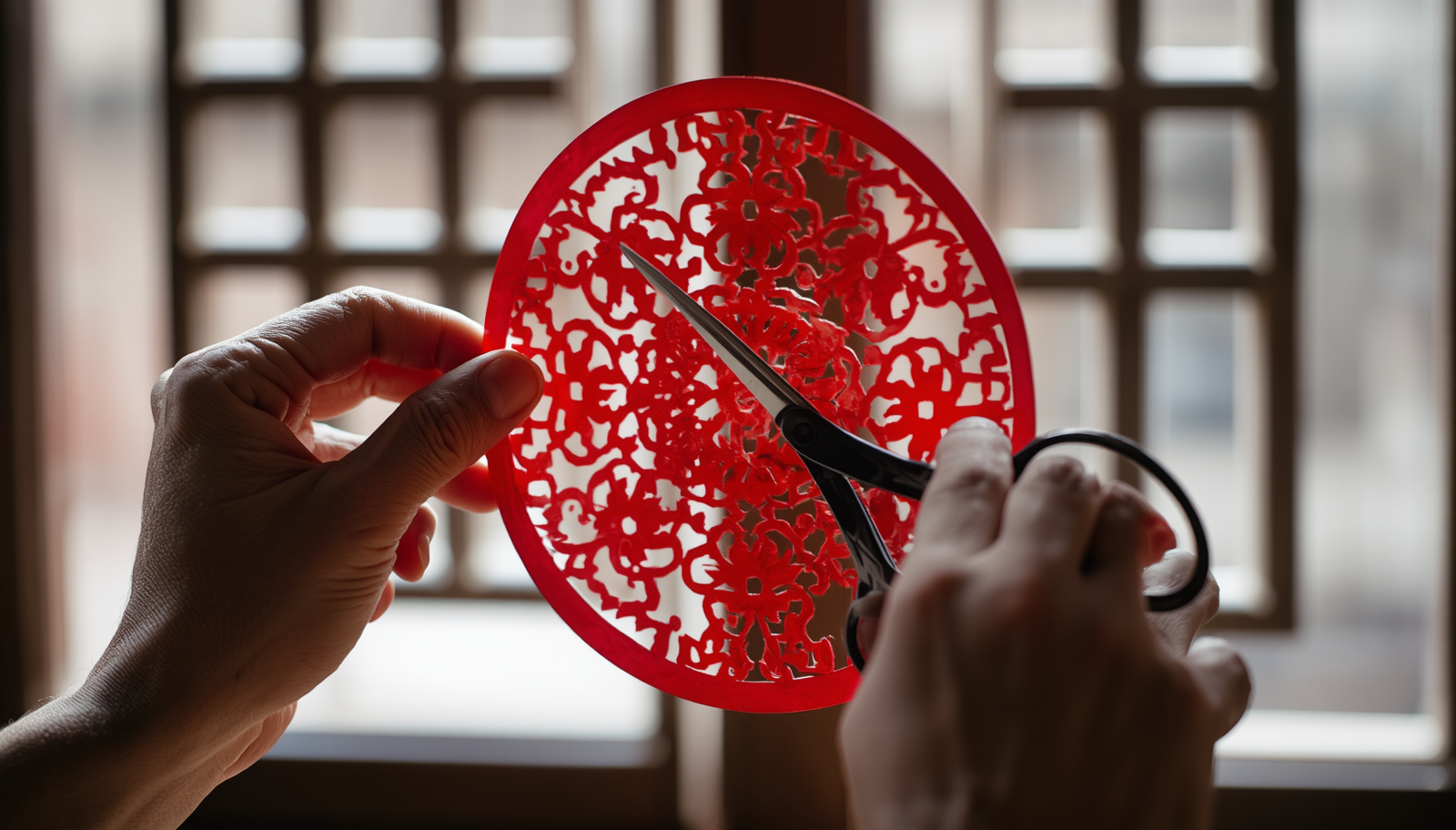
A few material notes will make your first cuts cleaner. Choose thin paper — 60 to 80 gsm — because you will be cutting through four or more layers at once; origami paper and thin craft paper work well, and proper Chinese "red paper" (hong zhi) is lightly colored on one side only, which helps you track the front of the design. Your scissors should have fine, pointed tips: folk cutters use small, very sharp scissors that can nibble out interior shapes. Professionals also work with small carving knives on a wax board, especially for the fine hatching of northern styles, but scissors alone will carry you a long way.
The two basic cuts: yin and yang
Nearly all Chinese paper cutting is built from two complementary techniques, and it helps to know them before your first cut.
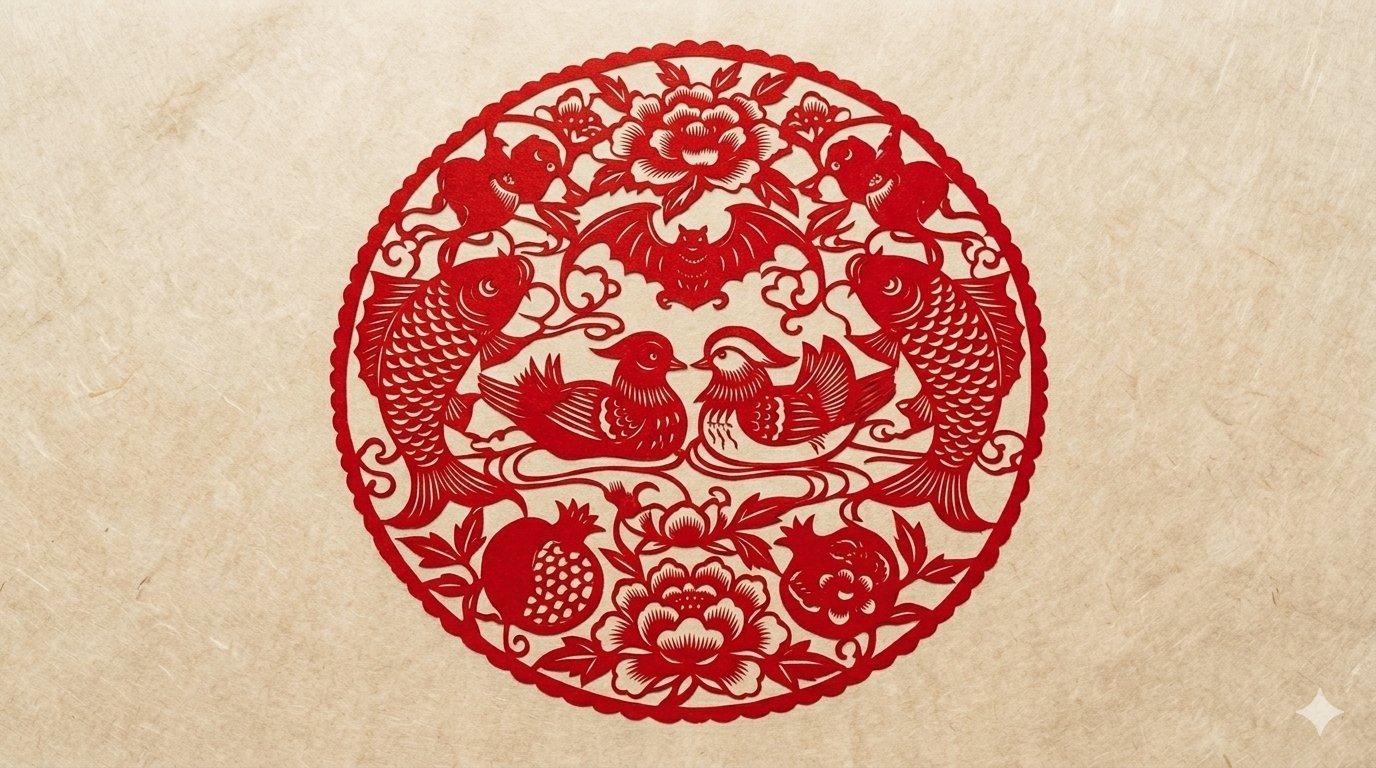
Yang cutting (阳刻) removes the background and keeps the lines. The design appears as connected red lines on white — every stroke of the pattern is paper that remains. Yang-cut work looks drawn, light, and lacy.
Yin cutting (阴刻) removes the lines and keeps the background. The design appears as white gaps in a field of red — the lines are what was taken away. Yin-cut work looks bold, heavy, and carved.
Traditional pieces often combine both: a yang-cut outline holding yin-cut interior detail. When you plan your own designs, ask a simple question of every shape — do I want this line to be paper, or to be light? That single decision is the whole grammar of the craft. A third, smaller technique, ci kong (刺孔, piercing), uses a needle to prick fine holes, mainly to fix multiple layers together or to add texture for embroidery patterns.
The four-fold snowflake
- Fold your paper in half lengthwise.
- Fold it in half again, so you have four layers.
- Draw a simple curved shape along the folded edge — a half-heart, a petal, or a swirl.
- Cut along your drawn line.
- Unfold carefully.
You will see a symmetrical pattern. Four identical shapes mirror around a center point. This is the basic grammar of many paper cuttings — the fold does the symmetry for you. The earliest surviving Chinese paper cuttings, five medallions unearthed from Northern Dynasties tombs near Turfan in Xinjiang and dated to the sixth century, were made by exactly this method: repeated folding, with figures arranged so they never overlap.
Two refinements separate a folk-looking cut from an accidental one. First, cut some shapes from the folded edges, not only the open ones — a half-petal on a fold becomes a whole petal, perfectly mirrored, when opened. Second, leave small bridges of uncut paper between shapes, so the finished design holds together as one connected piece.
Try the classic folds: six and eight
Once the four-fold feels easy, the traditional repertory opens up. The six-fold — fold the square in half, then into thirds like a pie — produces the six-petaled flowers and snow crystals of northern window decorations; the eight-fold gives chrysanthemums and rosettes. Chinese cutters use these tuan hua (团花), or medallion folds, for window flowers at New Year and for ceiling and canopy decorations at weddings.
A practical way in: fold to six layers, draw one bold petal and one small circle along the folds, cut both, and open. The rhythm of the repetition will surprise you — this is the moment most beginners understand why the craft has held people's attention for fifteen centuries.
Cut a character: spring
Characters are a uniquely Chinese part of the art, and the friendliest first character is chun (春, spring), cut for the New Year season. Fold your red square once. Lightly pencil half of the character — or a simplified flower-and-character combination — along the fold, keeping every stroke connected to a neighbor. Cut away the negative spaces first (the small gaps inside strokes), then cut the outline. Open it flat.
If you feel ambitious later, the doubled xi (囍, double happiness) is the wedding classic: symmetrical by design, forgiving to cut, and instantly recognized by anyone who sees it. Our guide to eight auspicious symbols in paper cutting explains what these characters and motifs say once you can cut them.
Video: Spring character (chun) paper-cutting tutorial via YouTube.
Cut a character: fu
The second classic character for beginners is fu (福, blessing), the most common character on New Year doors and windows. Like chun, it can be cut from a folded square, so the character opens symmetrically. Start with a simple block-style fu, keep the strokes thick, and leave bridges between the inner squares, so the character does not fall apart when unfolded.
Video: Fu character (fu) paper-cutting tutorial via YouTube.
Cutting tips
- Cut slowly. Unlike drawing, you cannot erase a cut.
- Turn the paper, not the scissors, to keep your hand comfortable — professional cutters feed the paper into a nearly still blade.
- Cut interior shapes first, outline last, so the sheet stays strong while you work.
- Leave small bridges between shapes, so the design does not fall apart.
- Start with simple curves before trying detailed lines;锯齿纹 (sawtooth) and crescent hatching can wait.
- Keep the layers from slipping. When cutting several sheets at once — folk cutters stack as many as the scissors will take — clip or lightly stitch the edges together, so the bottom layer matches the top.
- Unfold gently. Damp or thin paper tears at the creases; open the piece flat on the table, petal by petal.
Displaying your paper cut
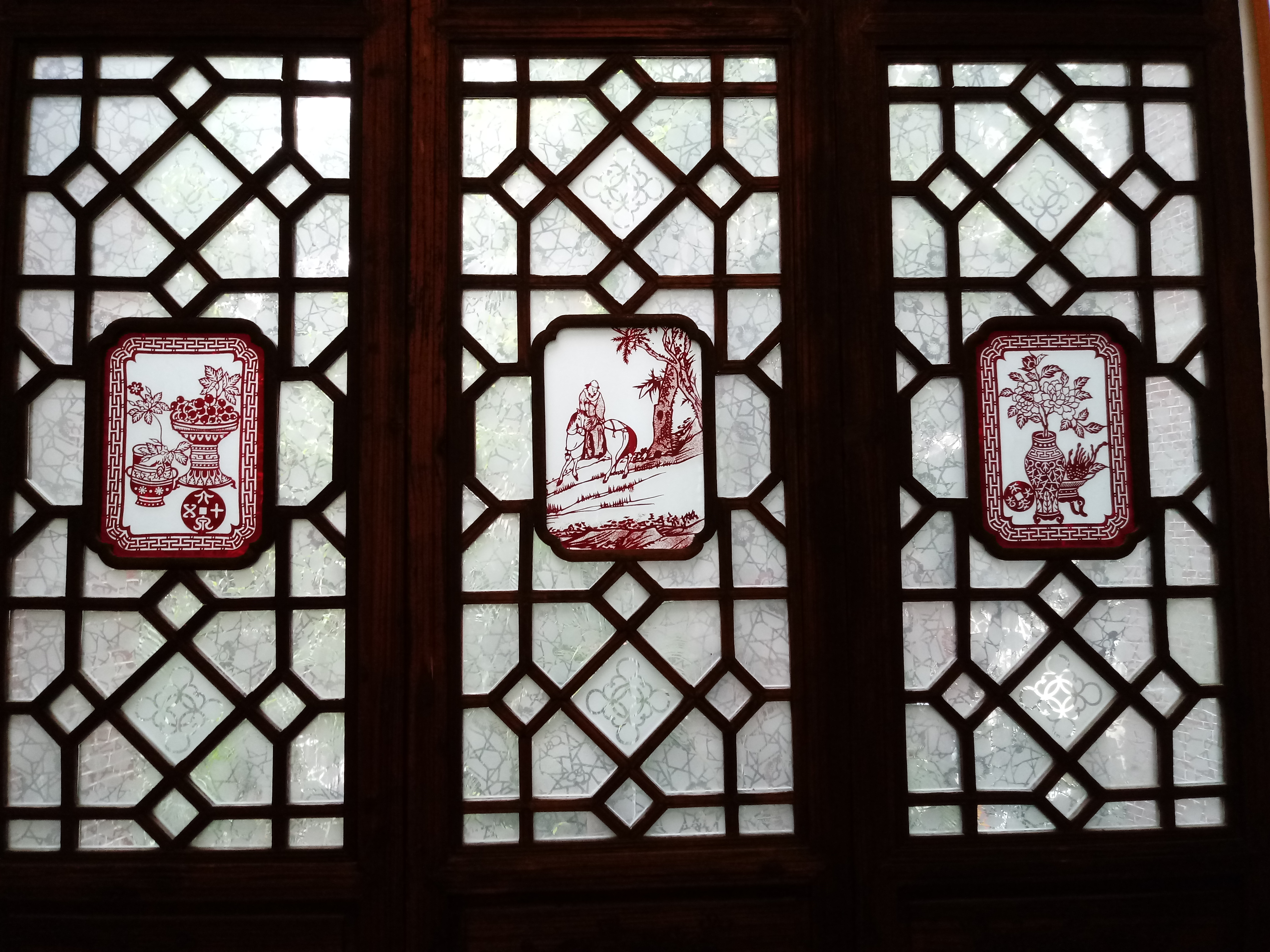
Tradition gives you several correct answers. Window flowers are pasted — just a dab of paste at the center — against window glass or paper panes, so daylight shines through the cut spaces; this is still how northern villages dress a house for New Year. Wedding pieces go on doors, mirrors, and gift boxes. In a modern home, a paper cut mounted on white or cream card and framed looks striking, because the mount supplies the contrast the window once did. Slip pieces you want to keep between sheets of paper in a book; the cut edges are delicate and crease easily.
Next steps
Once you can make a four-fold design, try folding your paper into six or eight sections for more complex patterns. Then explore traditional motifs like fish, flowers, and the double happiness character — the eight classic auspicious symbols are the natural next repertory. Look at regional masters for direction: the bold yin-cut opera faces of Yuxian in Hebei, dyed in brilliant colors after cutting, and the hair-fine lines of Yangzhou in the south show how far the same two techniques can go. Our history of Chinese paper cutting tells their story.
The goal is not to copy a master. It is to feel how a flat sheet of paper can hold a story — and to join, for an afternoon, the hundreds of millions of hands that have folded and cut before yours.
Frequently asked questions
What kind of paper is best for Chinese paper cutting?
Thin paper, 60 to 80 gsm, is best because you cut through several folded layers at once. Red paper colored on one side is traditional and helps you track the front of the design; origami and thin craft paper are good substitutes. Avoid cardstock until you are comfortable cutting single-layer silhouettes.
Should I use scissors or a craft knife?
Start with small, sharp, pointed scissors — they are safer and fully traditional. Chinese folk cutters use scissors for most work and reserve small knives on a wax board for fine interior detail and batch cutting through many layers. Move to a knife only when your designs demand tiny hatching.
What is the easiest first design?
A four-fold medallion: fold the square twice, cut a half-heart or petal along the fold, and open. It teaches the core principle — the fold creates the symmetry — in five minutes. After that, a folded chun (spring) character is the classic second project.
Why do my cuttings fall apart when I open them?
Because every part of a paper cut must stay connected. Leave small bridges of uncut paper between shapes, and plan interior holes to connect back to the main body. If a piece tears at the folds, your paper may be too thin or damp — let it dry flat and open it more gently.
Is paper cutting suitable for children?
Yes, with child-safe scissors and thin paper. The four-fold medallion is a standard school and festival project in China, and cutting characters for New Year decorations is a classic family activity. Reserve knives and multi-layer stacks for adults.
Author
This article was prepared by the team at ChineseFolkCrafts.com. We are not intangible-cultural-heritage inheritors or museum researchers. Our job is to find authoritative Chinese sources, understand them, and explain them clearly for international readers.
If you spot an error — a date, a translation, a misattributed custom — please let us know and we will correct it. Last updated 2026-07-12.