On the front of a traditional Chinese jacket or qipao, the fastener is not a factory button but a small knot tied from cord: a round, coiled disk that slips through a loop and holds the garment closed. Look closely at that disk and you will see a spiral rising from a flat base — the curve, Chinese tiers say, of a little pipa, the pear-shaped lute. This is the pipa knot, the prettiest member of the button-knot family and the classic knot of the Chinese frog button.
This tutorial teaches the single-cord pipa knot step by step, then shows how to turn it into a working frog button with its loop. Along the way: why the knot is named after a musical instrument, where frog buttons came from, and the variations you will meet on fine Chinese dress.
What is a pipa knot?
The pipa knot — pi pa jie (琵琶结) — is a variation of the Chinese button knot. Chinese manuals describe it exactly: it takes the button knot as its base and changes it, and it is named because its shape resembles the pipa, the four-stringed lute with the pear-shaped body that has been played in China for nearly two thousand years. The coiled disk of the knot is the instrument's round back; the short stem of cord above it is the neck and pegbox.
There is a second, quieter layer to the name, and it is the kind of wordplay Chinese folk art loves. The word for the lute, pipa (琵琶), sounds exactly like pipa (枇杷), the loquat — a golden, clustering fruit that reads in folk symbolism as abundance and fruitfulness. Tie the knot, and you carry the pun with it.
Underneath the decoration, the pipa knot belongs to the hardworking button-knot family (niu kou jie, 纽扣结). The plain button knot itself travels in Western knotting under sailors' names — the knife lanyard knot and the bosun's whistle knot — because the same compact ball finishes lanyards and whistle cords the world over. In China it did something more: it held clothing closed, and it was named, simply, for what it does.
Frog buttons in Chinese clothing
The Chinese frog button is pan kou (盘扣): pan for the coiled decoration, kou for the fastening function. A complete frog is a pair — a knotted button (the kou tou, 扣头) on one side of an opening and a loop (the kou pan, 扣袢) on the other. Push the knot through the loop and the friction of the coil locks it. The closure lies flat, decorates the garment, and never needs a buttonhole.
Knots have closed Chinese clothing for a very long time. The Zuo Zhuan, one of the oldest Chinese chronicles, already notes that "the collar has an intersection, and the belt is tied as knots" — dress was knotted before it was buttoned. By the Qing dynasty, decorative knotting embellished everything from ruyi scepters and sachets to purses, fan tassels, and spectacle cases, and knotted fasteners held robes closed at collar and side.
The frog button's great era came with the qipao — the cheongsam. The Manchu robe itself was built with a standing collar, a right-side closure, and pan kou, and the craft of making those robes is recorded today in China's national intangible cultural heritage listings, where both the Manchu qipao tradition of the northeast and the handmade "Longfeng" qipao of Shanghai appear. In 1920s Shanghai the robe was recut to Western lines and became the close-fitting haipai qipao — and down its collar and slanted front ran a row of pan kou, the small knots suddenly the most visible detail of the most modern dress in China. The Longfeng workshop's heritage entry lists the old Shanghai tailoring skills it preserves and names the pan kou, with their auspicious meanings, as part of the tradition. On a fine qipao the frogs were never merely fasteners: paired, shaped, and flowered, they were the finishing signature of the garment.
Materials
For one practice pipa knot:
- One length of satin rat-tail cord, 2 to 2.5 millimeters thick, about 1 meter (a finished small pipa knot uses roughly 60 to 80 centimeters; the rest is working slack)
- Scissors
- Clear nail polish or craft glue
- A thick pencil or chopstick (optional, to keep the center hole open while you learn)
To turn the knot into a frog button, add:
- A hand-sewing needle and strong thread matching the cord
- Optional, for the traditional fabric version: a 2-centimeter bias strip of silk or satin about 40 centimeters long, and a thin cotton filler cord
The pipa knot is tied in the hand, not on a board, so cord behavior matters more than tools. Satin cord is the standard: it slides smoothly as you coil and tighten. Choose a cord firm enough to hold a coil — very soft, slippery cord makes a knot that relaxes and spreads. Match the color to the garment for working frogs; red and gold make the classic festive pair.
How to tie the pipa knot
Work over a table with good light. The knot is a spiral: you wind the cord around a small starting loop, then close the spiral from the tail. Read through all the steps once before you begin.
-
About 10 centimeters from one end of the cord, form a small loop roughly 1.5 centimeters across, with the long working cord crossing over the short tail. Pinch the crossing point firmly between the thumb and forefinger of your other hand. This small loop is the center of the knot; everything else winds around it.
-
Bring the working cord down behind the loop and up through its center from back to front, then lay it down the front and around the outside of the loop's standing parts. You have made the first turn. Snug it gently — it should hold its place but still slide.
-
Continue winding in the same direction. Each new turn goes down behind the growing coil and up through the center hole, then lies down the front beside the previous turn, never crossing it. After three or four turns you have a small flat coil, like a miniature mosquito coil, with a hole in the middle and every turn lying side by side. While you learn, keep a thick pencil or chopstick in the center hole so it cannot close early.
-
When the coil is the size you want — three turns for a small knot, four or five for a bold one — pass the working end up through the center hole one last time and let it hang on the same side as the short tail. Remove the pencil.
-
Close the knot slowly. Hold the coil flat between the fingers of one hand and pull the short tail a little at a time with the other. The center cinches down and the turns draw together into a firm, rounded disk. Then adjust: with your fingertips, nudge each turn until the disk lies flat and the spiral ridges run evenly from the center outward. Leave a short stem of cord standing above the disk — the pipa's neck.
-
Finish. Trim the working end to match the tail, or leave both ends long if you are sewing the knot to a garment. Seal any cut tip with clear nail polish and let it dry before handling.
From knot to frog button
A pipa knot alone is decoration; with a loop it becomes a frog. There are two ways to get there.
The simple all-cord frog. Tie the pipa knot with both ends exiting the center, and do not trim them. Sew the knot to one side of the garment opening with a few strong stitches through the back of the knot. Take one of the remaining ends, coil it into a flat loop just big enough to grip the knot firmly, and sew its base to the other side of the opening. Size the loop against the knot itself: it should pass the knot with gentle resistance and then hold it by friction.
The traditional fabric frog. On a real qipao the frog is made from a filled cord of matching fabric. Cut a bias strip of silk or satin about 2 centimeters wide — cutting on the 45-degree bias lets it curve without wrinkling — fold it around a thin cotton filler cord, and stitch it closed close to the cord, making a slim, firm fabric tube. Tie the pipa knot with this tube for the button side, and coil the same tube into the loop on the other side. The pair is then sewn to the two edges of the opening — collar, slanted front, or side slit — in the traditional placements.
Either way, attach frogs in pairs and check the closed line of the garment before you commit the stitches: a frog that strains will pull the cloth out of shape.
Variations
- More turns, bigger pipa: five or six turns in thick cord make a bold disk for a coat; two turns in fine cord make a delicate one for a blouse.
- Paired pipa frogs: shape both the knot side and the loop side as matching pipa coils, so the closed fastener is a symmetrical ornament.
- Two-color pipa: join two cords of contrasting colors and wind them as one, and the spiral stripes like a candy swirl. Join with a tiny, flat seam so the coil stays even.
- The auspicious cloud knot (xiang yun jie, 祥云结): a sibling of the button knot — tie a button knot and, at the last moment, pull the two ends out flat to left and right so the knot opens into a cloud. It is used for cloud motifs in necklaces and belts.
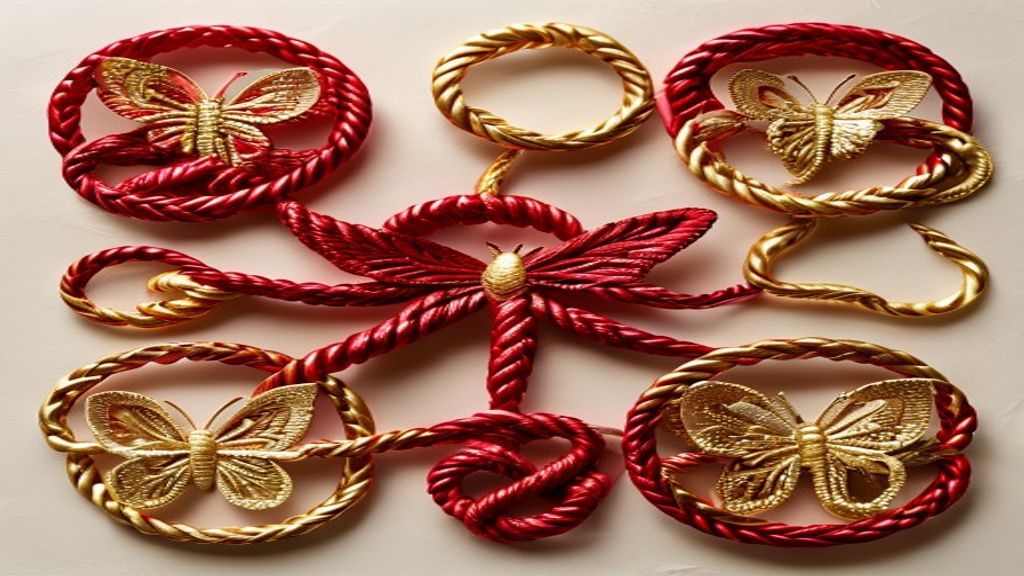
- Flower frogs (hua kou, 花扣): the peak of the craft. The pipa coil is combined with shaped fabric-cord scrolls into flowers, butterflies, grapes, and whole sprays — soft flowers shaped freehand, hard flowers built over a wire or filler core. On a fine qipao these are jewelry, not fasteners.
Where to go next
The pipa knot rewards the same two skills as every Chinese knot: even tension and patient adjusting. If you are building those skills, the double coin knot is the friendliest first knot, and the pan chang (good luck) knot is the classic next challenge. For the bigger picture of what these knots mean, see five common Chinese knots and their meanings. And if the clothing side of this craft interests you, our guides to tiger shoes and baby sachets and to China's four great embroidery styles show the folk garments and stitches the frogs once fastened.
Frequently asked questions
Why is it called a pipa knot?
Because its coiled disk and short stem resemble the pipa, the pear-shaped Chinese lute. There is also a lucky pun in the name: the word for the lute, pipa (琵琶), sounds identical to pipa (枇杷), the loquat, a golden fruit associated with abundance and fruitfulness.
What is the difference between a pipa knot and a button knot?
The button knot is the plain, round ball knot used worldwide as a fastener and lanyard knot. The pipa knot is a variation built on it: the cord is coiled into a flat spiral disk with a short stem, giving the lute shape. Both work as fasteners; the pipa knot is the decorative version made for display on Chinese dress.
What is a Chinese frog button (pan kou)?
A pan kou is a knotted fastener made in two parts: a knotted button on one side of a garment opening and a cord loop on the other. The knot pushes through the loop and holds by friction. Frog buttons are the signature closure of the qipao (cheongsam) and other traditional Chinese garments, often shaped into decorative forms like the pipa knot.
What cord should I use for pipa knots?
Satin rat-tail (Chinese knotting) cord, 2 to 2.5 millimeters thick, firm enough to hold a coil. Very soft cord makes a knot that relaxes and spreads. For wearable frogs, match the cord color to the garment — or make the traditional fabric frog from a bias strip of the garment's own silk wrapped around a filler cord.
How do I keep a pipa knot from coming loose?
Tighten it in stages and dress every turn of the coil with your fingertips so the spiral lies flat and even — the adjusting stage, not the tying, sets the knot. For a frog that will be worn and unbuttoned often, add a few hidden stitches or a pinpoint of craft glue at the back center of the knot, and seal the cut ends with clear nail polish.
Author
This article was written by the ChineseFolkCrafts.com team, a folk-craft enthusiast based in Beijing, China. Last updated 2026-07-17.